Why Standard Inverters Fail in Pakistan’s Harsh Climates
Solar panels are built to last. Most run for 25 to 30 years without much trouble. Standard string inverters are a different story. They typically last only 10 to 15 years, and about one-third of them fail for the first time before the 15-year mark.
That gap matters more in Pakistan than almost anywhere else. This is why why many cheap inverters don’t last in Pakistan’s heat is one of the most common questions buyers ask before installing. The country puts hardware through a genuine multi-stress environment. Scorching summer heat, monsoon downpours, wind-blown dust, coastal humidity, and insects all take their turn wearing down an inverter’s internal parts.
Reliability data on power electronics failures backs this up clearly. Temperature accounts for 55% of failures, which is why we recommend installing safe and reliable solar inverters engineered with advanced thermal protections. Mechanical vibration and shock account for another 20%. Humidity and moisture cause 19%. Contaminants and dust make up the remaining 6%. Every one of these stress factors shows up somewhere in Pakistan, often in the same installation.
Finding the best solar inverter for Pakistan weather starts with understanding these numbers. An inverter for Pakistani weather needs to be chosen for the specific stress factors of its installation site, not picked off a shelf based on price alone.
Demystifying Ingress Protection, What the IP Digits Mean
IP stands for Ingress Protection. It is a global standard, defined under IEC 60529, that spells out how well an electrical enclosure shields the delicate components inside it. The rating always appears as two digits, and each digit measures something different.
The first digit, ranging from 0 to 6, measures protection against solid objects and dust. A low number means only finger-sized objects are kept out. A 6 means the enclosure is fully dust-tight.
The second digit, ranging from 0 to 8, measures protection against water. A low number covers light vertical drips only. A high number covers powerful jets from any direction, and the highest numbers cover submersion.
A higher IP number does not automatically make an inverter better for every site. Sealing an enclosure tighter also raises the cost and creates real heat-management challenges, since trapped heat has fewer ways to escape.
Geographic Climate Zone 1, The High-Dust Arid Plains of Sindh and Central Regions
Sindh and much of central Pakistan present a specific challenge. These plains are arid, dry, and windy, with fine sand and heavy dust present year-round. Anyone searching for solar inverter for dusty areas Pakistan solutions is dealing with exactly this environment.
The damage mechanism is mechanical, not chemical. Dust accumulation blocks internal ventilation channels. That raises operating temperatures inside the unit, degrades sensitive electronic parts over time, and can trigger insulation safety trips.
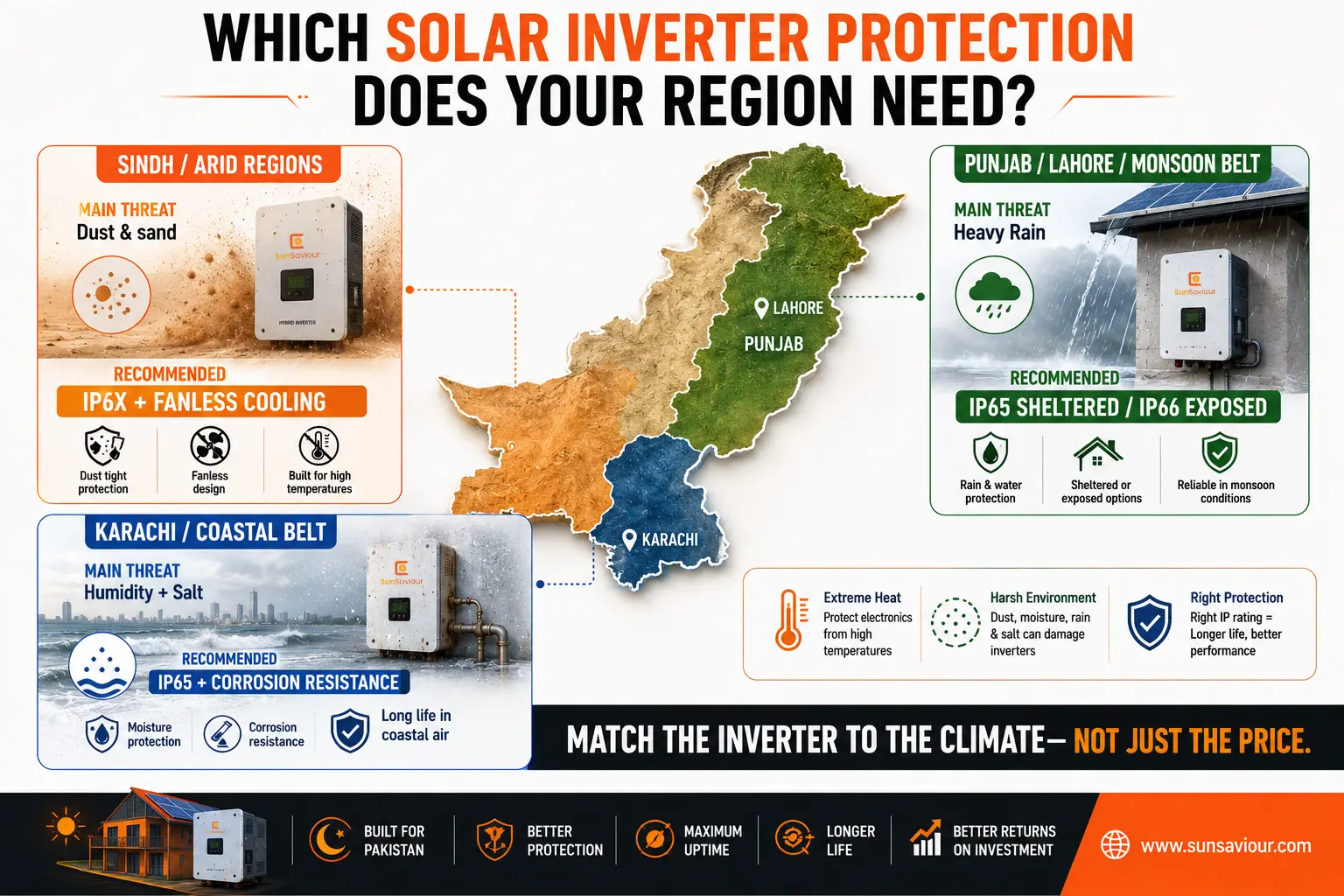
The prescription here is an IP6X rating, meaning fully dust-tight on the first digit. A dust-resistant inverter built to this standard keeps particles out of the sensitive internals entirely, rather than trying to manage dust once it’s already inside.
The best engineering solution pairs that IP6X rating with a fanless solar inverter design. Active cooling fans actually draw dust into the unit’s heat sinks as they spin, which defeats the purpose in a dusty environment. Passive cooling manages extreme heat without ever exposing the internal circuit boards to abrasive particles. A solar inverter for Sindh or any similarly dusty region should combine both features together, not one or the other. A properly built heat-resistant solar inverter for this zone also needs to handle the region’s high daytime temperatures without relying on moving parts that dust will eventually clog.
Geographic Climate Zone 2, The Humid Coastal Belt of Karachi and Coastlines
Karachi and Pakistan’s coastal belt bring a completely different set of problems. Relative humidity here frequently exceeds 70 to 80%, and that humid air carries salt from the sea. Anyone looking into solar inverter for Karachi options needs to plan for both factors together.
The damage mechanism is chemical. High humidity combined with salt spray accelerates corrosion on copper circuit traces, solder joints, and heavy-duty busbars. That corrosion raises contact resistance inside the unit, which can lead to sudden localized heating or safety trips.
The prescription for this zone is an enclosure rated at least IP65. But an IP rating alone does not stop rust from forming. In coastal zones, an outdoor-rated corrosion-resistant solar inverter needs a specialized UV-resistant casing to protect delicate internal logic boards.
Anyone evaluating a solar inverter for coastal areas Pakistan should treat the IP65 minimum as a starting point, not the full answer. The casing material and connector coating matter just as much as the ingress rating itself.
Geographic Climate Zone 3, The Monsoon Belt and Rooftops of Punjab, Lahore, and Monsoon Regions
Punjab, and Lahore in particular, deal with intense seasonal monsoons. Powerful downpours arrive on schedule every year, and most rooftop solar setups in this zone sit fully exposed to the weather. A solar inverter for Punjab or solar inverter for Lahore installation has to be chosen with this exposure in mind.
The damage mechanism is direct. Rainwater ingress shorts internal power modules and charging circuits. That voids system warranties immediately, and it can create real electrical fire hazards in the process. Anyone asking solar inverter for monsoon Pakistan questions is really asking how to keep water out of the enclosure entirely.
This is the zone where the choice between IP65 and IP66 actually matters, and where IP65 vs IP66 solar inverter comparisons come up most often. IP65 protects against standard water jets and is suitable if the inverter is mounted on an external wall under a protective eave, canopy, or balcony. So is IP65 enough for monsoon conditions in that specific mounted position, yes.
IP66 protects against powerful water jets from any angle, and it becomes mandatory if the inverter sits on an open, unprotected rooftop or an industrial factory shed. In that fully exposed position, the unit faces relentless, wind-driven torrential rain from every direction, and IP65 is no longer sufficient. Anyone installing a solar inverter on an open roof should treat our high-efficiency, IP66-rated on-grid inverters as the baseline, not an upgrade.
The Core Comparison, IP21 vs IP65 vs IP66 Inverters
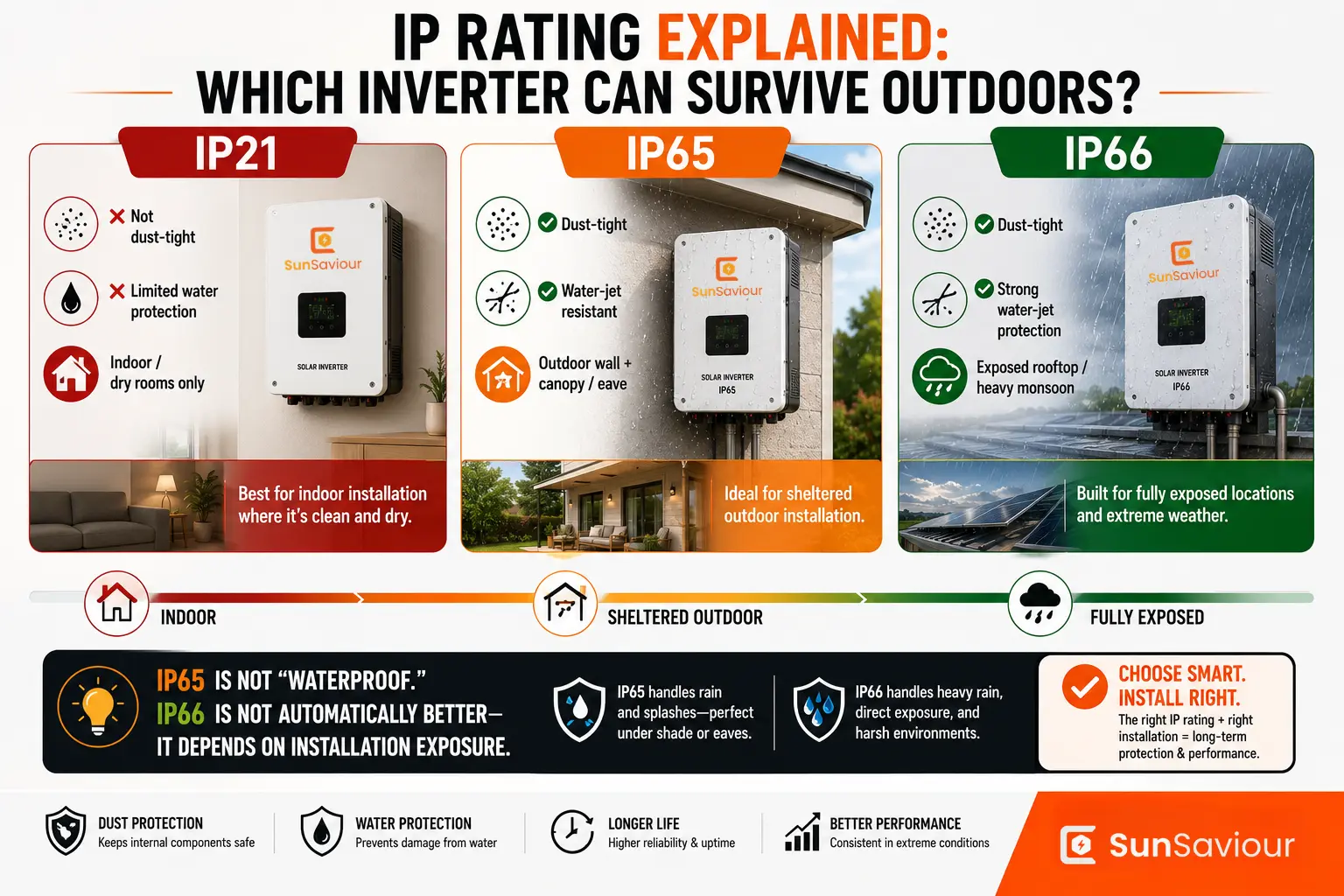
The table below summarizes the three ratings side by side.
Rating | Dust Protection | Water Protection | Best Use |
IP21 | Basic finger protection | Vertical drips only | Strictly indoor, dry utility rooms, closed garages |
IP65 | Dust-tight | Standard water jets | Outdoor walls under eaves or canopies |
IP66 | Dust-tight | Powerful water jets | Fully exposed outdoor rooftops |
This is where the IP21 vs IP65 solar inverter question gets settled for most buyers. This is why IP21 units are built strictly for indoor use. Standard indoor-rated IP21 hybrid inverters must be placed in closed, dry utility rooms or garages where wind-driven moisture cannot reach them
Wind-driven rain, insects, and shifting humidity levels will reach an IP21 inverter in a semi-outdoor space. The result is rapid deterioration, higher maintenance costs, and a warranty exclusion when a claim is eventually filed. Buyers searching for the best IP65 solar inverter Pakistan has to offer are already ahead of this mistake, since IP65 is the realistic minimum for any outdoor mounting position.
An IP65 solar inverter Pakistan buyers choose for a wall-mounted, sheltered position will perform well. Whether is IP66 better than IP65 for solar inverter questions apply to a specific project depends entirely on how exposed that installation is.
Field Checklist, Ensuring Your Inverter’s IP Rating Survives Installation
A printed IP rating is only as good as the installation behind it. Poor workmanship can degrade protection below the factory rating on day one, no matter what the spec sheet says.
Seal every cable gland properly. Use the correct gland size for each cable, and fully seal any unused communication or entry ports. An open port defeats the enclosure rating entirely.
Follow the manufacturer’s mounting angle. Rainwater should never be able to pool on flat covers or gather around cable entry points. The wrong angle turns a dust-tight, water-resistant unit into a slow leak.
Shade the unit, always. An outdoor-rated IP65 or IP66 inverter is not automatically heat-proof. Direct sunlight can still push the unit into thermal derating, where it deliberately lowers output to avoid overheating. Natural shade or a protective canopy solves this.
Tighten every gasket and blanking plug. All physical covers, gaskets, and communication blanking plugs need to be fully tightened before the system goes live. A loose cover is the single most common reason a properly rated inverter fails early anyway.
Getting these details right during installation is what actually delivers on the promise of a solar inverter for Pakistani climate conditions. The rating on the box is only the starting point.
Frequently Asked Questions
Can I install an IP21 solar inverter outdoors if it is fully undercover?
No. A roof, carport, or balcony cannot shield against wind-driven rain, outdoor dust, insects, or changing relative humidity. IP21 inverters must be installed in clean, dry, indoor rooms only.
Is an IP65 solar inverter completely waterproof?
No. IP65 means the inverter is dust-tight and resistant to water jets from any direction. It is not an immersion rating, and it cannot withstand flooding, high-pressure washing, or submersion.
Is IP65 good for hot weather?
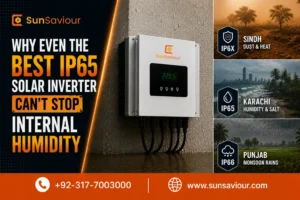
Partly. Is IP65 good for hot weather depends on the cooling design, not the IP rating itself. IP65 protects against dust and water ingress, but it says nothing about heat management. A fanless, passively cooled IP65 unit handles heat better than a sealed unit relying on a fan that struggles to move air through a tight enclosure.
Does extreme heat affect an outdoor-rated IP65 inverter?
Yes. An IP65 rating protects against physical dust and rain ingress, but it does not make the inverter heat-proof. Outdoor-rated inverters can still experience thermal derating in direct sunlight, meaning they intentionally lower power output to prevent internal overheating. Always install them in shaded locations.
Is IP66 better than IP65 for a solar inverter?
It depends on the mounting location. Both ratings are fully dust-tight. IP65 protects against standard water jets, which is ideal for walls mounted under eaves. IP66 handles powerful water jets from any angle, which is essential for fully exposed rooftop setups facing heavy monsoon rain.
Choosing the right IP rating and cooling design protects the investment for years, not just for one season. Explore SunSaviour’s range of fanless, corrosion-resistant, and dust-tight inverters built for Pakistan’s regional climates at sunsaviour.com, and get hardware matched to your exact location before the next monsoon or dust storm arrives.