A solar inverter converts DC power from panels into usable AC electricity for your home and the grid. Choosing the right on grid inverter separates households that save PKR 15,000 monthly from those that waste money on inefficient models. This guide breaks down the decision tree for Pakistan’s grid-tied solar market.
What Is a Solar Inverter?

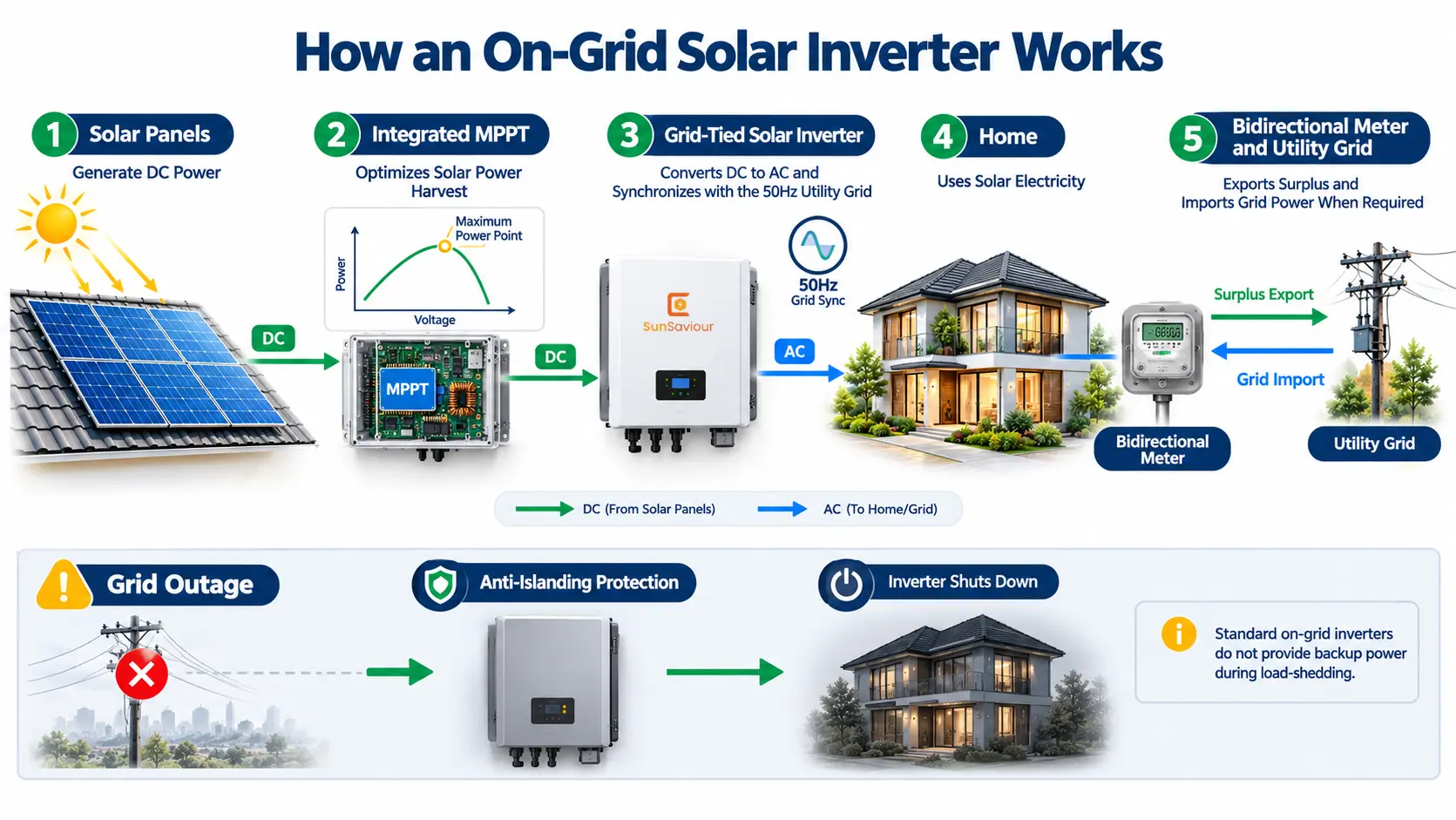
A solar inverter sits between your panels and home electrical system, managing three critical jobs: power conversion, grid synchronization, and safety monitoring.
Power conversion: Solar panels generate DC (direct current) electricity. A solar inverter inverts it to AC (alternating current) so your appliances can use it.
Grid synchronization: A grid tied inverter must match the grid’s frequency (50 Hz in Pakistan), voltage (230V single-phase or 400V three-phase), and phase angle exactly. Without synchronization, you’d damage equipment and create safety hazards.
Safety monitoring: Every solar inverter monitors for ground faults, over-voltage, under-frequency, and islanding (grid disconnection). If dangerous conditions occur, the inverter shuts down automatically.
Pakistan’s grid is unstable. Voltage fluctuates 180V-280V in many areas. A quality on grid inverter corrects for this automatically.
On-Grid Solar Inverter vs Hybrid Inverter
The decision between on grid inverter and hybrid inverter shapes your entire energy strategy.
On-Grid Solar Inverter (This Guide’s Focus)
An on grid solar inverter feeds all power directly to WAPDA. No battery backup. When grid fails, the system shuts down completely. That’s the trade-off for simplicity and cost.
Cost: PKR 210,000-275,000 for 5-10 kW models.
Efficiency: 98.1-98.6%, industry-leading.
Backup during load-shedding: Zero hours.
Best for: Daytime-only energy savings, commercial setups, budget-conscious homes.
Pakistan’s new net billing (NEPRA February 2026) pays PKR 11-13 per kWh export credit. A 5 kW on grid inverter system saves PKR 15,000-22,000 monthly but provides no backup.
Hybrid Inverter (For Comparison)
A hybrid inverter includes built-in battery management and can switch to battery power when grid fails.
Cost: PKR 350,000-600,000 (plus separate battery system PKR 950,000-1,200,000 for lithium).
Backup during load-shedding: 6-10 hours with typical setup.
Best for: Energy independence, backup protection, maximizing self-consumption of solar power.
On grid inverter vs hybrid: On-grid is simpler and cheaper upfront. Hybrid offers backup but costs 2-3x more. The decision depends on whether you need backup during load-shedding (most Pakistani homes do).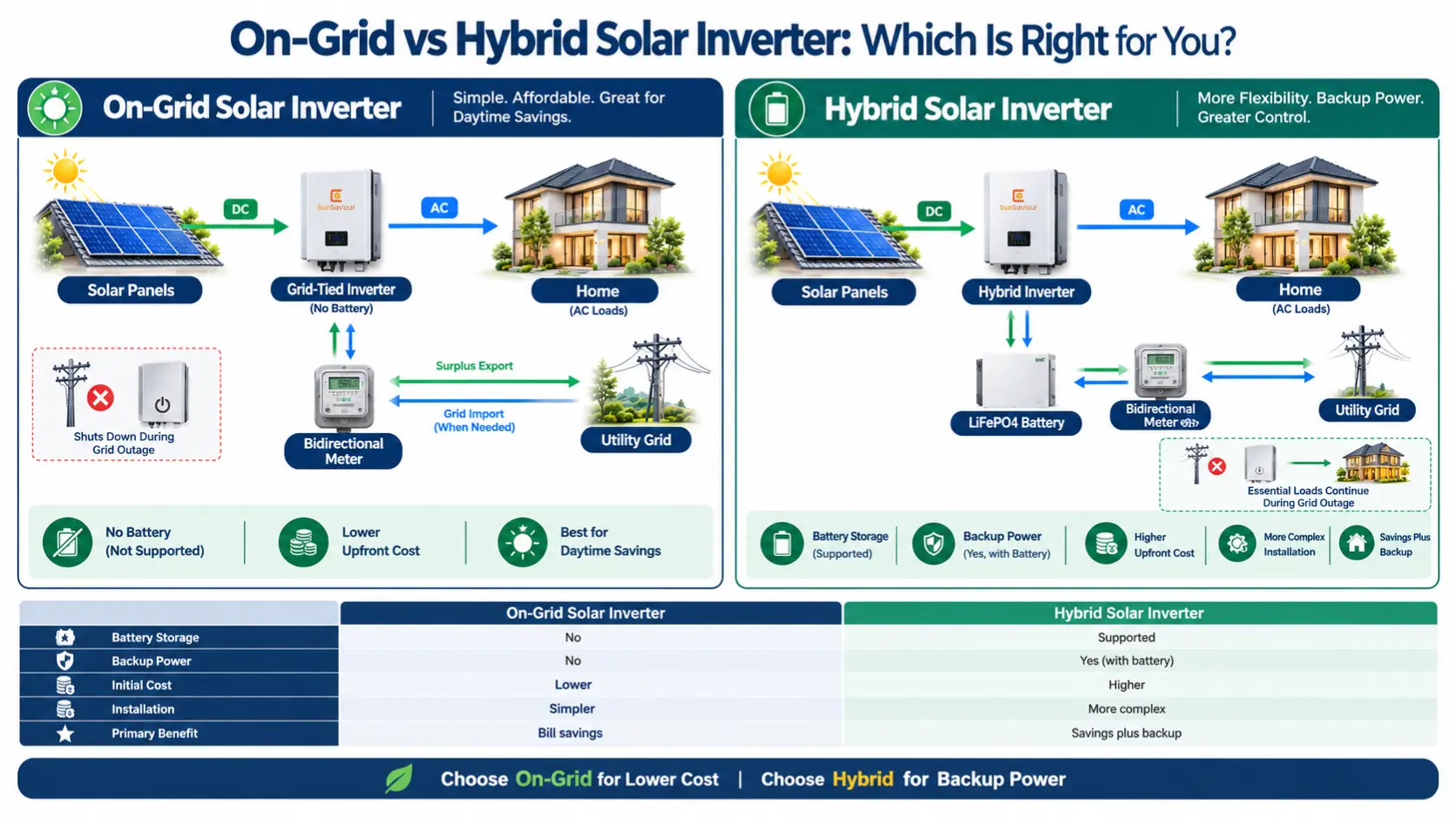
How MPPT Charge Controller Works
Most solar inverters include integrated MPPT charge controller technology. Understanding MPPT solar charge controller function clarifies why some inverters cost more.
MPPT stands for Maximum Power Point Tracking. Solar panels’ power output varies with temperature, angle, and cloud cover. A MPPT charge controller continuously scans these conditions and adjusts voltage to extract maximum power.
Example: A panel rated 500W at standard test conditions generates only 350W in Pakistan’s 50°C summer heat. An MPPT solar charge controller compensates by lowering voltage demand and increasing current, maintaining 450W+ output instead of letting you lose power.
MPPT solar charge controller efficiency: Improves DC to DC conversion by 15-25% compared to basic PWM controllers.
Cost difference: A solar inverter with dual MPPT charge controller (one per string for 10+ kW systems) costs PKR 50,000-100,000 more but recaptures that in 2-3 years of extra energy harvest.
Pakistan-specific benefit: Heat robustness. Brands like Sungrow, Inverex, and Fox integrate MPPT charge controller that handles 45-50°C without efficiency loss.
Top 10 Solar Inverters in Pakistan 2026
Based on availability, efficiency, and market adoption:
Tier 1: Premium Global & Local Brands
SunSaviour TP-Series (10-80 kW On-Grid)
- Models: TP-Series 10KW, 15KW, 20KW, 25KW, 50KW, 80KW on-grid inverters
- Type: Transformerless design, IP66 rated
- MPPT: Integrated charge controller
- Three-phase and single-phase configurations
- Pakistan-optimized for voltage fluctuations
- Available nationwide through 59+ sales points and 28 service centres
- Explore TP-Series models
Sungrow (10-20 kW On-Grid)
- Model: SG10KTL-M (10 kW), SG20KTL-M (20 kW)
- Efficiency: 98.6%
- MPPT: Dual trackers
- Price: PKR 210,000-345,000
- Warranty: 10 years
- Available in Lahore, Islamabad, Karachi, Peshawar
Inverex Nitrox (15-20 kW On-Grid)
- Models: 15 kW, 20 kW three-phase
- Efficiency: 98.6%
- MPPT: Dual trackers, 200-800V range
- Price: PKR 248,000-500,000
- Warranty: 10 years
- Pakistan assembled
Fox Solar (20 kW On-Grid)
- Model: 20 kW three-phase
- Efficiency: 98.2%
- MPPT: Operating range 140-1000V
- Price: PKR 275,000-325,000
- Designed for Pakistani grid volatility
Tier 2: Mid-Range Reliable Brands
Solis, Growatt, Deye, Max Power models offer 97-98.5% efficiency at PKR 180,000-280,000 for 5-10 kW.
MPPT Controller Selection for On-Grid Systems
On-grid installations rarely need separate MPPT charge controller because the solar inverter integrates it. However, larger commercial systems (50+ kW) sometimes use external MPPT solar charge controller units for string management.
For residential 5-10 kW: Integrated MPPT in inverter is sufficient.
For commercial 20-50 kW: Dual MPPT inverter design (handles two separate string groups) is standard.
For 50+ kW: Consider external MPPT solar charge controller for each string group. Cost: PKR 80,000-150,000 per unit. Benefit: Optimizes each string independently.
Grid-Tie Inverter Installation and Compliance
Pakistan requires all grid tie inverter installations to register with NEPRA as of February 2026. Installation steps:
Step 1: Size the System Determine your home’s average monthly consumption (kWh). A 5 kW on grid solar inverter generates 500-600 kWh monthly in Lahore, 400-500 kWh in Peshawar.
Step 2: Select Inverter Choose 5 kW for 500 kWh/month consumption, 10 kW for 1,000 kWh/month.
Step 3: DC-AC Ratio Install 1.2-1.3x of solar inverter rating in panel capacity. For a 10 kW on grid inverter, install 12-13 kW of panels (20-22 panels at 580W each).
Step 4: Connection to DISCO Your installer coordinates with local WAPDA office. Grid tie solar power systems must feed power to your meter first, then excess goes to the grid.
Step 5: Metering You need a bidirectional meter that tracks power consumption vs. export. NEPRA approved meters cost PKR 50,000-80,000.
Buying Checklist for Grid-Tie Inverters
Before purchasing a solar inverter, verify:
Efficiency rating: Look for 98%+ European efficiency, not just peak efficiency claims.
MPPT capability: Dual trackers for 10+ kW systems.
Temperature tolerance: Operates 45-50°C without derating.
Voltage range: Handles Pakistan’s 180-280V fluctuations (true MPPT adjusts for this).
Warranty: 10 years minimum for inverter, 25 years for panels.
Local support: Service centers in your city. Lahore, Islamabad, Karachi, Peshawar all have centers.
NEPRA compliance: System must be registerable. Ask installer about Prosumer Regulation 2026 compatibility.
DC/AC ratio: Confirms panel oversizing matches grid safety standards.
SunSaviour’s TP-Series delivers professional-grade on-grid inverter performance for residential and commercial installations. The grid tied inverter range (10kW to 80kW) integrates dual MPPT charge controller technology and handles Pakistan’s 180-280V voltage fluctuations seamlessly. IP66-rated for durability in extreme heat and dust. Available through 59+ sales points and 28 service centres nationwide. View TP-Series models or visit sunsaviour.com for authorized dealer locator.
Cost of Solar Inverter and System Payback
System Size | On-Grid Inverter Cost | Panel Cost (12kW) | Total System Cost | Monthly Savings | Payback Period |
5 kW | PKR 210,000 | PKR 420,000 | PKR 630,000 | PKR 15,000–20,000 | 3–4 years |
10 kW | PKR 275,000 | PKR 840,000 | PKR 1,115,000 | PKR 30,000–40,000 | 2.3–3.7 years |
20 kW | PKR 345,000 | PKR 1,680,000 | PKR 2,025,000 | PKR 60,000–80,000 | 2.1–3.4 years |
Payback assumes net billing at NEPRA rates (PKR 11-13 per kWh export).
Frequently Asked Questions
What is the most important feature in a grid-tie solar inverter?
Efficiency. A 98.6% solar inverter recovers 0.6% more energy annually than a 98% model. Over 25 years, that’s significant. Dual MPPT charge controller capability is second priority for 10+ kW systems.
Can I use a hybrid inverter as a grid-tie inverter?
Yes, but it’s overkill. A hybrid inverter functions as a grid tied inverter if you don’t connect batteries. You’re paying PKR 150,000-200,000 extra for unused battery capability.
Do I need separate MPPT controllers for grid-tie?
No, not for residential. Modern grid tie inverters integrate MPPT charge controller technology. Separate controllers are for very large systems (50+ kW) needing per-string optimization.
What if Pakistan’s grid voltage fluctuates? Will my solar inverter fail?
Quality on grid inverters adjust automatically. Look for models with 180-280V input tolerance. Sungrow, Inverex, and Fox models handle this. Cheap units from unknown brands may trip offline frequently.
How long does a solar inverter last?
10-15 years for quality brands. Most manufacturers warranty 10 years. After 10 years, efficiency may drop 1-2%. Replacement cost at that time: PKR 250,000-350,000 for a new unit.
Is grid-tie solar still worth it after NEPRA’s net billing change?
Yes. A 5 kW on grid solar inverter system still saves PKR 15,000-20,000 monthly. Payback is 3-4 years. After payback, electricity is essentially free for 20+ years. That’s hard to beat.
What brands of grid-tie inverters are available in Lahore, Islamabad, Karachi, Peshawar?
SunSaviour (TP-Series), Sungrow, Inverex (Pakistan assembled), Fox, Solis, Growatt, Deye. All have authorized dealers in major cities. SunSaviour’s TP-Series on grid inverter models range 10-80 kW and are stocked through 28 dedicated service centres nationwide. Ask for NEPRA-approved installers specifically.
Do on-grid systems work during load-shedding?
No. When the grid fails, grid tie inverters shut down for safety (islanding prevention). No backup. If you need backup, choose a hybrid inverter instead.
What is the DC-AC ratio on a solar inverter?
It’s the ratio of panel capacity to inverter rating. Example: 12 kW panels with a 10 kW inverter = 1.2 ratio. Higher ratios (up to 1.3) improve yield in low-light conditions but require grid approval.
Do I need permission from WAPDA to install a grid-tie inverter?
Yes, as of February 2026. NEPRA Prosumer Registration is mandatory. Your installer handles paperwork. Approval takes 2-4 weeks.
Conclusion
A solar inverter for grid-tied systems is the lowest-cost entry into solar energy. A 5 kW on grid solar inverter system costs PKR 630,000 and saves PKR 15,000-20,000 monthly, paying for itself in 3-4 years.
Choose brands with MPPT solar charge controller technology, 98%+ efficiency, and local service support. SunSaviour’s TP-Series grid tied inverter, Sungrow, Inverex, and Fox dominate Pakistan’s market for good reason. SunSaviour TP-Series inverters are engineered specifically for Pakistan’s voltage volatility and available nationwide through extensive service networks.
The trade-off: on grid inverters provide zero backup during load-shedding. If backup matters to you, invest in a hybrid inverter system instead, despite the higher cost.