Pakistan’s electricity crisis is pushing millions toward the best solar battery backup system for home as a practical solution. With 4 to 10 hours of daily load-shedding across most regions, families no longer have to choose between cutting electricity bills and maintaining power during outages. This guide walks you through every decision point to find the system that works for your budget, backup needs, and appliances.
What Is a Solar Battery Backup System?
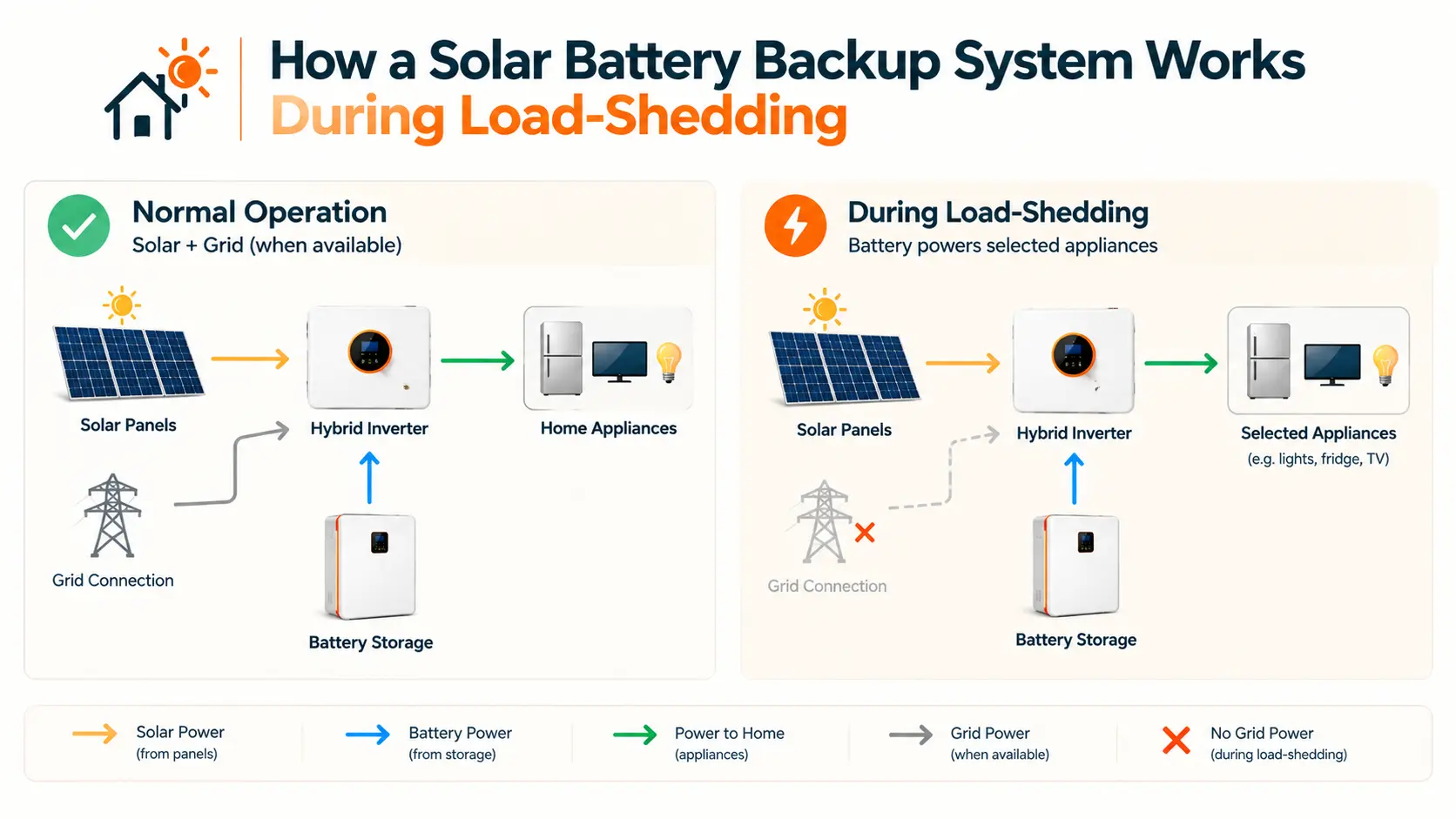
A solar battery backup system is a hybrid solar setup that combines three energy sources: solar panels, battery storage, and grid power. Unlike a standard grid-tied solar system that shuts down during load-shedding, a solar system with battery backup automatically switches to stored power when the grid fails, keeping critical appliances running.
The core components are simple: solar panels generate DC electricity, a hybrid inverter manages the energy flow, and a battery stores unused solar power for nighttime or cloudy days. When the grid goes down, the system doesn’t. This is why hybrid solar systems are reshaping home energy in Pakistan.
For Pakistani households facing 6-8 hour daily outages, a solar backup battery system pays for itself faster than on-grid solar alone because it eliminates both the electricity bill and the need for expensive diesel generators.
Types of Solar Backup Systems for Pakistani Homes
Choosing the right solar battery backup system starts with understanding which type fits your situation. Three main configurations exist in Pakistan’s 2026 market.
Hybrid Solar with Battery (DC-Coupled)
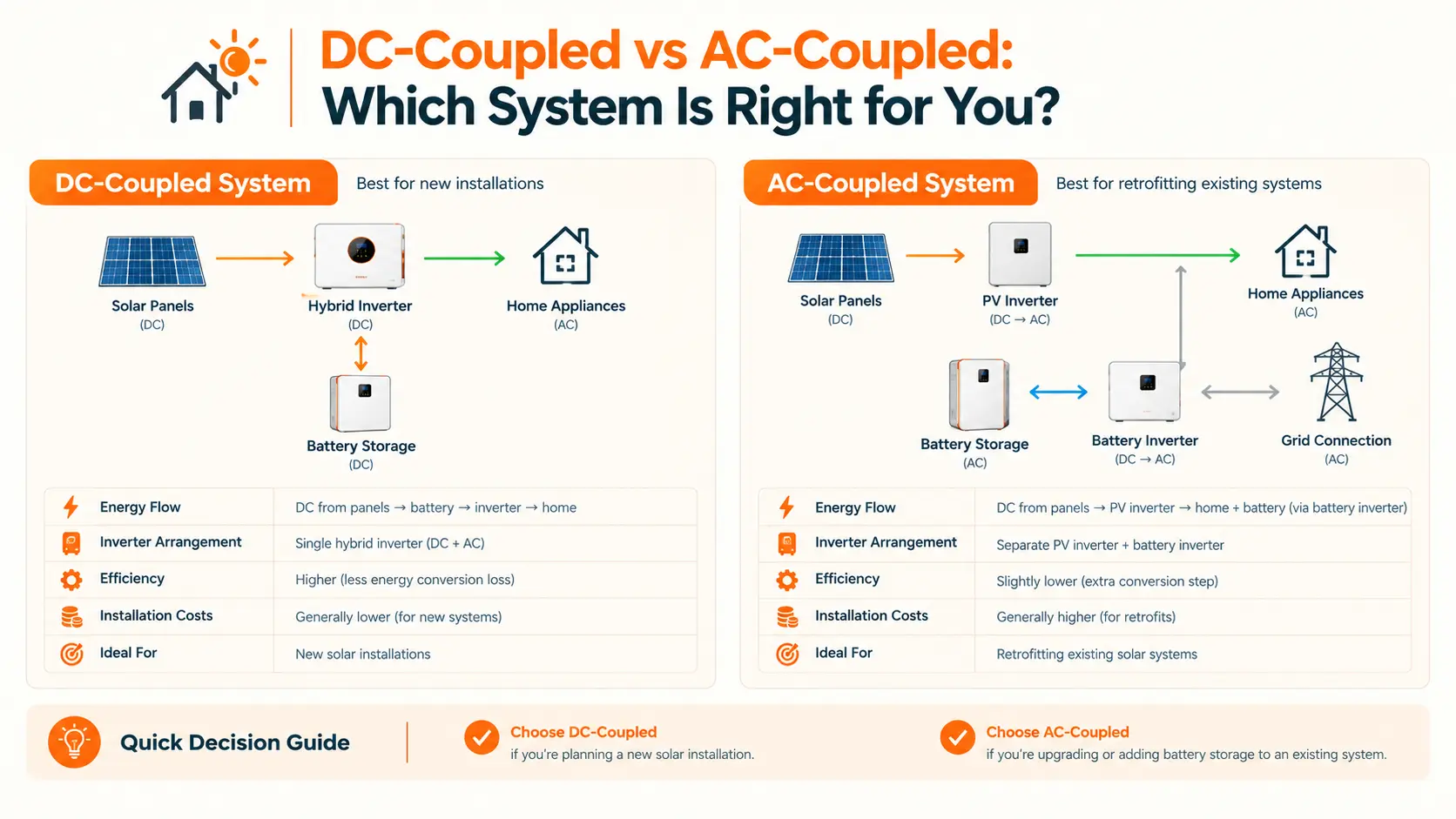
A hybrid solar system with DC-coupling connects solar panels and batteries directly to a single inverter without converting power to AC first. The DC power from panels charges the battery directly, and the inverter converts DC to AC only once for home use.
Why this matters for Pakistan: DC-coupled systems are more efficient because they skip unnecessary power conversions. A 5kW DC-coupled solar system with battery backup loses 3-5% of energy compared to 8-12% in AC-coupled setups. For homes running 4-8 hours of backup daily, that efficiency difference adds up to 20-30 kWh per month.
Cost in Pakistan 2026: A 5kW DC-coupled system with 5-10 kWh LiFePO4 battery storage costs PKR 1,300,000 to 1,700,000 installed. A 10kW system ranges PKR 1,800,000 to 2,200,000.
Hybrid Solar with AC-Coupled Battery
In an AC-coupled configuration, the solar inverter converts DC to AC first, then a separate battery system charges from that AC power. This setup is more common when retrofitting batteries onto existing on-grid systems.
Pakistan context: AC-coupled systems are less efficient but offer more flexibility. If you already have an on-grid solar system and want to add battery backup later, AC-coupling avoids redesigning the entire installation. The trade-off is higher equipment cost (two inverters instead of one) and lower round-trip efficiency.
Off-Grid Solar with Battery
Off-grid systems disconnect entirely from WAPDA and rely 100% on solar generation and battery storage. These require oversized panels and larger batteries because the system must survive multiple cloudy days without grid backup.
Why it’s rare in Pakistan: Off-grid costs PKR 3-4 lakh more than hybrid systems for the same capacity, and NEPRA regulations favor grid-connected systems. Only remote rural areas without DISCO access use pure off-grid setups.
Hybrid vs On-Grid Solar in Pakistan: The Real Comparison
After NEPRA’s February 2026 Prosumer Regulations replaced 1:1 net metering with net billing at PKR 11-13 per kWh export credit, the decision tree changed completely.
On-grid solar alone (no battery):
- Cost: PKR 800,000 to 900,000 for 5kW
- Produces electricity during the day only
- Shuts down entirely during load-shedding
- Monthly savings: PKR 15,000 to 22,000 depending on location
- Payback period: 3-4 years
Hybrid solar with battery (this article’s focus):
- Cost: PKR 1,300,000 to 1,700,000 for 5kW plus battery
- Produces 24 hours with battery backup
- Keeps essentials running during 6-8 hour daily load-shedding
- Monthly savings: PKR 18,500 to 29,000
- Payback period: 5-7 years
The math: Hybrid systems cost PKR 500,000-800,000 more upfront but save an extra PKR 3,500-7,000 monthly because you eliminate load-shedding losses. Over 10 years, that’s PKR 420,000-840,000 in additional savings. The battery pays for itself.
SunSaviour’s hybrid inverters solve this exact decision by integrating solar charging, battery management, and grid tie in one unit. With 59+ sales points and 28 service centres across Pakistan, professional sizing and installation support is available nationwide. Visit sunsaviour.com to explore inverter options matched to your home’s backup needs.
DC-Coupled vs AC-Coupled Solar Battery Systems
Understanding the difference between DC coupled vs AC coupled systems is the second major decision in solar battery backup.
DC-Coupled (Store First, Convert Later)
In a DC coupled system, solar panel electricity goes straight to the battery without first converting to AC. The inverter only converts once, when power is needed at home. Fewer conversions mean less energy loss.
- Equipment: 1 hybrid inverter + 1 charge controller
- Efficiency: 94-97% round-trip
- Cost for 5kW + 10kWh battery: PKR 1,300,000 to 1,500,000
- Best for: New installations, maximum efficiency
- Pakistan advantage: Works perfectly in 50°C summer heat; LiFePO4 batteries tolerate high temperatures with minimal lifespan impact
AC-Coupled (Convert First, Store Later)
In an AC coupled system, solar power converts to AC first for home use, and any surplus goes through a second inverter to charge the battery. This requires multiple conversions.
- Equipment: 1 solar inverter + 1 AC battery system
- Efficiency: 85-92% round-trip
- Cost for 5kW + 10kWh battery: PKR 1,600,000 to 1,900,000
- Best for: Retrofitting batteries onto existing solar systems
- Pakistan advantage: Less impact on existing DISCO grid-tie permits
The decision: For a new solar battery backup system, choose DC-coupled. It’s cheaper, more efficient, and simpler. Only choose AC-coupled if you already have a working on-grid solar system and want to add batteries without redesigning.
Key Factors to Consider When Sizing a Solar Backup System
1. Calculate Your Backup Load
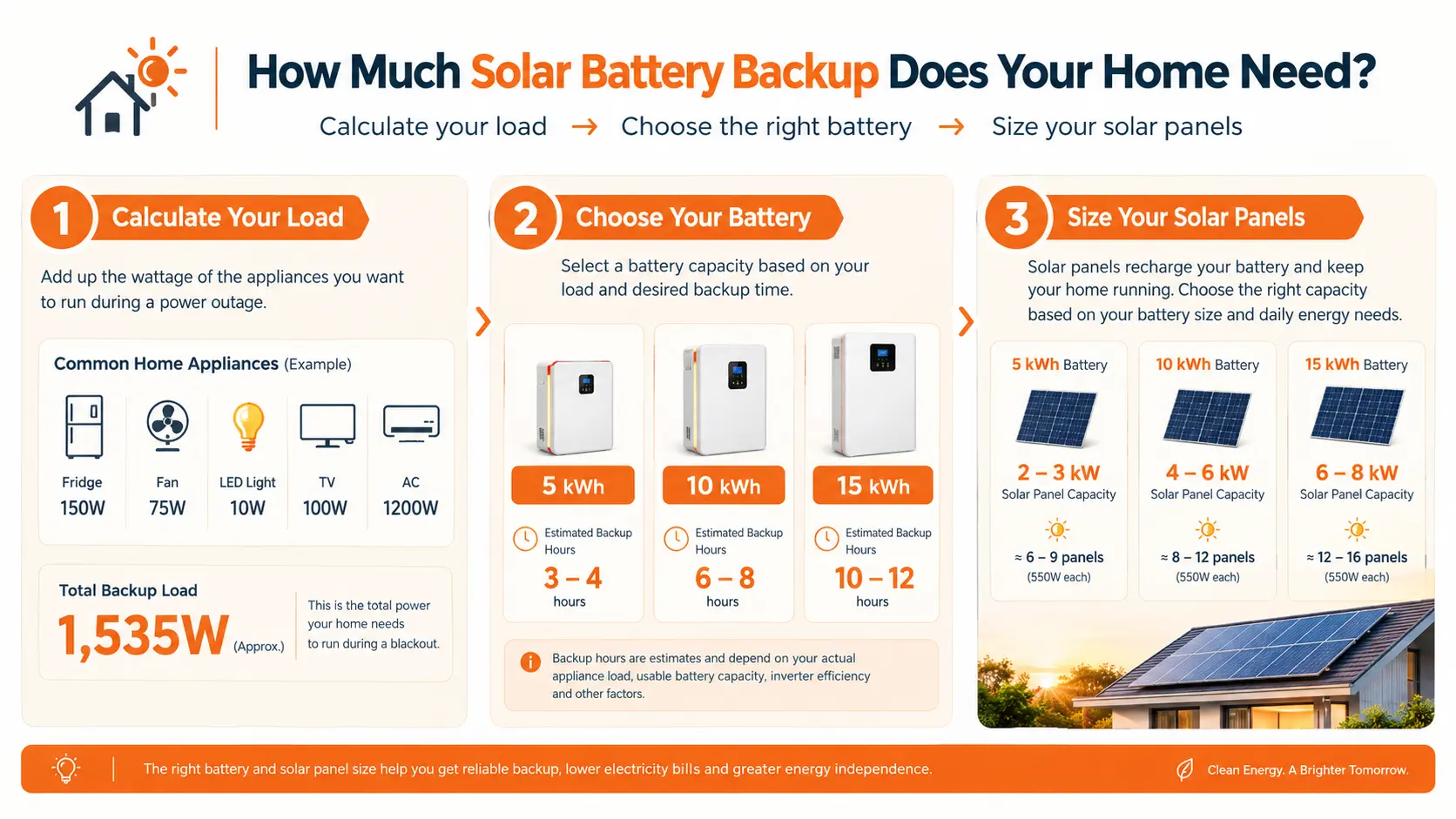
Your backup load in solar terms means the total watts of appliances you want to run during outages. Not your entire monthly bill capacity—just what you’ll actually use without grid power.
Typical Pakistani home backup load:
- 2-3 ceiling fans: 600W
- 1 refrigerator: 200W (running only)
- 8-10 LED lights: 80W
- 1 TV: 100W
- Phone chargers and router: 50W
- Total backup load: 1,000-1,200W continuous
A 5kW inverter can handle 5,000W peak load and 1,000-1,200W continuous backup load safely. This is why 5kW is the most popular residential size in Pakistan.
2. Battery Capacity: How Many Hours of Backup?
Battery size depends on how long you want to run that backup load without solar or grid.
- 5 kWh battery + 1kW backup load = 5 hours backup (covers midday outages)
- 10 kWh battery + 1kW backup load = 10 hours backup (covers evening to morning)
- 15 kWh battery + 1kW backup load = 15 hours backup (covers extended outages)
Pakistan’s daily load-shedding is typically 4-8 hours in one continuous block. A 10 kWh LiFePO4 battery handles 8 hours of 1.2kW backup load with 20% safety margin.
Cost of LiFePO4 battery storage in Pakistan 2026:
- 5 kWh: PKR 475,000 to 600,000
- 10 kWh: PKR 950,000 to 1,200,000
- 15 kWh: PKR 1,400,000 to 1,800,000
3. Solar Panel Capacity: How Many Panels?
For a solar system with battery backup, the panel array must be 1.25-1.5 times larger than the inverter rating to ensure full battery recharge by midday.
- 5kW inverter needs 6-7.5 kW of panels (11-13 Longi Hi-Mo 6 panels at 580W each)
- 10kW inverter needs 12-15 kW of panels (21-26 panels)
Why oversizing matters: Pakistan’s average peak sun hours are 4-5 per day in winter and 5-6 in summer. Oversized panels maximize charging speed, allowing full battery recovery even on cloudy days.
4. Backup Load Calculation Checklist
Before finalizing a system size, verify three numbers:
Appliance audit:
- List every appliance you’ll run during load-shedding
- Check the power rating (watts) on each device’s nameplate
- Add them: total is your backup load
- Example: 3 fans (600W) + fridge (200W) + lights (80W) + TV (100W) = 980W
Outage duration:
- Ask neighbors or check DISCO load-shedding schedule
- 4-6 hours = 5 kWh battery sufficient
- 6-8 hours = 10 kWh battery recommended
- 8+ hours = 15 kWh battery
Budget constraint:
- PKR 1.3-1.5 lakh for 5kW + 5kWh system
- PKR 1.5-1.7 lakh for 5kW + 10kWh system
- PKR 2.0-2.5 lakh for 10kW + 10kWh system
Best Solar Battery Backup System for Home Cost in Pakistan
Current 2026 pricing for complete installed systems:
System Type | Panel Capacity | Battery Capacity | Estimated Cost (PKR) | Monthly Savings (PKR) | Payback Period |
5kW Hybrid + 5kWh LiFePO4 | 6kW | 5 kWh | 1,300,000–1,500,000 | 18,500–20,000 | 6–7 years |
5kW Hybrid + 10kWh LiFePO4 | 6kW | 10 kWh | 1,500,000–1,700,000 | 20,000–24,000 | 6–7 years |
10kW Hybrid + 10kWh LiFePO4 | 12kW | 10 kWh | 1,800,000–2,200,000 | 28,000–32,000 | 6–7 years |
Costs vary by:
- Battery chemistry (LiFePO4 vs tubular vs lead-acid)
- Panel brand (Tier-1 vs local)
- Inverter efficiency rating
- Installation location (Lahore, Islamabad, Karachi, Peshawar)
- Duty/import tax fluctuations
Why LiFePO4 is the standard: A 5-year-old 10 kWh tubular battery system would need PKR 300,000-400,000 in battery replacement. A LiFePO4 battery lasts 10-15 years, eliminating that cost entirely. Over 15 years, LiFePO4 is cheaper in total cost of ownership despite higher upfront price.
How to Choose the Best Solar Battery Backup System for Your Home
Use this five-step decision framework:
Step 1: Identify Your Backup Load Walk through every room and note appliances. Fans, lights, fridge, TV, chargers. Add the watts. Realistic backup load for most Pakistani homes: 1,000-1,500W.
Step 2: Determine Your Outage Duration Call your DISCO or ask neighbors: 4 hours, 6 hours, 8 hours daily? Longer outages require larger batteries. 10 kWh is the safe default for most Pakistani cities.
Step 3: Choose DC-Coupled or AC-Coupled New system = DC-coupled (cheaper, more efficient). Retrofitting to existing on-grid = AC-coupled.
Step 4: Select Panel Count and Inverter Size
- Backup load 1-2 kW = 5kW inverter, 6kW panels
- Backup load 2-4 kW = 10kW inverter, 12kW panels
- Backup load 4+ kW = 15kW inverter, 18kW panels
Step 5: Finalize Battery Type LiFePO4 (10-15 year lifespan, PKR 95,000-120,000 per kWh) > Tubular (2-3 year lifespan, PKR 40,000 per kWh). Do the math: LiFePO4 total cost of ownership is lower.
SunSaviour’s X-Series and ALPHA Series hybrid inverters are engineered for Pakistan’s voltage fluctuations and summer heat. The X-Plus model integrates advanced battery backup load management for systems up to 15kW. Visit sunsaviour.com to compare inverter specifications matched to your backup system size.
Frequently Asked Questions
How long do solar backup batteries last in Pakistan?
Premium LiFePO4 batteries last 10-15 years under normal daily cycling. This translates to 6,000-8,000 full charge-discharge cycles before capacity drops below 80%. In Pakistan’s 50°C summer heat, LiFePO4 tolerates high temperatures with minimal lifespan impact. Tubular batteries, by contrast, last only 2-3 years and cost more in total replacement cost.
What is a hybrid solar system versus on-grid?
A hybrid solar system has battery backup and keeps running during load-shedding. An on-grid system has no battery and shuts down entirely when the grid fails. Hybrid costs PKR 500,000 more upfront but eliminates your load-shedding losses.
Can I build a solar battery backup system in stages?
Yes. Start with 5kW inverter and 6kW panels. Add 5 kWh battery immediately for backup. 6-12 months later, add a second 5 kWh battery to expand backup to 10 hours. This approach spreads the cost but requires buying a hybrid inverter rated for future expansion.
What is the difference between on-grid and DC-coupled systems?
On-grid systems have no battery. DC-coupled systems have batteries wired directly to the inverter’s DC side (more efficient). AC-coupled systems have batteries wired to the AC side (less efficient, but easier to retrofit).
How many solar panels do I need for backup during load-shedding?
For a 5kW inverter, install 6-7kW of panels (11-13 panels at 580W each). This oversizing ensures full battery recharge by midday even on cloudy days. Pakistan’s 4-6 peak sun hours per day requires this buffer.
What is backup load in solar systems?
Backup load is the total watts of appliances you actually run when the grid is down. It’s usually 20-30% of your total home consumption. Most Pakistani homes can backup 1-2 kW continuously (fans, fridge, lights, TV) with a 5kW system.
Which solar battery backup system is best for summer heat in Pakistan?
LiFePO4 is the only practical choice for Pakistan’s 45-50°C summers. It tolerates heat without significant capacity loss. Lead-acid and tubular batteries lose 40-50% capacity in extreme heat and fail within 1-2 years in Pakistani conditions.
How much can I save with a hybrid solar system in Pakistan?
A 5kW hybrid system saves PKR 20,000-24,000 monthly (year-round, including load-shedding benefit). Over 10 years, that’s PKR 2,400,000-2,880,000 in electricity savings. Payback is 5-7 years.
Do I need NEPRA approval for a hybrid solar system?
Yes. Since February 2026, all grid-tied systems (including hybrids) require NEPRA Prosumer Registration. Your installation partner handles the paperwork. NEPRA approval takes 2-4 weeks.
Can I use a hybrid solar system off-grid?
Yes, but it’s not recommended. Off-grid hybrids need much larger panels and batteries (3-4 lakh extra cost) because the system must survive 3-4 cloudy days without grid backup. Grid-connected hybrids are cheaper and more practical.
What brands of hybrid inverters work best in Pakistan?
Inverex Nitrox, Solis Hybrid, Growatt SPH, Deye, and Max Power brands are widely available. All offer 48V LiFePO4 battery compatibility. Installation partners in Lahore, Islamabad, Karachi, and Peshawar stock these brands.
Conclusion
Finding the best solar battery backup system for home in Pakistan comes down to three decisions: DC-coupling for efficiency, a 10 kWh LiFePO4 battery for reliability, and a 5-6 kW panel array for fast charging. The total cost of PKR 1,500,000-1,700,000 seems high until you calculate 6-7 years of payback plus 8-10 years of free electricity after the loan is paid off.
Pakistan’s load-shedding isn’t ending soon, but your home doesn’t have to suffer. A hybrid solar system with battery backup gives you energy independence, lower bills, and peace of mind during outages. Start by calculating your backup load, confirm your local outage duration, and contact an installer to size the right system for your home. Pakistan’s electricity crisis is pushing millions toward the best solar battery backup system for home as a practical solution