Introduction
Choosing an energy storage inverter is the most important decision in a battery-backed solar system. The inverter controls how your panels charge the battery, when the battery supplies your home, and whether your system keeps running during load shedding. Get this choice right and the rest of the system works as designed. Get it wrong and even good panels and batteries underperform.
Pakistan’s market offers many options. A solar inverter can cost anywhere from roughly PKR 100,000 to over PKR 500,000 depending on capacity, type, and brand. Prices alone do not tell you which unit fits your home. This guide explains the main inverter types, how to size and match one to your load and battery, what a realistic hybrid inverter price in Pakistan looks like, and the checks that protect your purchase.
What Is an Energy Storage Inverter?
An energy storage inverter is an inverter that manages solar panels, a battery bank, and the grid at the same time. It converts DC power from panels into AC for your appliances, decides whether surplus energy charges the battery or exports to the grid, and switches to battery power when the grid goes down.
In Pakistan, the most common version is the hybrid solar inverter. It handles all three energy sources in one unit. A standard solar inverter that only feeds grid-tied systems cannot store energy, so it shuts down during outages. That single difference is why most Pakistani households with daily load shedding choose a hybrid design.
The Main Inverter Types You Will Compare
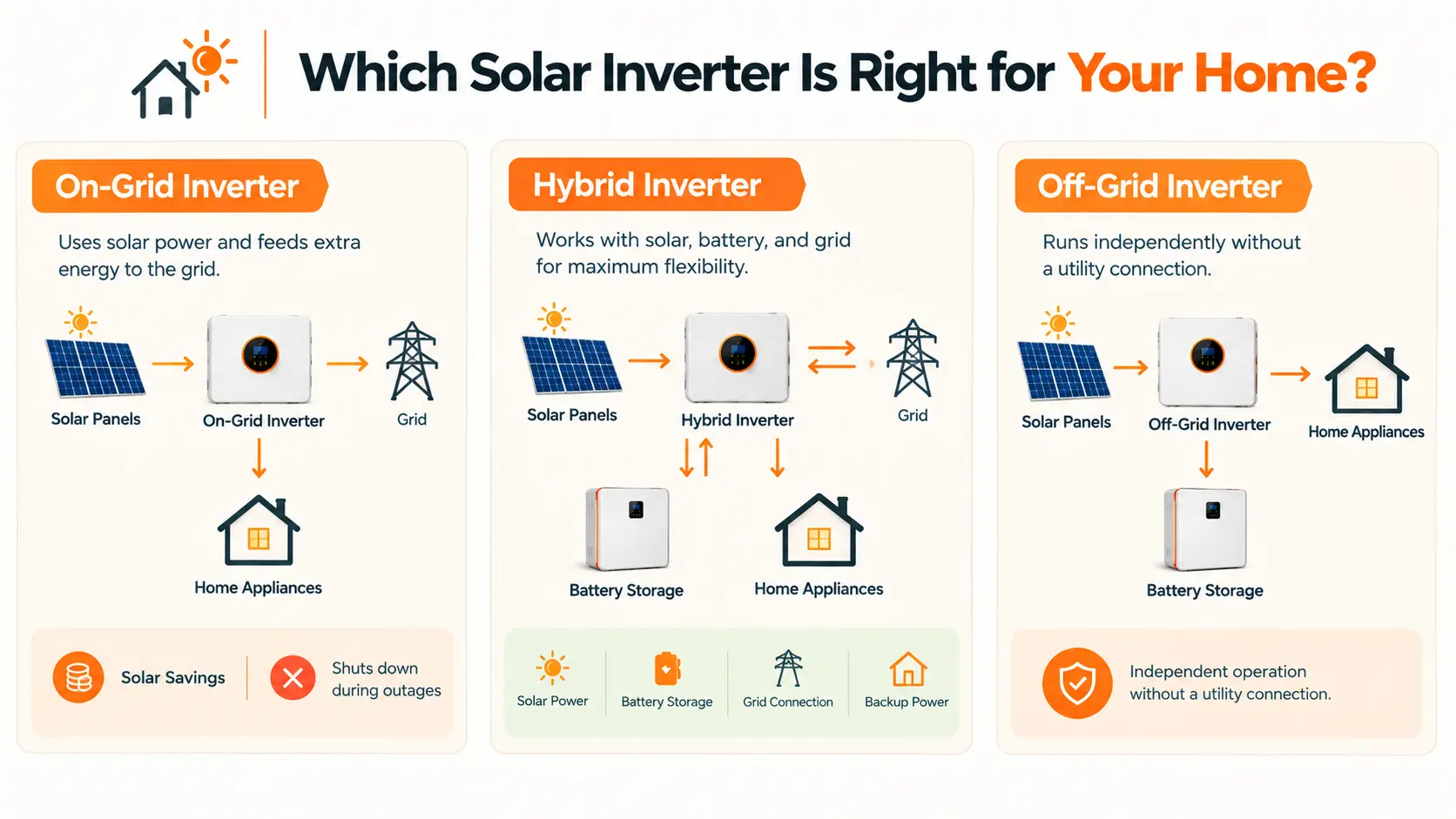
On-grid inverters convert solar power for home use or export. They have no battery input and stop during outages for safety. They suit homes with few power cuts that mainly want lower daytime bills.
Hybrid inverters support solar, battery, and grid together. They provide backup during load shedding, store energy for the evening, and manage net billing exports under NEPRA’s current framework. For most Pakistani homes, this is the correct starting point.
Off-grid inverters run without a utility connection. They are used in remote locations or where grid supply is unavailable. They require enough battery and panel capacity to cover all loads year-round, so they cost more to size correctly.
Searches for off grid inverter and off grid solar inverter usually come from buyers without reliable grid access. If your home is connected to WAPDA, a hybrid unit that can run in backup mode gives more flexibility than a pure off-grid design.
Step 1: Confirm Your Phase Type
Before comparing models, check your electricity bill or meter. Most Pakistani homes have a single-phase supply. Single-phase inverters typically cover systems up to about 10kW.
Three-phase inverters suit commercial sites, factories, and properties with three-phase service. A three-phase unit cannot be connected to a single-phase supply without a formal DISCO upgrade. Confirm this first, because it narrows your options before any price comparison starts.
Step 2: Calculate Your Daily Energy Use
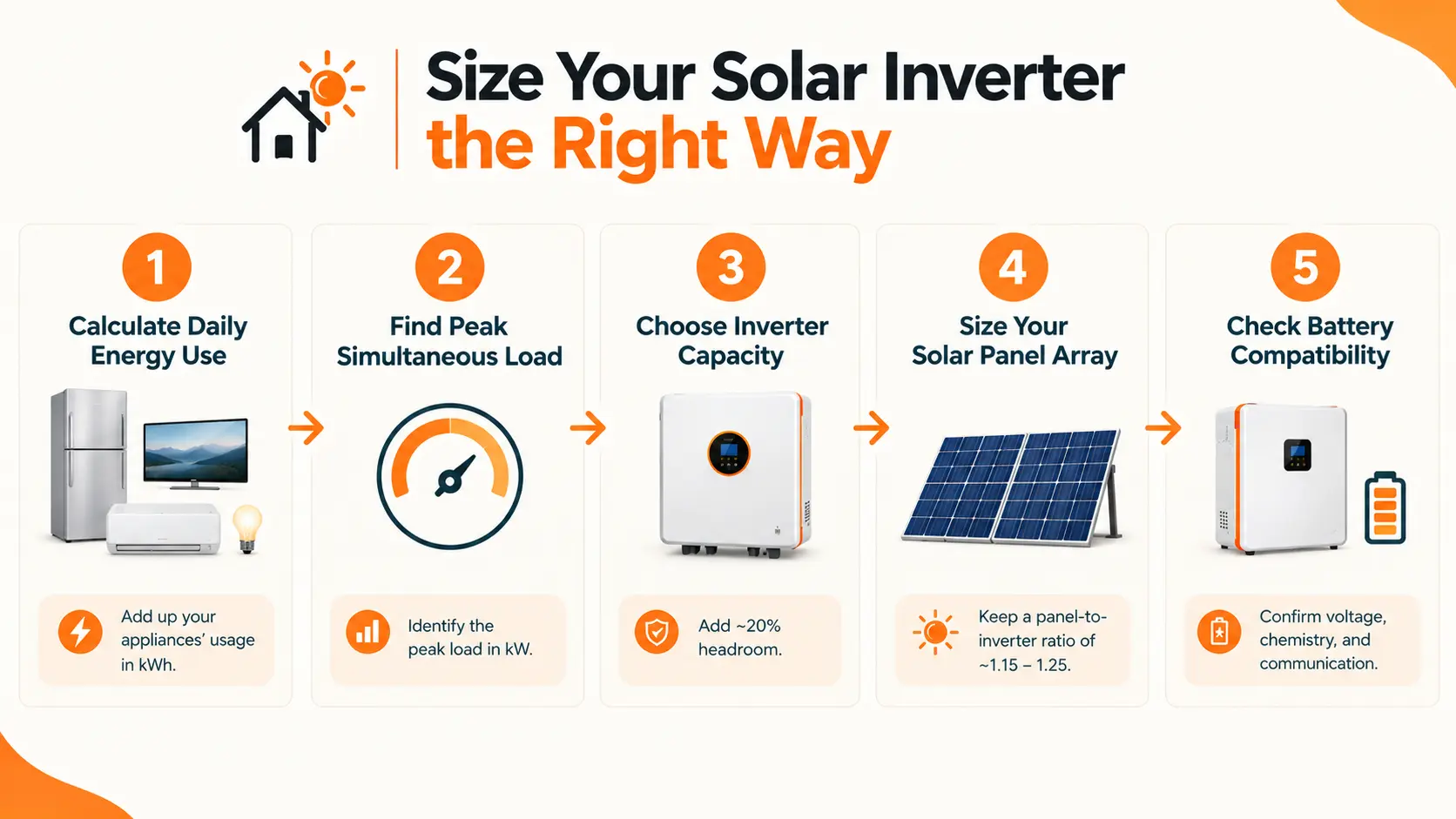
Sizing starts with load, not with a package name. List each appliance, its wattage, and hours of use. Add up the total daily kilowatt-hours and the peak simultaneous load.
Two numbers matter most:
- Daily energy (kWh): This sizes your panels and battery.
- Peak running load (kW): This sets the minimum inverter output you need.
A common mistake is buying a 5kW solar inverter for a home whose air conditioners and water pump start together, then finding the unit overloads during peak use. Add a safety margin of about 20% above the peak simultaneous load.
Step 3: Match the Inverter to Your Panels
Inverter size and panel size are related but not equal. A common approach is a DC-to-AC ratio between about 1.15 and 1.25. For example, a 6kW panel array pairs well with a 5kW inverter. Slight panel oversizing improves energy harvest in the morning and late afternoon, and the small amount of clipping at peak hours is usually an acceptable trade-off.
Oversizing far beyond that range causes more clipping losses and shortens the financial benefit of the extra panels.
Step 4: Match the Battery Chemistry and Voltage
An energy storage inverter must match the battery it charges. For Pakistani residential systems today, LiFePO4 (lithium iron phosphate) is the standard recommendation for daily cycling. It offers deeper usable capacity and longer life than lead-acid for the same nominal rating.
Check three things before buying:
- Communication protocol: The inverter should talk to the battery’s BMS over CAN or RS485.
- Voltage: Most residential systems use a 48V bank. The inverter and battery voltages must match.
- Charge current: The inverter’s maximum charge rate must be within the battery’s safe limit.
If your battery is not on the inverter’s approved list, do not assume it will work. Ask the manufacturer for written compatibility confirmation.
Energy Storage Inverter Price in Pakistan: What to Expect
Prices for hybrid and storage-ready inverters vary widely across brands, warranty terms, IP ratings, and stock. Recent 2026 listings from Pakistani dealers and price trackers show the following indicative ranges for single-phase hybrid units from established brands. These are inverter-only figures, not complete system prices.
Capacity | Indicative Price Range (PKR) | Typical Home Use |
3kW hybrid | 100,000 to 200,000 | Small flat, basic fans, lights, router |
5kW hybrid | 150,000 to 350,000 | Medium home, one or two ACs with load management |
6 to 8kW hybrid | 220,000 to 400,000 | Larger home, more AC load |
10kW hybrid | 270,000 to 550,000 | Large home, office, clinic, small commercial |
Price depends on brand tier, IP rating, warranty length, MPPT inputs, and whether monitoring hardware is included. A low hybrid inverter price in Pakistan quote for a branded unit deserves a check for authenticity. Grey-market and counterfeit products are a documented problem in this market.
Remember that the inverter is only one part of the total cost. A complete system also includes panels, battery, mounting, protection devices, cabling, and the net billing application. Ask every dealer for an itemized quote so you can compare like with like.
Brand Comparison Without Guesswork
Many buyers compare brands only by price. A more useful comparison covers:
- Warranty enforcement: Is the warranty honored by a local entity in Pakistan?
- Service access: Is there a technician or service centre in your city?
- Spare parts: Are replacement parts stocked locally?
- Monitoring: Does the app show battery state, grid import, and fault codes clearly?
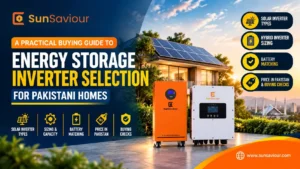
SunSaviour’s product range includes the ALPHA Series, V-Series, X-Series, and X-Plus hybrid inverters, along with TP-Series on-grid units and lithium battery options. When comparing any brand, use the same checklist so your decision rests on support and performance, not only on the sticker price.
SunSaviour’s hybrid inverter range, including the ALPHA Series, V-Series, X-Series, and X-Plus, is built for Pakistani homes that need battery backup and bill reduction. Explore SunSaviour inverter options at sunsaviour.com
Step 5: Check Protection and Local Conditions
Pakistan’s grid and climate are demanding. Look for:
- IP65 or higher rating for dust, especially in Punjab, Sindh, and KPK during dust and smog seasons
- Operating temperature range that covers summer heat, with documented derating behavior
- Surge and voltage protection for frequent grid fluctuations
- Dual MPPT inputs if your roof has panels facing different directions
- Remote monitoring so you can spot faults without a site visit
An inverter installed in direct sun on a south-facing wall in June can see ambient temperatures above 50°C. Choose a shaded or ventilated mounting location where possible.
Step 6: Plan for Future Expansion
Load grows. You may add an AC unit, an EV charger, or more batteries later. Check whether the inverter supports:
- Additional battery modules or parallel battery connection
- Higher PV input if you add panels
- Firmware updates for new features
Planning expansion at purchase saves the cost of replacing the inverter when your needs change.
Energy Storage Inverter Selection Checklist
Before you sign any purchase agreement, confirm each item:
- Phase type matches your DISCO supply
- Daily energy and peak load calculated
- Inverter sized with 20% headroom over peak load
- Panel-to-inverter ratio between about 1.15 and 1.25
- Battery chemistry, voltage, and charge current match the inverter
- Written battery compatibility confirmed for your exact model
- IP rating, temperature range, and MPPT inputs suit your site
- Warranty and service centre confirmed locally
- Unit purchased from an authorized dealer with original documents
- Monitoring app tested before final payment
Frequently Asked Questions
What is an energy storage inverter?
An energy storage inverter manages solar panels, batteries, and the grid together. It stores surplus solar energy in the battery and supplies your home during outages. In Pakistan, this is usually a hybrid inverter.
Is a hybrid inverter the same as an energy storage inverter?
Most hybrid inverters are energy storage inverters, because they include battery management. Some on-grid units can be upgraded or paired with storage, but the hybrid design is built for it from the start.
What is the difference between a solar inverter and a hybrid inverter?
A standard solar inverter converts panel power for home use or grid export and shuts down during outages. A hybrid inverter adds battery charging, battery discharge, and backup switching.
How do I choose between on-grid and hybrid?
If you have frequent load shedding or want to store energy for evening use, choose hybrid. If you have very few outages and only want daytime bill savings, an on-grid unit may be enough.
What size inverter do I need for my home?
Calculate your daily energy use and peak simultaneous load first. Choose an inverter that covers peak load with about 20% headroom, then pair it with panels at roughly 1.15 to 1.25 times the inverter’s AC rating.
Does an energy storage inverter need a battery?
No, but without a battery it cannot provide backup during outages. If load shedding affects your area, install the battery with the inverter from the start.
Can I use a 5kW inverter with a 10kW panel array?
That ratio is much higher than the typical 1.15 to 1.25 range and will cause significant clipping at peak output. Size the panels and inverter together based on your load and roof space.
What is the hybrid inverter price in Pakistan for a 10kW unit?
Recent 2026 listings place a branded 10kW single-phase hybrid inverter roughly between PKR 270,000 and PKR 550,000, depending on brand, IP rating, and warranty. Compare quotes on the same specifications.
Conclusion
Selecting an energy storage inverter is a decision about fit, not only price. Confirm your phase type, size the unit to your real load, match the battery chemistry and voltage, and check protection and warranty support before you buy.
For most Pakistani homes, a single-phase hybrid inverter with LiFePO4 battery compatibility gives the best balance of backup power, bill reduction, and long-term reliability. Use the checklist in this guide to compare options on the same terms, and do not let a low headline price replace a careful check of specifications and service.
SunSaviour supplies hybrid inverters and lithium battery storage for homes and businesses across Pakistan, supported by 59+ sales points and 28 service centres nationwide. Visit sunsaviour.com to find the right energy storage inverter for your system.