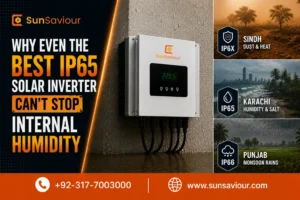
Owners of outdoor solar systems often assume a best IP65 inverter is fully sealed against moisture. Then a fault shows up anyway, and it doesn’t make sense. The inverter trips into safe mode, or an insulation fault appears out of nowhere, even though the box was marketed as weatherproof.
The problem isn’t the hardware failing early. It’s a misunderstanding of what IP65 actually protects against. How condensation affects solar inverter components is a different question entirely from how well the enclosure blocks rain, and most buying guides never separate the two.
The IP65 Illusion, Why Waterproof Enclosures Do Not Stop Humidity
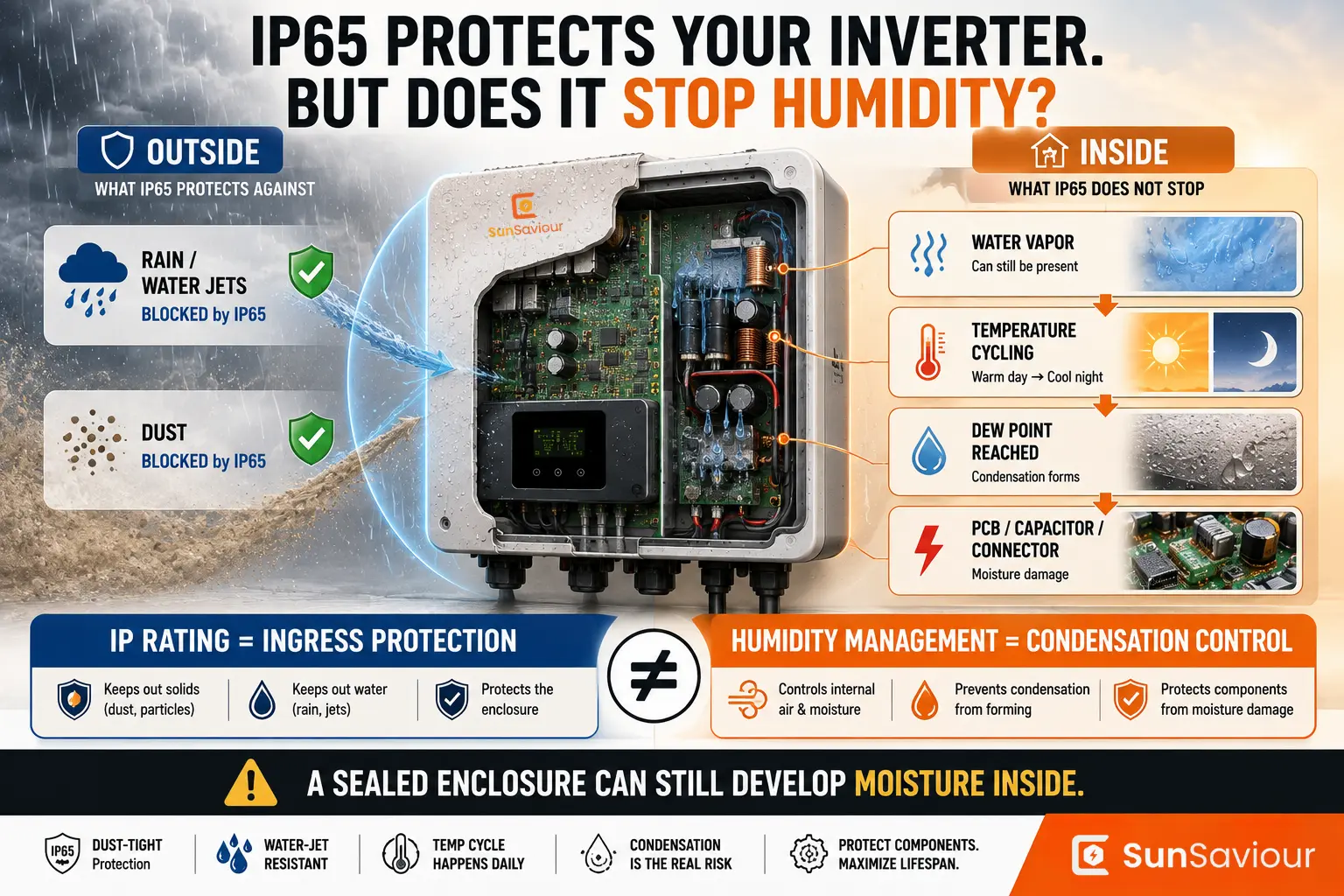
The IP65 rating has a precise, literal definition. The first digit, 6, means the enclosure is completely dust-tight. The second digit, 5, means it’s protected against low-pressure water jets from any direction.
That’s the entire definition. The rating only measures protection against liquid water and solid particles. It says nothing at all about gaseous moisture, or how the enclosure manages water vapor once it’s inside.
This is the gap most people miss. Does IP65 protect inverter from humidity the way it protects against rain? No. Whether an IP65 enclosure is fully sealed or fitted with a small membrane vent, gaseous humidity can still get in, or become trapped once it’s already there. Can humidity damage a solar inverter that’s rated IP65? Yes, and it happens more often than the rating suggests it should.
The Physics of Thermal Cycling, How Condensation Forms Inside a Sealed Box
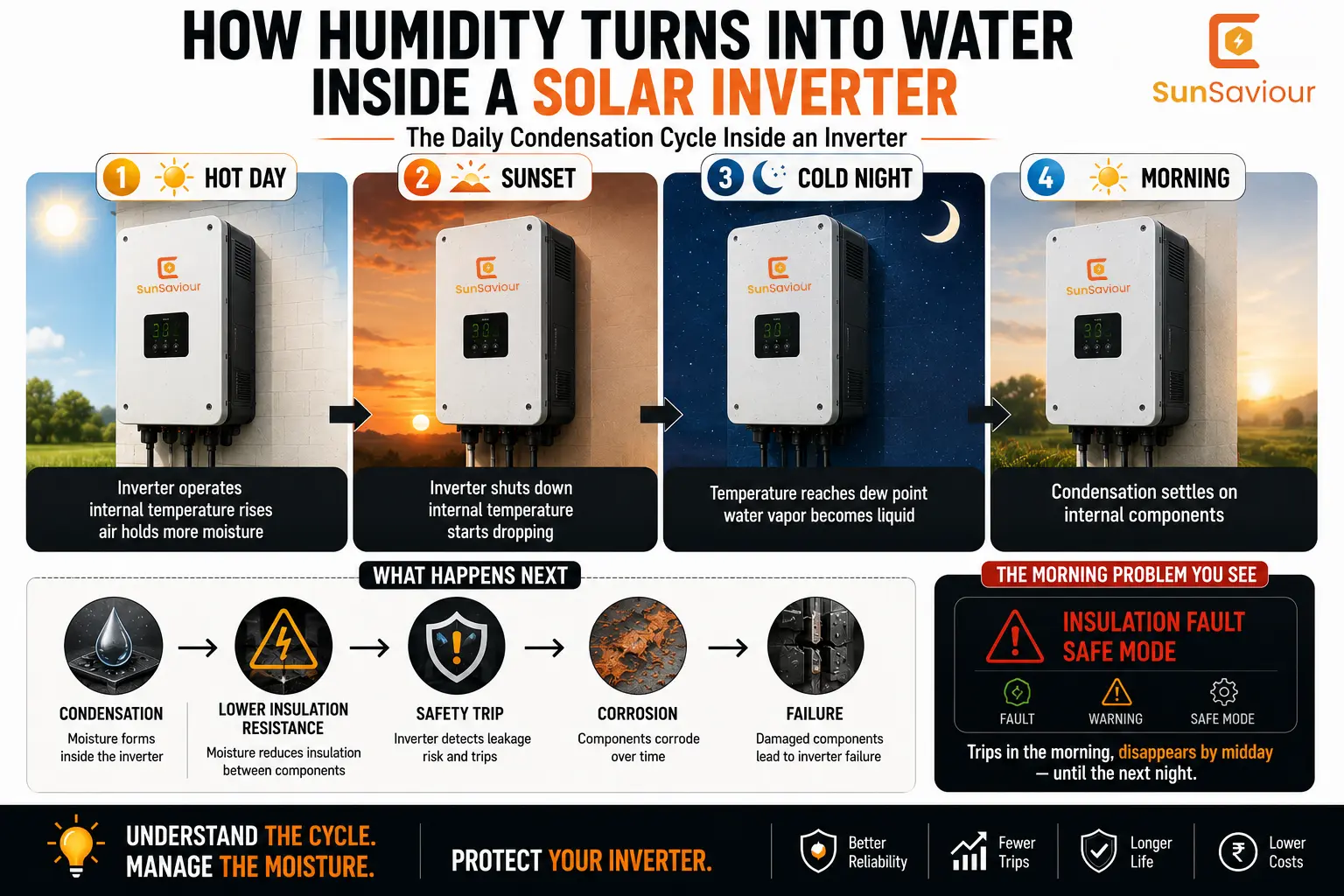
Inverter thermal cycling is the real mechanism behind most humidity-related failures, and it repeats every single day.
During daylight hours, the inverter runs under heavy load and heats up. That warms the air trapped inside the enclosure, and warm air absorbs more moisture, whether from the surrounding environment, leftover rain, or moisture releasing from internal polymer components.
When the sun goes down and the inverter shuts off, the temperature inside the enclosure drops sharply. Cooled air simply cannot hold as much moisture as warm air could.
Once the internal temperature crosses the dew point, gaseous water vapor turns into liquid water. It condenses directly onto the coldest internal surfaces it can find, usually circuit boards, transformers, and capacitors. This daily cycle is what actually drives solar inverter condensation, not a one-time exposure to rain.
Diagnostic Clues, How to Recognize a Humidity Problem
The Signature of an Intermittent Morning Safety Trip
There’s a classic symptom technicians look for. The system trips into safe mode, or displays an insulation fault, early in the morning. This is exactly when relative humidity peaks and dew has had all night to form on internal electronics.
By midday, the fault often clears on its own. Natural warmth, plus heat generated by the components themselves, dries out the interior. The inverter resumes normal operation, seemingly fine, only for the same cycle to repeat the next morning. This pattern is one of the clearest signs of solar inverter condensation problems in the field.
Understanding Insulation Resistance and Leakage Currents
Condensation sitting on delicate circuits lowers insulation resistance. That drop is not cosmetic. It triggers immediate safety trips, specifically to prevent electrical shock or a hardware short before it becomes dangerous.
This is what technicians mean by inverter insulation failure. It’s rarely a single dramatic event. It’s usually a slow pattern of morning trips that gets worse over months, as inverter moisture damage accumulates a little further each cycle.
Inside the Enclosure, How Humidity Destroys Key Components
Capacitor Deterioration, the Leading Point of Failure
Aluminium electrolytic capacitors are widely considered the weak point of inverter hardware. They account for roughly 30% of all inverter failures industry-wide.
Moisture degrades the seals on these capacitors and promotes internal corrosion. That leads to a drop in capacitance and a spike in Equivalent Series Resistance, known as ESR. Left unchecked, this chain of events causes local thermal runaway inside the unit.
PCB Corrosion and Parasitic Conductive Paths
Condensation forming directly on printed circuit boards creates small parasitic conductive paths where none should exist. Over time, this corrodes the fine copper traces and solder joints that hold the board’s circuitry together. This is the core mechanism behind most inverter PCB corrosion cases seen in the field.
Busbar Oxidation and Semiconductor Vulnerabilities
Moisture also oxidizes busbars and connectors over time. That oxidation raises contact resistance, which generates dangerous localized heat exactly where it’s least wanted. Power transistors, known as IGBTs, are primarily vulnerable to thermal stress rather than moisture directly. But humidity-driven insulation faults still cut sharply into their long-term reliability. Together, these mechanisms explain most of the broader inverter component corrosion and solar inverter failure causes technicians report.
The Installer’s Blind Spot, AC/DC Combiner and Protection Boxes
Inverters get all the attention, but they aren’t the only enclosure at risk. AC/DC combiner, junction, and disconnect boxes go through the exact same daily thermal condensation cycle. They often have even less internal heat to dry out the trapped air, since they generate far less heat than the inverter itself.
Enclosure material matters here more than most installers realize. ABS polymer enclosures suffer more condensation than metal ones. Their thermal behavior widens the gap between the enclosure wall temperature and the internal air temperature, which lets water pool quietly at the bottom of the box, often for months before anyone notices.
The failure chain that follows is genuinely dangerous. Corroded connections raise contact resistance. That resistance generates localized heating. The heating leads to electrical arcing. Arcing is a fire hazard. This inverter condensation risk applies to every sealed box in the system, not just the main inverter enclosure, and it deserves the same level of attention.
Solving the Moisture Problem, Passive vs Temporary Protections
The Limitations of Yearly Inspections and Temporary Fixes
Standard field treatments like compressed air, water-displacing sprays, or manual silica gel packets are reactive by nature. They only address the moisture present on the day of the inspection, and they saturate quickly after that.
An annual inspection happens once a year. Condensation is a daily, relentless cycle that doesn’t pause between visits. This mismatch is why solar inverter moisture problems tend to resurface within weeks of a routine service call, no matter how thorough that visit was.
The Role of Self-Regenerating Desiccants
Self-Regenerating Desiccant technology, often built as a passive moisture-adsorbing sticker or tape, offers a genuine fit-and-forget alternative. It’s one of the more effective answers to how to protect solar inverter from humidity without adding an ongoing maintenance task.
The mechanism is elegantly simple. At night, as relative humidity rises, the material actively adsorbs moisture vapor from the air inside the enclosure. During the day, as the inverter heats back up, the material naturally releases that moisture, which vents out of the enclosure. The desiccant resets itself for the next night automatically, with no manual intervention required. This kind of built-in solar inverter moisture protection is increasingly standard on inverters designed specifically for inverter for high humidity environments and other inverter for humid environments conditions.
Comparing Protection Levels, IP21 vs IP65 vs IP66
Understanding IP65 vs IP66 protection, and where a basic IP21 rating fits in, helps explain why humidity control has to be engineered separately from dust and water protection.
Rating | Dust and Water Protection | Humidity Control | Best Fit |
IP21 | Basic finger protection, vertical drips only | None | Strictly indoor, dry rooms |
IP65 | Dust-tight, standard water jets | Not addressed by the rating itself | Outdoor walls, needs added desiccant or venting |
IP66 | Dust-tight, powerful water jets | Not addressed by the rating itself | Fully exposed rooftops, needs added desiccant or venting |
The difference between IP21 and IP65 solar inverter ratings comes down to how much dust and water each can physically block. Neither the IP65 vs IP21 inverter comparison nor a straight IP65 vs IP66 comparison actually answers the humidity question, since none of these ratings measure vapor control at all. That’s a separate design decision, handled through venting, desiccants, or both.
For buyers specifically comparing an IP65 hybrid inverter against standard grid-tied units, this distinction matters even more. Hybrid units often run longer daily cycles and heavier loads, which means more pronounced thermal cycling. Pairing them with a compatible lithium battery series with multi-layer BMS protection is essential for stable home backup.
Keeping Up with Solar Inverter Maintenance
Routine solar inverter maintenance should include a visual check for condensation residue, corrosion on connectors, and any signs of pooling inside combiner boxes. Catching early inverter internal humidity signs during a scheduled visit is far cheaper than replacing a capacitor bank or an entire control board later.
An inverter built with humidity in mind from the start, rather than one that relies solely on its IP rating, is the more reliable choice for best solar inverter for humid climate conditions across Pakistan. SunSaviour’s range includes units designed specifically to manage internal moisture, not just block it at the door.
Frequently Asked Questions
How do humidity affect solar inverters over time?
Repeated daily condensation cycles slowly corrode circuit boards, connectors, and capacitor seals. How humidity affects solar inverters is less about a single failure event and more about accumulated damage that eventually shows up as insulation faults or reduced output.
Does an IP65 rating mean an inverter is protected from humidity?
No. IP65 measures protection against dust and liquid water jets only. It does not measure or guarantee any protection against gaseous water vapor or internal condensation.
What’s the difference between IP21 and IP65 for a solar inverter?
IP21 offers only basic finger protection and resistance to vertical drips, which limits it to indoor use. IP65 is dust-tight and resistant to water jets from any direction, making it suitable for sheltered outdoor mounting.
Can a solar inverter’s moisture problem be fixed permanently?
Reactive fixes like silica gel packets or compressed air only offer temporary relief. Self-regenerating desiccant technology, built into the enclosure, offers a genuinely passive, long-term answer to solar inverter humidity protection without repeat manual servicing.
Protecting a solar investment means looking past the IP rating on the box. Explore SunSaviour’s humidity-managed inverter range at sunsaviour.com and choose hardware built for what actually happens inside the enclosure, not just what the rating promises on paper.