Pakistan’s Energy Crisis Makes Solar Battery Storage No Longer Optional
A solar system without a battery only works while the sun is out. The moment load shedding hits in the evening, a battery-less system goes dark along with the grid.
This is why so many Pakistani households are now asking why use solar battery in Pakistan rather than whether to use one at all. A correctly chosen solar battery for load shedding turns a partial daytime solution into round-the-clock power.
This guide breaks down every major battery type sold in Pakistan, what they actually cost in 2026, and how to match one to your home or business.
Why Pakistani Homes and Businesses Need Solar Battery Backup
Load Shedding, Rising Tariffs and the Case for Energy Independence
Many parts of Pakistan continue to experience daily load shedding, and grid tariffs have risen sharply in recent years. A solar battery for load shedding directly addresses both problems: it stores daytime solar generation for use after dark, and it reduces dependence on grid electricity during peak tariff hours. Energy independence pakistan solar setups, meaning a hybrid system with adequate battery storage, are increasingly the standard recommendation rather than a premium add-on.
How a Solar Battery Transforms Your System From Partial to Complete
Without storage, solar only powers your home while panels are actively generating. Why use solar battery in Pakistan comes down to this gap: a battery captures surplus daytime generation and releases it exactly when the grid is most likely to fail. For households that want to go further, an off grid solar battery system removes grid dependency entirely, sizing the battery bank to cover the full daily cycle rather than just outage hours.
Types of Solar Batteries Available in Pakistan
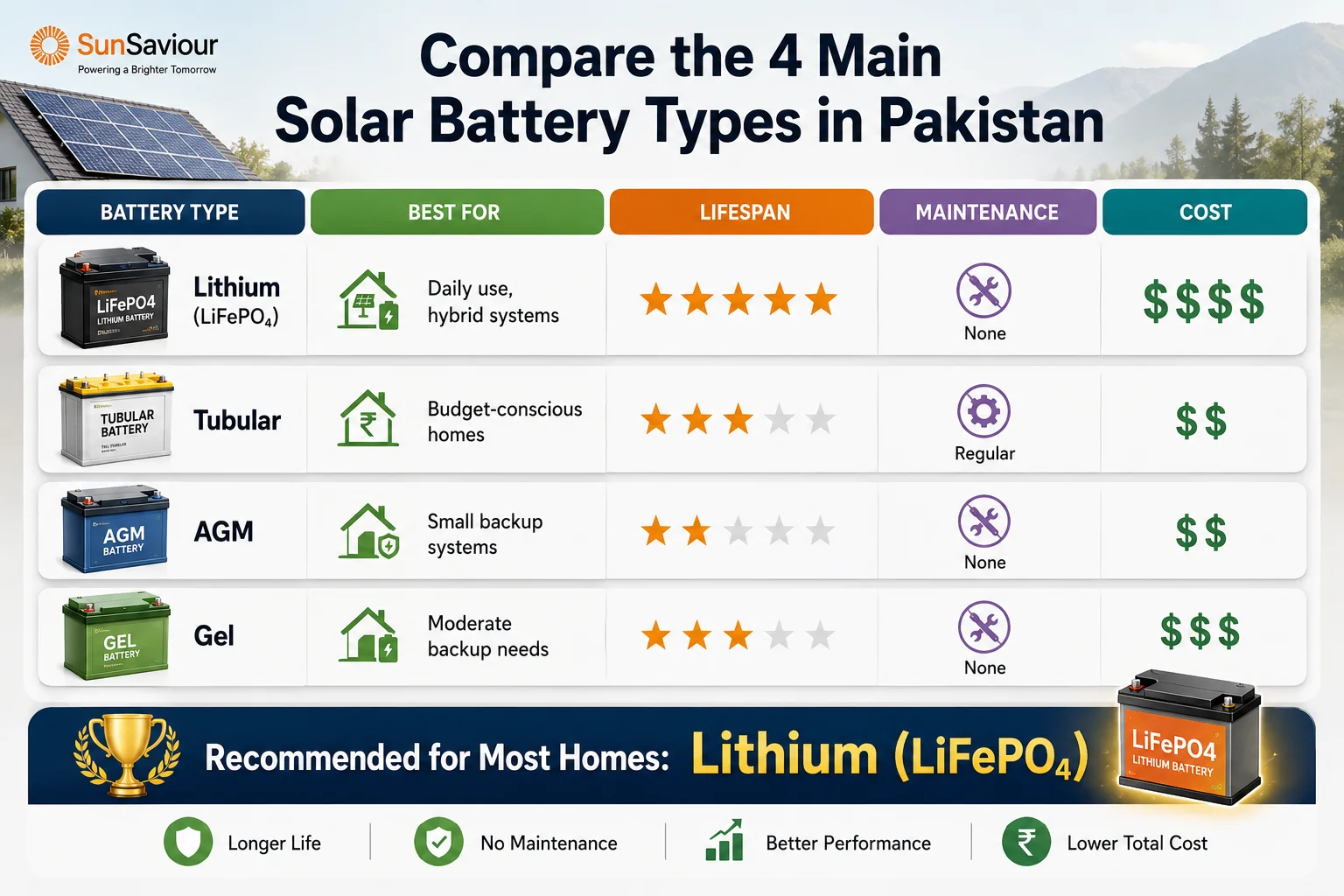
There are four main types of solar batteries in Pakistan today, and a solar battery comparison Pakistan buyers actually need looks at chemistry, depth of discharge, and total lifespan rather than sticker price alone.
Lithium-Ion Batteries: The Modern Choice for Solar Storage
Lithium battery for solar pakistan setups almost always use LiFePO4 (lithium iron phosphate) chemistry. The main lithium battery advantages are deeper usable discharge, typically 80 to 90% of rated capacity versus roughly 50% for lead-acid types, a longer cycle life often rated in the thousands of cycles, and minimal maintenance since there is no water top-up required.
Tubular Batteries: Still a Popular Option in Pakistan
Tubular battery for solar setups remain the most widely installed lead-acid option in Pakistan. They use a tube-shaped positive plate design that handles deep cycling better than standard flat-plate batteries, though they still require periodic water top-ups and proper ventilation. Among the types of solar batteries in pakistan, tubular is generally the entry point for budget-conscious buyers.
AGM and Gel Batteries: Where They Fit in Pakistan’s Market
AGM battery solar pakistan options are sealed and maintenance-free, but most installers note they tolerate deep discharge and extreme heat less well than tubular batteries, with a comparatively shorter cycle life at similar price points.
A gel battery for solar system setup is also sealed and somewhat more heat-tolerant than AGM, but gel batteries charge slowly and are sensitive to overcharging, so they only perform well with a correctly configured charge controller. Neither is commonly recommended as a primary storage choice; tubular and lithium dominate Pakistan’s solar market for a reason.
Lithium vs Lead-Acid in Pakistan: Which Makes More Sense for You?
Performance and Lifespan Comparison in Pakistan’s Climate
The core lithium vs lead acid battery pakistan trade-off comes down to upfront cost versus long-term value. Lead-acid batteries (tubular, AGM, gel) are cheaper to buy but need replacement more frequently and tolerate less usable capacity before damage occurs. Lithium batteries handle Pakistan’s high summer temperatures more reliably with a properly designed battery management system, and their deeper usable discharge means a smaller-rated lithium battery can deliver similar real-world backup to a larger lead-acid bank. For the best battery type for solar system use specifically in Pakistan’s climate, installers commonly point to lithium’s heat tolerance and reduced maintenance as the deciding factors for daily-cycling systems.
Cost Reality: Upfront Price vs Long-Term Value in Pakistan
Lead-acid batteries cost considerably less per unit upfront but need replacement on a shorter cycle, while lithium batteries cost several times more initially but typically last considerably longer with proper care. The solar battery system cost pakistan calculation should always be done on a cost-per-year-of-use basis, not sticker price alone, since a battery replaced twice within a lithium battery’s working life can erase the apparent upfront savings.
How to Choose the Best Solar Battery in Pakistan
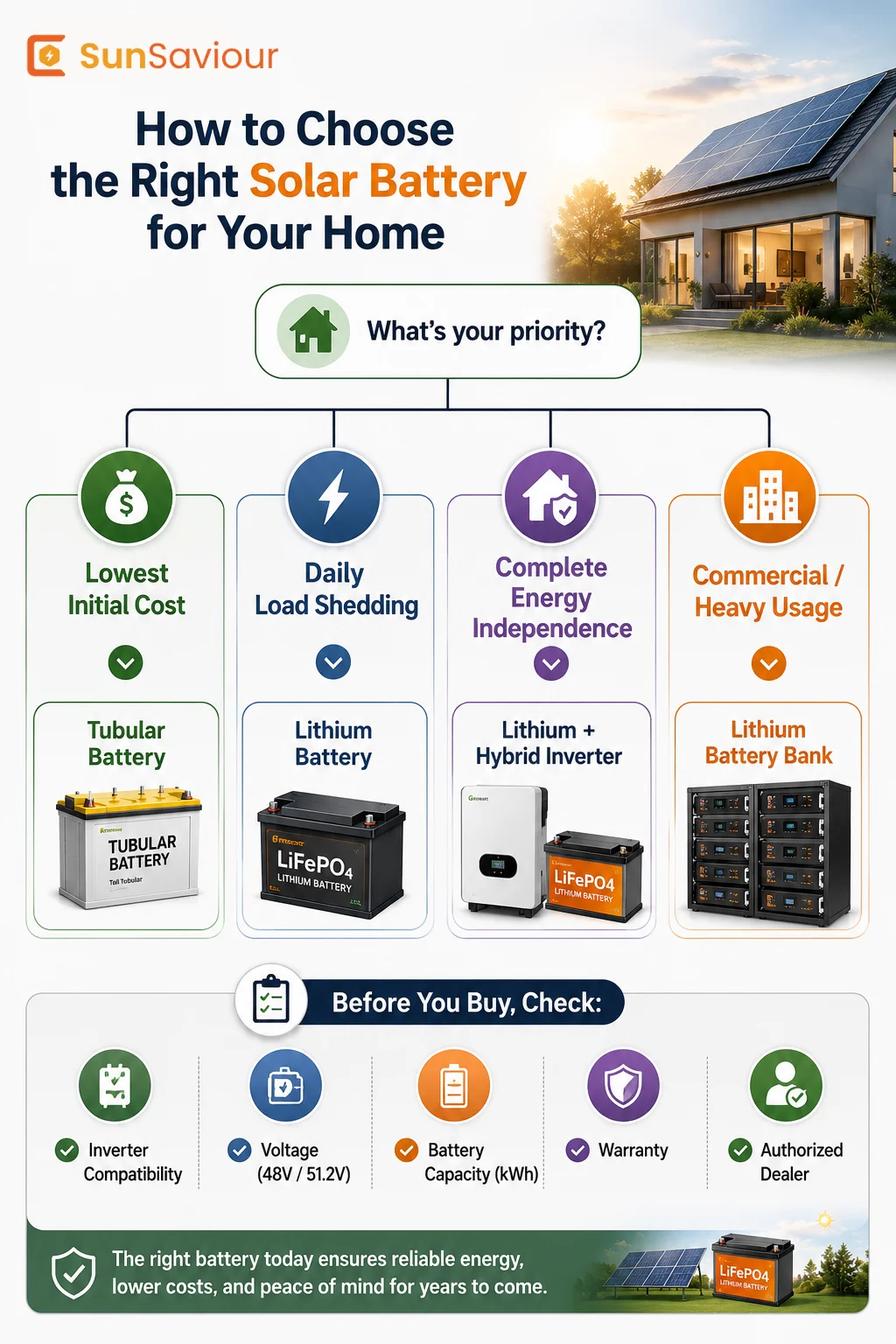
Key Factors to Evaluate Before Buying
The best solar battery in pakistan for your situation depends on a few practical checks rather than brand reputation alone:
- Inverter compatibility: lithium batteries need a BMS that communicates with your inverter, usually via CAN or RS485. Confirm this before buying.
- Voltage matching: a 48V inverter generally needs a matching 48V (or 51.2V) battery bank.
- Capacity in kWh, not just Ah: Ah ratings alone don’t account for voltage differences between products.
- Warranty and authorized dealer status: counterfeit batteries are a known problem in Pakistan’s market.
- Ventilation needs: lead-acid types need airflow and periodic water top-ups; lithium and sealed types do not.
Matching Battery Capacity to Your Home or Business Load
For a typical home running fans, lights, and a refrigerator through several hours of load shedding, a mid-capacity lithium battery (commonly a 48V or 51.2V, 100Ah unit) is the standard recommendation from Pakistani installers. Homes wanting full energy independence pakistan solar coverage, including running an air conditioner overnight, generally need a larger bank or multiple units in parallel, sized against actual daily consumption rather than a generic rule of thumb. For an off grid solar battery system specifically, the bank must cover the full daily load cycle, not just outage hours, since there is no grid to fall back on.
Solar Battery Costs in Pakistan: What to Expect in 2026
Price Ranges Across Battery Types in the Local Market
Based on current 2026 market listings from multiple Pakistani solar retailers, here is the realistic solar battery price in pakistan picture by type:
Battery Type | Typical Capacity | Approximate Price Range (PKR) |
AGM | Small/automotive-style units | A few thousand up to tens of thousands |
Tubular | 150 to 280 Ah | Roughly 35,000 to 90,000 |
Gel | Varies by capacity | Generally priced above comparable AGM |
Lithium (LiFePO4) | 48V/51.2V, 100Ah (around 5kWh) | Roughly 180,000 to 310,000 |
These figures vary by brand, warranty length, BMS quality, and dealer, so always confirm current pricing before purchasing. Lithium pricing has trended downward as more brands enter the market, while tubular pricing has stayed relatively stable.
How to Get the Best Value Without Compromising on Quality
The best solar battery in pakistan for your budget is rarely the cheapest unit on the shelf. A genuine, authorized-dealer battery with a documented warranty protects against the counterfeit stock that circulates in Pakistan’s market, and correct sizing does more to reduce electricity bill solar battery costs over time than chasing the lowest sticker price. For a strict budget, a quality tubular battery remains reasonable. For daily-cycling hybrid setups, lithium battery advantages in deep discharge and lifespan generally justify the higher upfront cost.
SunSaviour’s Lithium Battery Series is designed to pair directly with their hybrid inverter range for fully integrated solar storage in Pakistan. Explore SunSaviour battery options at sunsaviour.com
The Right Solar Battery in Pakistan Is the One That Fits Your Load, Budget and Goals
There is no single best solar battery in pakistan that works for every household. The right choice depends on your daily load, your budget, your inverter’s compatibility, and how much backup time you actually need during load shedding.
What is consistent across every scenario is this: why use solar battery in pakistan comes down to closing the gap between when solar generates and when you actually need power. Whether that means a budget tubular battery or a fully integrated lithium system, matching the battery to your real consumption is what determines whether your investment pays off.
SunSaviour offers hybrid inverters and lithium battery storage solutions backed by a nationwide network of 59+ sales points and 28 service centres across Pakistan. Visit sunsaviour.com to find the right battery and inverter combination for your home or business.
Frequently Asked Questions
What is the best battery type for a solar system in Pakistan?
It depends on budget and usage pattern. Lithium batteries offer deeper discharge, less maintenance, and better heat tolerance for daily cycling. Tubular batteries remain a reasonable lower-cost option for buyers with a tighter budget.
How much does a solar battery cost in Pakistan in 2026?
Tubular batteries generally range from roughly PKR 35,000 to 90,000 depending on capacity and brand. Lithium batteries for a typical 48V/51.2V 100Ah home setup generally range from roughly PKR 180,000 to 310,000 depending on brand, warranty, and BMS quality. Always confirm current pricing with an authorized dealer.
Are AGM or gel batteries good for solar systems in Pakistan?
They are used in the market, but most installers do not recommend them as a primary solar storage choice in Pakistan’s climate, since they tolerate deep discharge and heat less well than tubular batteries at comparable price points.
Can a lithium battery work with my existing solar inverter?
Most modern hybrid inverters support lithium batteries, but compatibility depends on whether the inverter can communicate with the battery’s BMS, typically through a CAN or RS485 connection. Check your specific inverter’s documentation or consult your installer before buying.
Is an off-grid solar battery system practical for a typical Pakistani home?
Yes, particularly in areas with limited or unreliable grid access. For most urban homes, however, a hybrid system combining grid connection with battery backup is more cost-effective than going fully off-grid.