Why AI Is Becoming Essential in Modern Solar Systems
A solar power system without intelligence is a passive one. Panels generate what the sun allows, batteries charge and discharge on fixed schedules, and any fault sits undetected until output drops or equipment fails.
AI in solar energy changes that entirely. Modern AI-powered systems monitor thousands of data points per second, adjust energy flow in real time, predict faults before they occur, and optimise every component based on actual conditions rather than factory presets.
This article explains exactly how AI in PV and storage systems works, what components enable it, and why it matters for system owners who want maximum output, minimum downtime, and longer equipment life.
What Does AI Actually Do in a Solar System?
AI in a solar system performs one core function: it converts raw data into decisions that improve energy output, reduce waste, and extend system lifespan.
Traditional solar systems follow static rules. An AI-enabled system learns from patterns, adapts to changing conditions, and continuously improves its own decisions over time. Solar energy optimization through AI is not a single feature. It is a continuous feedback loop running across every component simultaneously.
From Data Collection to Smart Decision-Making
IoT in solar systems is the foundation layer. Sensors embedded in panels, inverters, batteries, and meters collect real-time data including voltage, current, temperature, irradiance, state of charge, and grid frequency.
A solar monitoring system aggregates this data and feeds it into machine learning models. Those models identify patterns that human operators would never detect manually, such as a gradual efficiency drop in a specific panel string caused by microscopic cell degradation, or a battery cell drifting out of balance before it causes a measurable capacity loss.
The AI then acts on those patterns automatically, adjusting inverter settings, shifting battery charge cycles, or issuing fault alerts without waiting for manual intervention.
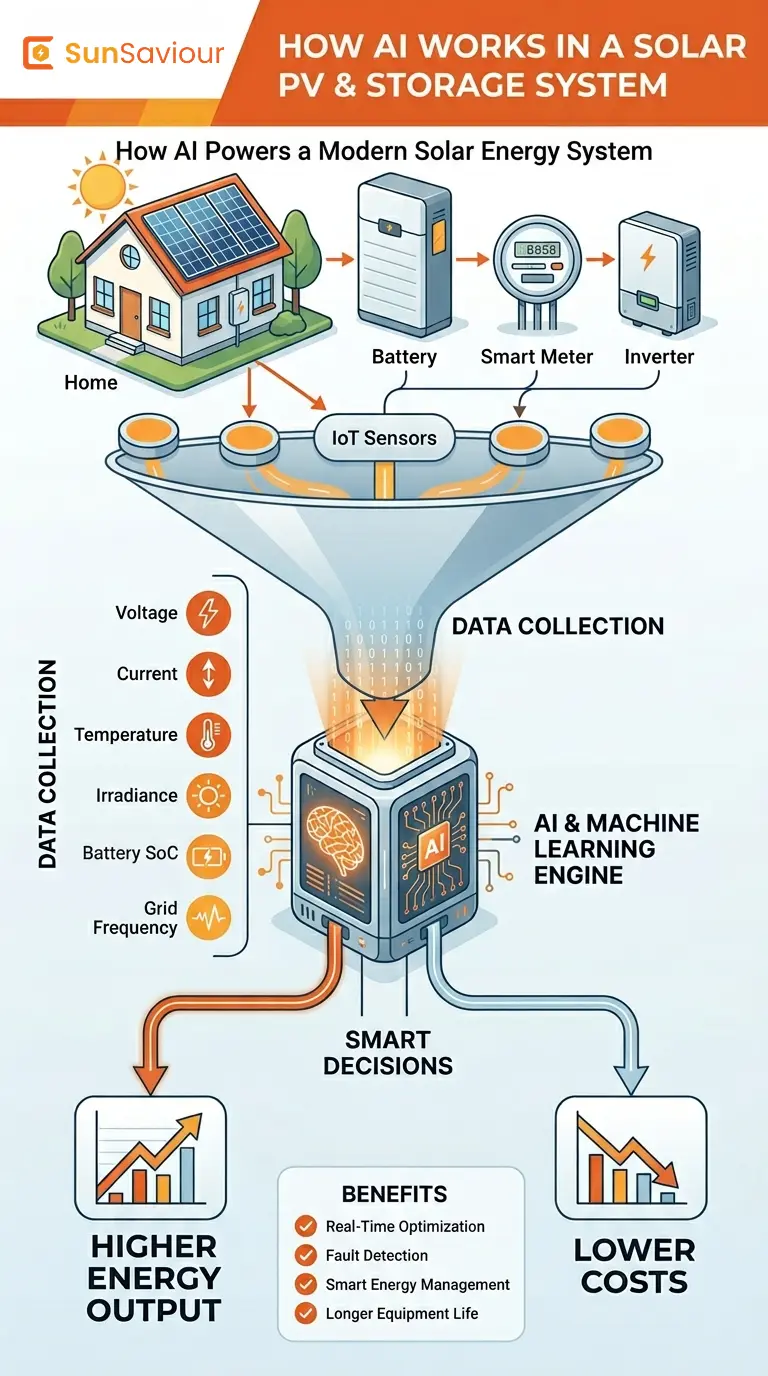
How AI Processes Real-Time Energy Data
Energy management systems powered by AI process data across three time horizons simultaneously:
- Real-time (milliseconds to seconds): Voltage regulation, MPPT adjustment, frequency response.
- Short-term (minutes to hours): Load forecasting, battery dispatch scheduling, grid export decisions.
- Long-term (days to weeks): Degradation trend analysis, maintenance scheduling, seasonal performance modelling.
This multi-horizon processing is what separates AI-driven energy management from conventional timer-based or threshold-based control systems. The result is measurably better solar system reliability and significantly higher energy yield across the system’s lifetime.
Smart Inverters: The Brain of an AI-Powered Solar Setup
A smart solar inverter does more than convert DC to AC. It serves as the central processor of an AI-enabled solar system, managing energy flow, communicating with the grid, and continuously optimising output based on real-time conditions.
What Makes an Inverter “Smart”?
A conventional inverter follows fixed conversion parameters. A smart solar inverter integrates several capabilities that a standard unit does not have:
- Bidirectional communication with the grid and energy management system.
- Onboard processing to run MPPT algorithms and fault diagnostics.
- Remote firmware updates that improve performance after installation.
- Data logging and cloud connectivity for performance analytics.
- Dynamic reactive power control for grid stability compliance.
In AI in PV and storage systems, the smart inverter is the execution layer. The AI sends decisions; the inverter carries them out across the DC and AC sides of the system in milliseconds.
A hybrid solar inverter extends this further by managing panels, battery storage, and grid connection simultaneously from a single unit. For systems with storage, a hybrid inverter is not optional. It is the integration point where AI-driven energy management becomes physically possible.
SunSaviour’s ALPHA Series, V-Series, X-Series, and X-Plus hybrid inverters are built for exactly this role. Explore the SunSaviour hybrid inverter range to find the right fit for your system size and load profile.
MPPT and AI: Maximizing Every Watt of Solar Output
Maximum power point tracking (MPPT) is the algorithm that keeps panels operating at their optimal voltage-current combination regardless of changing light and temperature conditions.
A conventional MPPT solar inverter runs a fixed perturb-and-observe algorithm. It incrementally adjusts the operating point and measures whether power increased or decreased. Effective under stable conditions, but slow to respond to rapid changes like cloud edges or partial shading.
AI-enhanced MPPT replaces the fixed algorithm with a predictive model. Using irradiance sensors, historical patterns, and weather forecast data, the AI anticipates changes before they happen and pre-positions the operating point rather than reacting after the fact.
In field studies comparing conventional and AI-enhanced MPPT under partially shaded conditions, AI-driven systems recovered 5 to 12% more energy during periods of variable irradiance. For a 10kW system in a dust-prone or partially shaded installation, that translates to a meaningful reduction in payback period.
AI-Driven Energy Storage: Getting More From Your Batteries
Battery storage systems are the most expensive component in any solar installation. They are also the component most sensitive to how they are managed. AI turns battery management from a fixed schedule into a continuously optimised strategy.
How AI Decides When to Store and When to Discharge
Energy storage optimization through AI involves three inputs: current state of charge, forecast energy generation, and forecast energy demand.
A rule-based system might discharge batteries whenever grid power becomes unavailable. An AI-driven energy management system makes more nuanced decisions:
- If tomorrow’s forecast shows 6 peak sun hours, it may allow deeper discharge tonight because it knows the battery will be fully recharged.
- If grid tariffs are time-of-use, it discharges during expensive hours and recharges during cheap hours.
- If a storm is forecast, it charges the battery fully in advance regardless of standard cycling rules.
This type of decision-making is not possible with static charge controllers. It requires a system that continuously learns the relationship between forecasted conditions and actual outcomes.
Reducing Battery Wear Through Intelligent Charge Management
Battery degradation is primarily driven by three factors: depth of discharge, charge rate, and operating temperature. AI-driven battery management systems monitor all three continuously and adjust charge parameters to minimise cumulative stress.
Specifically, the AI tracks:
- Cell-level voltage deviation to detect imbalance before it causes capacity loss.
- Temperature gradients across the battery bank to prevent hotspot formation.
- State-of-health metrics over time to project remaining useful life.
In lithium iron phosphate (LiFePO4) battery deployments managed by AI, cycle life improvements of 15 to 30% have been reported compared to fixed-parameter charge management. For a battery bank costing PKR 5,00,000 or more, that improvement in solar system reliability has a direct financial value.
SunSaviour’s Lithium Battery Series is designed to pair with their hybrid inverter range for fully integrated, AI-ready storage. View SunSaviour lithium battery options to see compatible configurations.
Predictive Maintenance and Fault Detection in PV Systems
Reactive maintenance means you discover a problem after it has already cost you energy or damaged equipment. Predictive maintenance solar systems powered by AI shift that entirely, identifying anomalies at the component level before they become failures.
How AI Detects Problems Before They Become Failures
Solar fault detection AI analyses performance data against expected output models to identify deviations that indicate developing faults. Common detectable conditions include:
- Hotspot formation: Individual cells operating at higher temperatures than their neighbours, often caused by partial shading, contamination, or cell defects. Detectable through thermal baseline deviation before visible damage occurs.
- Bypass diode failure: A shaded or failed bypass diode causes an entire string section to underperform. AI detects this through string-level current imbalance.
- Soiling loss quantification: AI separates weather-related output reduction from cleaning-related losses, generating automatic cleaning alerts when soiling losses exceed a defined threshold.
- Inverter degradation: Gradual efficiency reduction in power conversion components that precedes full inverter failure by weeks or months.
Early fault detection in PV systems typically prevents losses ranging from 3 to 8% of annual yield for residential installations, and up to 12% for large commercial arrays where manual inspection intervals are longer.
Remote Monitoring: Keeping an Eye on Performance 24/7
A solar monitoring system with AI capabilities provides continuous oversight without physical presence. Modern platforms provide:
- Real-time performance dashboards accessible via mobile or web interface.
- Automated alerts for deviations from expected output thresholds.
- String-level and panel-level diagnostics in systems with module-level electronics.
- Historical trend analysis for solar energy efficiency optimization over time.
In Pakistan’s context, where certified service technicians may not be available in all regions, remote monitoring with AI-powered diagnostics significantly reduces the technical expertise required to maintain a high-performing system over its 25-year lifespan.
SunSaviour supports installed systems through a nationwide network of 59+ sales points and 28 service centres across Pakistan. Find your nearest SunSaviour location to discuss monitoring, maintenance, and after-sales support options.
Smart Grid Integration and Energy Management
As solar penetration increases across Pakistan’s grid, the relationship between individual solar systems and the utility becomes more complex. AI is what makes that relationship manageable at scale.
How AI Balances Solar Output With Grid Demand
Smart grid solar integration through AI allows individual solar systems to respond to grid conditions in real time. Rather than simply injecting power whenever it is available, AI-enabled systems:
- Modulate export based on grid voltage and frequency signals.
- Participate in demand response programs by shifting controllable loads.
- Provide reactive power support to stabilise local feeder voltage.
- Curtail output automatically when grid conditions require it, avoiding penalties under NEPRA net metering regulations.
Solar energy optimization at the grid level requires this kind of two-way coordination. A static grid-tied inverter can only follow the grid. An AI-enabled inverter can actively support it, which is increasingly required as more distributed solar capacity connects to distribution feeders in urban Pakistan.
The Role of IoT in Connected Solar Systems
IoT in solar systems provides the communication infrastructure that makes AI-driven grid integration possible. Every smart component in the system, including the inverter, battery management system, smart meter, and load controllers, communicates through a shared data layer.
This connected architecture enables several capabilities that isolated components cannot achieve:
- Coordinated dispatch: The inverter, battery, and controllable loads respond as a single optimised unit rather than independent devices.
- Aggregated grid services: Multiple connected PV systems can be coordinated through a virtual power plant platform, contributing collectively to grid stability.
- Over-the-air updates: Algorithm improvements developed from fleet-wide performance data are pushed automatically to individual systems, improving performance without hardware changes.
IoT connectivity turns a solar installation from a fixed asset into an adaptive system that improves with scale and time.
The Future of Solar Is Smart: Is Your System Ready?
AI in PV and storage systems is not a future capability. It is available today in commercially deployed smart inverters, battery management platforms, and monitoring systems from brands operating in the Pakistani market.
The question for system owners is not whether AI-powered solar exists. It is whether their current installation can take advantage of it. A system with a conventional string inverter, no monitoring, and a fixed-parameter charge controller is leaving measurable yield and component life on the table.
For new installations, specifying a smart hybrid inverter, an IoT-connected monitoring system, and an AI-capable battery management system costs incrementally more at installation and returns that premium many times over through better solar system reliability, lower maintenance costs, and higher lifetime energy yield.
Solar energy optimization is no longer a function of hardware alone. The intelligence layer is now as important as the panels themselves.
If you are evaluating smart solar components in Pakistan, SunSaviour’s hybrid inverter and lithium battery range is a practical starting point. Explore SunSaviour products at sunsaviour.com or find your nearest location across SunSaviour’s 59+ sales points and 28 service centres nationwide.
Frequently Asked Questions
What is AI in solar PV systems?
AI in PV systems refers to machine learning algorithms and data processing systems that monitor, optimise, and manage solar panel output, inverter performance, battery storage, and grid interaction in real time.
Do smart inverters work with existing solar panels?
Yes. A smart solar inverter or hybrid solar inverter can be integrated into an existing PV system as an upgrade, provided the panel array specifications are compatible with the inverter’s input range.
How does AI improve battery life in solar systems?
AI-driven battery management continuously adjusts charge rate, depth of discharge, and thermal management based on real-time conditions and forecasted usage. This reduces cumulative cell stress and extends useful battery life by 15 to 30% compared to fixed-parameter charge controllers.
Is predictive maintenance available for residential solar systems?
Yes. Several monitoring platforms now offer AI-powered fault detection and predictive maintenance for residential PV systems, typically through a cloud-connected solar monitoring system that analyses performance data against expected output baselines.
Can AI help reduce electricity bills further?
Yes. AI-driven energy management systems optimise self-consumption, time battery discharge to peak tariff hours, and manage controllable loads to minimise grid import. In time-of-use tariff environments, this can reduce net electricity costs beyond what panel sizing alone achieves.