Most buyers spend the majority of their research time comparing solar panels. The inverter typically gets a few minutes of consideration, usually reduced to “which brand is popular.”
This is the wrong approach. Panels are passive components. They sit on the roof and convert sunlight into DC electricity with minimal variation in day-to-day behavior. The inverter is the active brain of the system. It determines how efficiently that DC power is converted for use in your home, how the battery is charged and discharged, how the system behaves during load shedding, and what data you can access about your system’s performance.
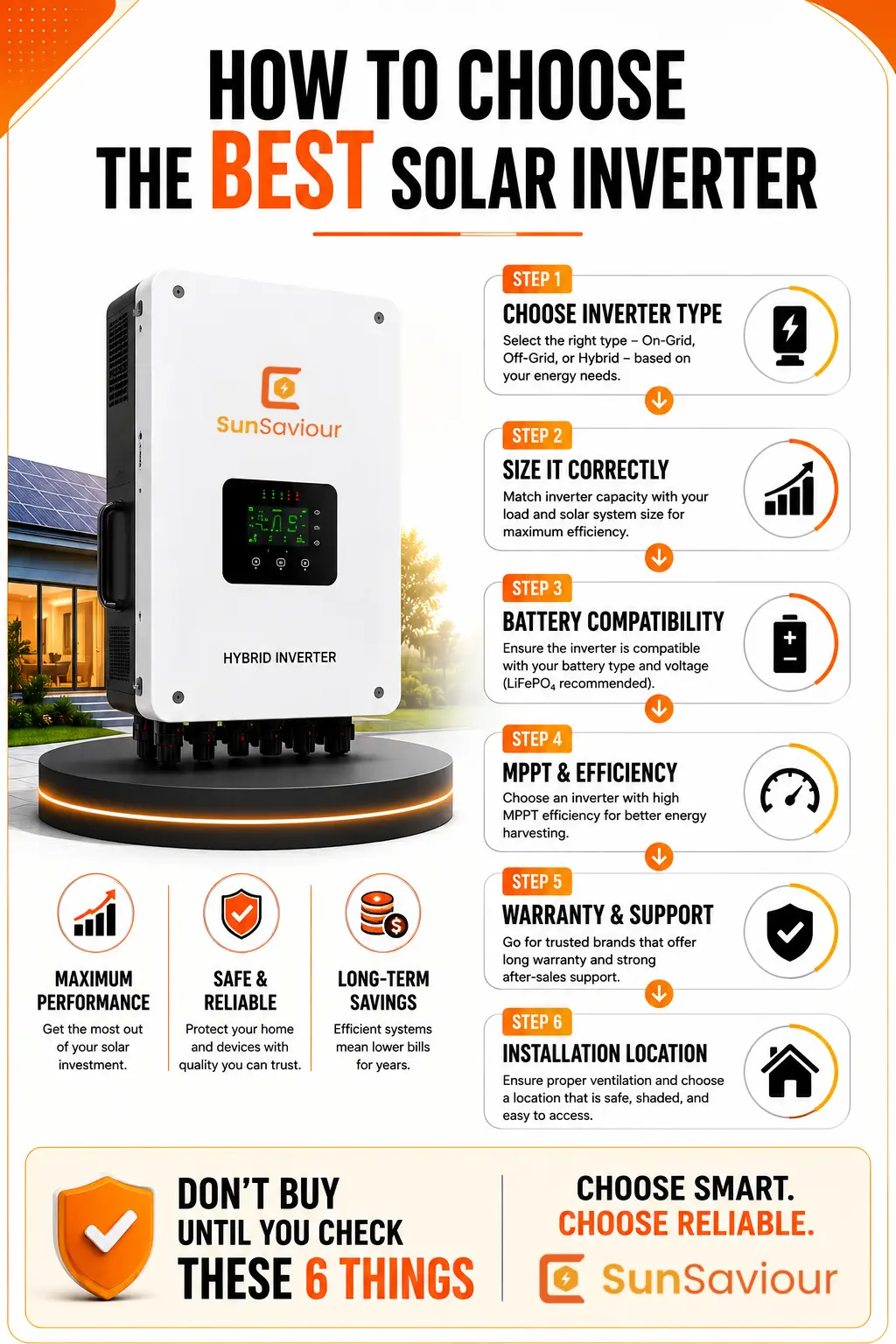
A poor inverter choice on good panels produces a poor system. A good inverter on average panels still produces a reliable, well-managed system. This guide explains how to choose the best solar inverter for a Pakistani home: the types available, solar inverter sizing, inverter load ratio, battery compatibility, heat management, and the questions to ask before buying.
The Types of Solar Inverters Available in Pakistan
Hybrid Solar Inverter
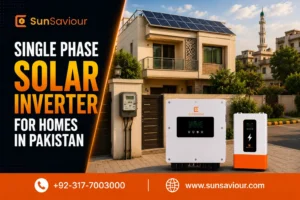
A hybrid solar inverter manages three energy sources simultaneously: solar panels, battery storage, and the utility grid. It decides in real time which source powers your loads and whether surplus generation should charge the battery or export to the grid.
For Pakistani homes with daily load shedding, a hybrid solar inverter is the most complete solution available. It provides backup power without a generator, maximizes self-consumption under the NEPRA 2026 net billing rules, and integrates battery storage for night use. This is why the hybrid solar inverter dominates the residential market in Pakistan today.
String Inverter (On-Grid Only)
A string inverter connects directly to the grid and converts solar DC to AC for immediate use or grid export. It has no battery management capability and shuts down automatically during grid outages as a safety requirement.
String inverters cost less upfront and suit buyers in areas with minimal load shedding who primarily want to reduce daytime electricity bills. Under NEPRA’s 2026 net billing framework where export rates are lower than import tariffs, on-grid string inverters without battery backup deliver reduced benefit compared to hybrid configurations.
Microinverters
Microinverters are small inverters mounted on each individual panel, converting DC to AC at the panel level. This eliminates the “weakest panel limits the string” problem that affects string inverters under partial shading. They are more expensive per watt but perform better on rooftops with shading from water tanks, parapets, or neighboring buildings.
Microinverters are a niche option in Pakistan’s current market. Most residential systems use string or hybrid configurations.
How to Size a Solar Inverter Correctly
Solar inverter sizing is one of the most commonly misunderstood steps in system design. The widespread assumption that the inverter capacity must exactly match the panel capacity is incorrect and leads to either undersized or unnecessarily expensive systems.
The DC to AC Ratio and Inverter Load Ratio (ILR)
The inverter load ratio (ILR), also called the DC to AC ratio, is the relationship between the total DC capacity of your solar panels and the AC output capacity of your inverter.
A ratio of 1.0 means a 5kW panel array connected to a 5kW inverter. This sounds logical but is actually not optimal. Solar panels almost never operate at their rated peak capacity in real conditions. Temperature reduces output, shading reduces output, and irradiance is only at its theoretical maximum for a fraction of the day. An inverter sized at 1.0 ratio sits at partial load the vast majority of operating hours.
Industry standard practice and verified modeling data show that a DC to AC ratio between 1.15 and 1.25 produces more annual energy than a 1.0 ratio. For a practical example: a 6kW panel array paired with a 5kW inverter gives a ratio of 1.2, which is within the recommended range.
What Is Inverter Clipping?
Inverter clipping occurs when the solar array generates more DC power than the inverter’s AC rating can process. The inverter caps its output at the AC limit and the excess energy is not harvested.
This sounds like a problem but is actually an accepted engineering trade-off. At a 1.25 DC to AC ratio, verified studies show annual clipping losses of only 1 to 3% of total production. The cost saving from using a smaller inverter across a 25-year system life comfortably exceeds the value of that 1 to 3% clipped energy. Inverter clipping at a well-chosen ratio is not a flaw; it is a deliberate and financially sound design decision.
Clipping becomes a genuine problem only above a ratio of approximately 1.4 to 1.5, where clipping losses during peak hours grow significant enough to erode the economic justification. For most Pakistani residential systems, staying between 1.15 and 1.3 delivers the best balance.
Solar Inverter Size Chart: A Practical Reference
Panel Capacity (DC) | Recommended Inverter Size (AC) | DC to AC Ratio |
3 kW | 2.5 kW | 1.20 |
5 kW | 4 to 4.2 kW | 1.19 to 1.25 |
6 kW | 5 kW | 1.20 |
8 kW | 6.5 to 7 kW | 1.14 to 1.23 |
10 kW | 8 to 8.5 kW | 1.18 to 1.25 |
15 kW | 12 to 13 kW | 1.15 to 1.25 |
These are indicative figures. Your specific system should be sized using a load calculation and a performance estimation tool based on your location’s irradiance data, not a generic table.
Key Selection Criteria for a Hybrid Solar Inverter
Efficiency Rating
Solar inverter efficiency refers to the percentage of DC input power successfully converted to AC output. Modern quality hybrid inverters achieve peak efficiencies above 97%. This sounds like a small difference, but at 98% versus 95% efficiency on a 10kW system generating 40 units per day, the gap adds up to meaningful energy losses over a year.
Ask for both peak efficiency and weighted efficiency (CEC or European weighted). Peak efficiency is the maximum achieved under ideal conditions. Weighted efficiency reflects real-world average performance across the full range of operating conditions and is the more relevant figure for everyday comparison.
Reliability Over Efficiency
Reliability matters more than efficiency differences between well-specified options. An inverter running at 97% efficiency that fails in year 3 costs far more in lost production and replacement than one running at 96.5% that operates for 12 years without issue.
Reliability factors to evaluate:
- Thermal management: Inverters generate heat during operation. A unit with active cooling (fan) handles high ambient temperatures better but introduces a moving part that can fail. Passive-cooled (fanless) inverters are simpler but may thermally derate more in sustained high-output conditions. In Pakistan’s summer climate where inverter locations can see 40 to 50°C ambient temperatures, thermal derating is a real performance factor.
- IP rating: Minimum IP65 for inverters in any location exposed to dust. Pakistan’s agricultural regions in particular see heavy dust loading that enters inadequately sealed units and causes premature failure.
- Track record in Pakistan’s climate: Voltage fluctuations, irregular grid frequency, and high ambient temperatures are normal operating conditions in Pakistan. An inverter well-proven in similar markets is more relevant than one optimized for temperate European conditions.
Battery Compatibility
If your system includes or will include battery storage, battery compatibility is a non-negotiable selection criterion. Key checks:
- Does the inverter support LiFePO4 battery chemistry via BMS communication (CAN or RS485 protocol)?
- What is the maximum battery charging current the inverter supports?
- Does the inverter support battery expansion (parallel battery connection)?
- What low-battery protection settings are available to prevent deep discharge damage?
A solar inverter with battery management that does not properly communicate with the battery’s BMS is a system waiting to fail prematurely. Verify compatibility at the model level, not just the brand level.
MPPT Inputs
Maximum Power Point Tracking (MPPT) is the algorithm that continuously adjusts the operating point of the solar array to extract maximum power under changing conditions. For residential rooftops with panels on multiple orientations or with partial shading:
- Dual MPPT inputs allow two independent strings to be optimized separately. If your east-facing and west-facing panels are on the same MPPT input, the weaker string limits the stronger one’s production.
- The number of MPPT inputs and the voltage and current limits per input determine what panel configurations the inverter can accommodate.
How to Select the Right Inverter for Your Home: A Checklist
Use these questions when evaluating any hybrid solar inverter option:
- What is the DC to AC ratio when paired with my proposed panel capacity?
- What is the weighted efficiency rating?
- Does it support LiFePO4 BMS communication for battery storage?
- How many MPPT inputs does it have, and does that match my roof layout?
- What is the IP rating and passive or active cooling configuration?
- What is the warranty period and who handles claims locally in Pakistan?
- Does the manufacturer have a local technical support presence?
- Is remote monitoring included and accessible via mobile?
The Warranty Trap: What Most Buyers Miss
Most buyers ask “what is the warranty?” and accept the answer without deeper evaluation. The more useful questions are:
Who enforces the warranty in Pakistan? A 10-year warranty backed only by a factory in another country provides no practical protection when the inverter faults in year 4. Confirm there is a local entity that can process the claim, provide a replacement unit, and do so within a timeframe that does not leave your system offline for weeks.
What does the warranty exclude? Read the exclusions. Most inverter warranties exclude damage from voltage spikes, lightning, improper installation, and use outside specified temperature ranges. In Pakistan’s grid environment, voltage spikes and irregular supply are routine. Confirm whether surge protection is built in and whether the warranty covers damage from grid anomalies.
Is the product genuine? Counterfeit inverters with premium brand markings are a documented issue in Pakistan’s market. Purchase only from authorized distributors who can provide original manufacturer documentation and serial number verification.
Heat, Location, and Long-Term Performance
The location of your inverter installation directly affects its lifespan and output. This factor is consistently underweighted in inverter buying guides.
Avoid direct sunlight. An inverter in direct sun on a south-facing wall in Pakistan’s summer is operating in a significantly higher ambient temperature than its ratings assume. Most inverters specify performance at 25°C ambient. Rooftop locations in direct sun can reach 55 to 65°C in June and July, triggering thermal derating that reduces AC output automatically.
Avoid enclosed spaces without airflow. Battery rooms and utility cupboards without ventilation trap heat generated by both the inverter and the battery bank, accelerating degradation of both.
Ideal location: A north-facing wall in a shaded covered area with natural airflow, away from direct weather exposure. If an outdoor wall-mount is unavoidable, an IP65 or higher rated unit with shading from a simple canopy makes a meaningful difference to long-term reliability.
Which Solar Inverter Is Best for Home Use in Pakistan?
The best inverter for solar system use in a Pakistani home depends on three factors: load-shedding exposure, battery plans, and system size.
For homes with 4 or more hours of daily load shedding: A hybrid solar inverter with LiFePO4 battery storage is the correct choice. The inverter should support seamless switching to battery backup within 10 to 20 milliseconds.
For homes with minimal load shedding who primarily want bill reduction: An on-grid string inverter is viable and lower cost. Under NEPRA’s 2026 net billing rules, self-consumption is now more valuable than export, so a battery-less system is only optimal if daytime consumption is high relative to system output.
For systems above 10kW: Confirm whether your grid connection is single-phase or three-phase. Single-phase inverters above 10kW face utility export cap constraints in most Pakistani DISCO areas. Above 10kW on a three-phase supply, a three-phase hybrid inverter is the appropriate configuration.
For buyers comparing options, SunSaviour’s nationwide network of 59+ sales points and 28 service centres across Pakistan means product consultation and after-sales support are accessible regardless of location.
SunSaviour’s hybrid solar inverter range, including the ALPHA Series, V-Series, X-Series, and X-Plus, is designed for Pakistani residential and commercial conditions with LiFePO4 battery compatibility and remote monitoring support. Explore SunSaviour inverter options at sunsaviour.com
Solar Inverters Price List: What to Expect in Pakistan in 2026
Inverter pricing in Pakistan varies significantly by capacity, type, brand tier, and warranty terms. The following are indicative 2026 market ranges based on locally available products:
Inverter Type | Capacity | Approx. Price Range (PKR) |
On-Grid String Inverter | 3 to 5 kW | 50,000 to 120,000 |
Single-Phase Hybrid | 3 to 5 kW | 120,000 to 250,000 |
Single-Phase Hybrid | 6 to 10 kW | 220,000 to 450,000 |
Three-Phase Hybrid | 10 to 15 kW | 450,000 to 750,000 |
Three-Phase Hybrid | 20 to 30 kW | 700,000 to 1,200,000 |
These ranges reflect genuine branded products purchased from authorized dealers. Prices significantly below these ranges for equivalent-capacity units from claimed name brands should be verified carefully for authenticity.
Pre-Purchase Checklist
Before finalizing any inverter purchase:
- System load calculated and inverter capacity chosen at a DC to AC ratio between 1.15 and 1.25
- Weighted efficiency rating above 97% confirmed from manufacturer datasheet
- LiFePO4 BMS communication confirmed if battery is part of the system
- Number of MPPT inputs matches your roof layout and panel string configuration
- IP rating confirmed at IP65 or above for Pakistan’s dust conditions
- Warranty confirmed with local support entity identified by name and contact
- Product serial number verifiable through manufacturer’s official database
- Installation location chosen to minimize heat exposure
Frequently Asked Questions
How do I choose the right inverter for my home solar system?
Start with your daily energy load to determine the panel capacity you need. Size the inverter at a DC to AC ratio of 1.15 to 1.25 relative to panel capacity. Then confirm battery compatibility, MPPT inputs for your roof layout, IP rating, and local warranty support before finalizing.
What size solar inverter do I need for my home?
Divide your total panel capacity (kW) by 1.20 to find the recommended inverter AC rating. A 6kW panel array needs approximately a 5kW inverter. A 10kW array needs approximately an 8 to 8.5kW inverter.
What is inverter clipping and is it a problem?
Inverter clipping occurs when panel output exceeds the inverter’s AC rating and the excess is not harvested. At a standard 1.20 to 1.25 DC to AC ratio, annual clipping losses are 1 to 3% of production, which is economically acceptable and outweighed by the savings from using a correctly sized rather than oversized inverter.
Which solar inverter is best for home use in Pakistan?
A hybrid solar inverter with LiFePO4 battery compatibility is the most complete choice for Pakistani homes with regular load shedding. It provides backup power, maximizes self-consumption, and manages battery storage in a single unit.
Can I upgrade from a string inverter to a hybrid inverter later?
Yes, in most cases a string inverter can be replaced with a hybrid inverter later. However, the hybrid inverter will need to be compatible with your existing panel string voltages and current ratings. Planning for a hybrid inverter from the start avoids the cost of an unnecessary replacement and ensures the electrical design accommodates battery wiring from day one.
How does heat affect solar inverter performance in Pakistan?
Most inverters are rated for peak performance at 25°C ambient. Above 40°C, many models begin to thermally derate, reducing AC output automatically to protect internal components. In Pakistani summers where wall-mounted inverters in direct sun can reach 50 to 60°C, proper installation location can meaningfully improve both performance and inverter lifespan.
What is the typical lifespan of a solar inverter?
A quality solar inverter typically lasts 10 to 15 years under normal operating conditions. In Pakistan’s high-temperature, high-dust environment, inverters installed in direct sun without adequate ventilation can fail earlier. Proper installation location and an IP65 or higher rating extend operational life.
Is a hybrid solar inverter worth it over a string inverter?
For Pakistani homes experiencing 4 or more hours of daily load shedding, yes. The backup power capability alone justifies the cost premium over an on-grid string inverter. Under NEPRA’s 2026 net billing rules where export value is lower than self-consumption value, battery storage paired with a hybrid inverter also improves the financial return from the overall solar investment.