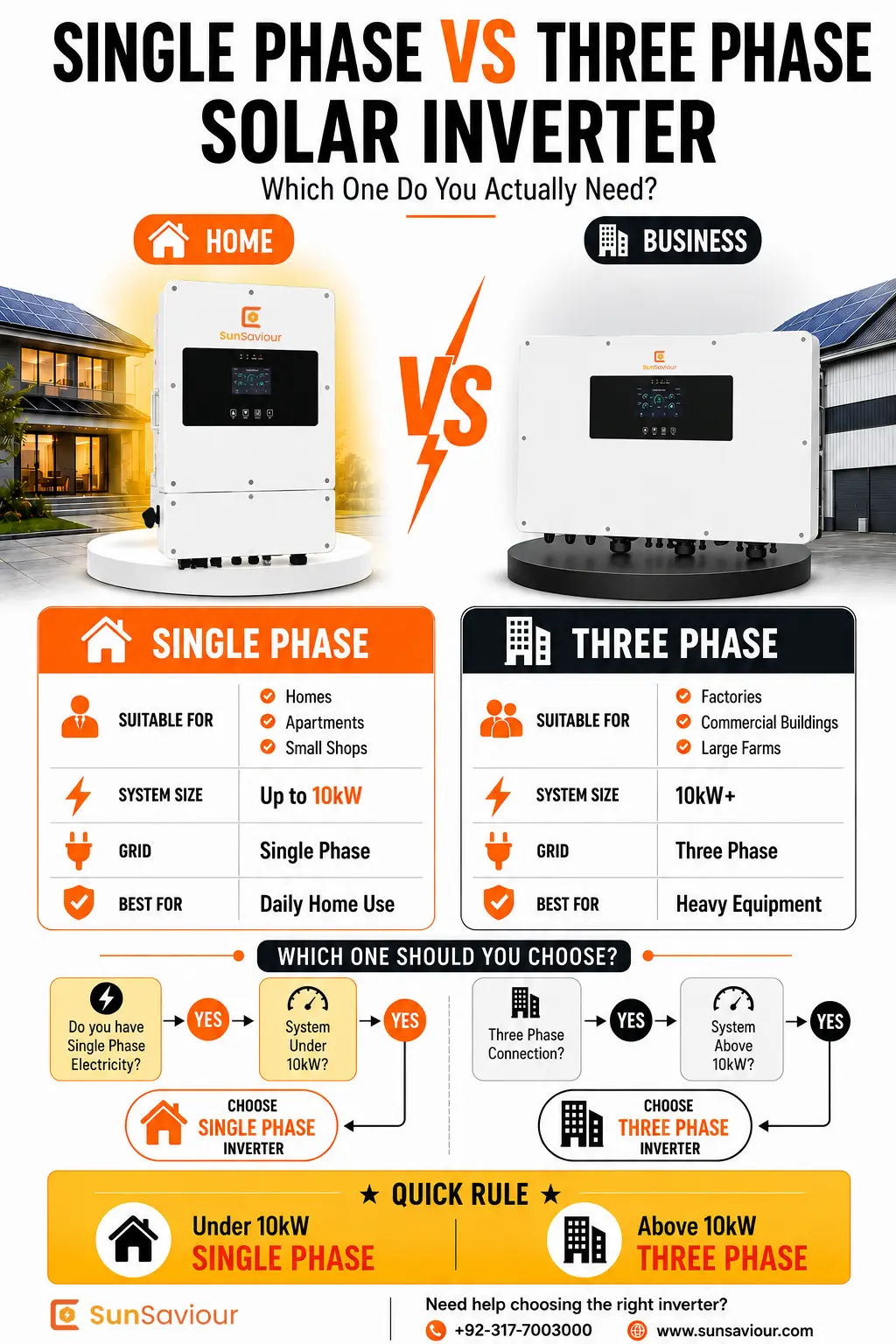
If your solar system is under 10kW and your property has a standard home connection, a single-phase solar inverter is almost certainly the right choice. If you have a three-phase grid connection, run heavy motors or industrial equipment, or your system exceeds 10kW, you need a three-phase hybrid inverter or three-phase string inverter.
That is the practical summary. Everything below explains why, so you can apply it confidently to your specific situation rather than just take the rule on faith.
What Is the Technical Difference Between Single Phase and Three Phase?
Waveforms and Voltage Delivery
A single-phase string inverter outputs one alternating current waveform at 220 to 240 volts. The voltage in a single-phase system rises and falls in a smooth sine wave, touching zero 100 times per second. For household appliances, this is perfectly adequate.
A three-phase hybrid inverter produces three AC waveforms spaced 120 degrees apart from each other, at 380 to 415 volts line-to-line. Because the three phases take turns peaking, the combined power delivery is nearly constant with no zero-crossing gaps. This makes three-phase power significantly better suited to motors, pumps, and high-draw equipment that rely on consistent voltage to run smoothly.
How Inverters Convert Solar Energy to AC Power
Both inverter types perform the same core function: they take the direct current (DC) electricity generated by solar panels and convert it into alternating current (AC) that the building’s electrical system can use. This conversion happens through DC-AC power stages using a technique called Pulse Width Modulation (PWM), which generates a clean sine wave output from the DC input.
Maximum Power Point Tracking (MPPT) is the algorithm running inside every modern solar inverter that continuously adjusts the operating point of the solar array to extract the maximum available power under changing light and temperature conditions. Higher-quality inverters use dual or multiple MPPT inputs, allowing strings of panels on different roof orientations or with different shading profiles to be optimized independently.
Solar inverter efficiency for modern units from established manufacturers typically exceeds 97% at peak conversion, meaning very little of the energy your panels generate is lost in the conversion process. This figure is broadly similar between single-phase and three-phase units at equivalent quality tiers.
The Case for Single Phase Solar Inverters
Who Should Choose Single Phase
Single-phase solar inverters are the standard choice for:
- Homes and apartments on a standard residential electrical connection
- Small shops and offices with a single-phase supply from the grid
- Systems up to 10kW in total panel capacity
- Properties where solar system capacity does not require grid export above the utility’s per-phase cap
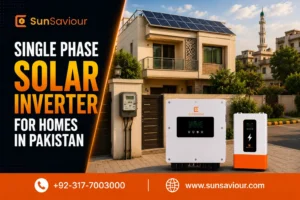
In Pakistan’s residential market, the overwhelming majority of properties have a single-phase WAPDA connection. For these households, a single-phase hybrid inverter with battery backup systems is the correct and most cost-effective configuration.
Key Advantages
Lower upfront cost: Single-phase inverters have simpler internal electronics with fewer power stages, making them less expensive to manufacture and purchase. For systems under 10kW, this cost advantage is real and meaningful.
Installation simplicity: Most single-phase hybrid models are compact and lightweight, some under 5kg, and wall-mounted with straightforward wiring. They connect to a standard single-phase distribution board without modifications.
Residential compatibility: A single-phase inverter matches the grid connection type present in most Pakistani homes. Installing a three-phase inverter on a single-phase supply is not possible without a full grid upgrade from PESCO, LESCO, or the relevant DISCO.
Whole-home backup capability: Modern high-powered single-phase hybrid inverters with LiFePO4 battery compatibility provide seamless backup during load shedding, typically switching within 10 milliseconds so most appliances and computers remain uninterrupted.
Known Limitations
Utility export caps: Many electricity utilities limit the solar export allowed on a single phase to approximately 5kW. For a household with a 10kW panel array, this means surplus generation above 5kW cannot be exported during peak production hours, reducing the financial return from net billing. In Pakistan’s context under NEPRA Prosumer Regulations 2026, understanding your DISCO’s specific per-phase export limit is important before sizing a large single-phase system.
Voltage rise on weak grids: Large single-phase systems on distribution feeders with many solar connections can cause local voltage to rise above acceptable limits, triggering active protective shutdown from the inverter. This is more relevant in dense suburban areas with high solar penetration.
Higher current per line: All the power flows through one cable, requiring thicker, more expensive wiring than an equivalent three-phase system where the current is distributed across three conductors.
The Case for Three Phase Solar Inverters
Who Should Choose Three Phase
Three-phase hybrid inverters and three-phase string inverters are the correct choice for:
- Properties with a three-phase grid connection (most commercial premises, factories, large agricultural setups)
- Systems above 10kW in panel capacity
- Any site running three-phase motors, irrigation pumps, industrial air conditioners, or heavy machinery
- Commercial and industrial (C&I) solar projects where balanced grid export and voltage stability are regulatory requirements
In Pakistan’s commercial context, factories, hospitals, large offices, cold storage facilities, and agricultural pump installations almost universally operate on three-phase supply. Installing a single-phase inverter at such a site is not simply suboptimal. It is technically incompatible with the motor and equipment loads present.
Key Advantages
Balanced grid export: Three-phase inverters spread solar generation evenly across all three phases, preventing the voltage rise and phase balance rules compliance issues that large single-phase systems can cause. Utilities generally accommodate three-phase solar exports more readily for this reason.
Support for inductive loads: Three-phase motors and pumps require three-phase power to start and run correctly. A three-phase inverter with appropriate unbalanced-output rating can supply backup power across all three phases even when backup loads are not perfectly balanced between them.
Lower current per line: At the same total power output, a three-phase system carries one-third of the current per conductor compared to single-phase. This reduces cable losses in large systems and allows thinner, less expensive cabling over long cable runs in industrial installations.
Scalability to large system sizes: Three-phase inverter platforms scale from 10kW to megawatt-level installations. A three-phase string inverter for a large commercial rooftop or industrial site provides the architecture for expanding system capacity without replacing core components.
Known Limitations
Higher upfront cost: Three-phase inverters cost more than single-phase units of equivalent capacity. For systems under 10kW, this cost premium is rarely justified unless the property already has a three-phase supply.
Professional installation required: Three-phase wiring, connection to a three-phase distribution board, and compliance with grid protection requirements are not DIY-friendly tasks. Certified electricians with three-phase experience are required.
Unnecessary for most homes: If the property only has a single-phase supply, a three-phase inverter cannot be installed without a full supply upgrade from the utility, which adds time and cost that rarely makes sense for standard residential systems.
Hybrid vs String Inverters: Adding Battery Storage
Single Phase Hybrid Solutions
A single-phase hybrid inverter integrates solar, battery, and grid management into one unit, making it the standard recommendation for Pakistani homes with load-shedding exposure. Key capabilities include:
- Seamless switching to battery backup during grid outages, typically within 10 milliseconds
- Compatibility with LiFePO4 battery banks for safe, deep-cycle overnight storage
- Self-consumption optimization: using solar first, then battery, then grid
- Net billing export management under NEPRA Prosumer Regulations 2026
For a household running fans, lights, a refrigerator, and a router through 6 to 8 hours of daily load shedding, a single-phase hybrid inverter with an appropriate battery bank is the most complete residential energy storage system available.
Three Phase Hybrid Capabilities
A three-phase hybrid inverter extends this capability to commercial sites. Features particularly relevant for Pakistani commercial and industrial (C&I) solar applications include:
- Unbalanced-output rating for backup across all three phases even when connected loads are not evenly distributed between phases
- Management of workshops and cold storage loads during grid outages
- Higher battery charging rates, allowing larger battery banks to recharge fully within the solar generation window
- Support for future EV charging infrastructure, which in commercial settings typically requires three-phase supply
Critical Decision Factors: A Direct Comparison
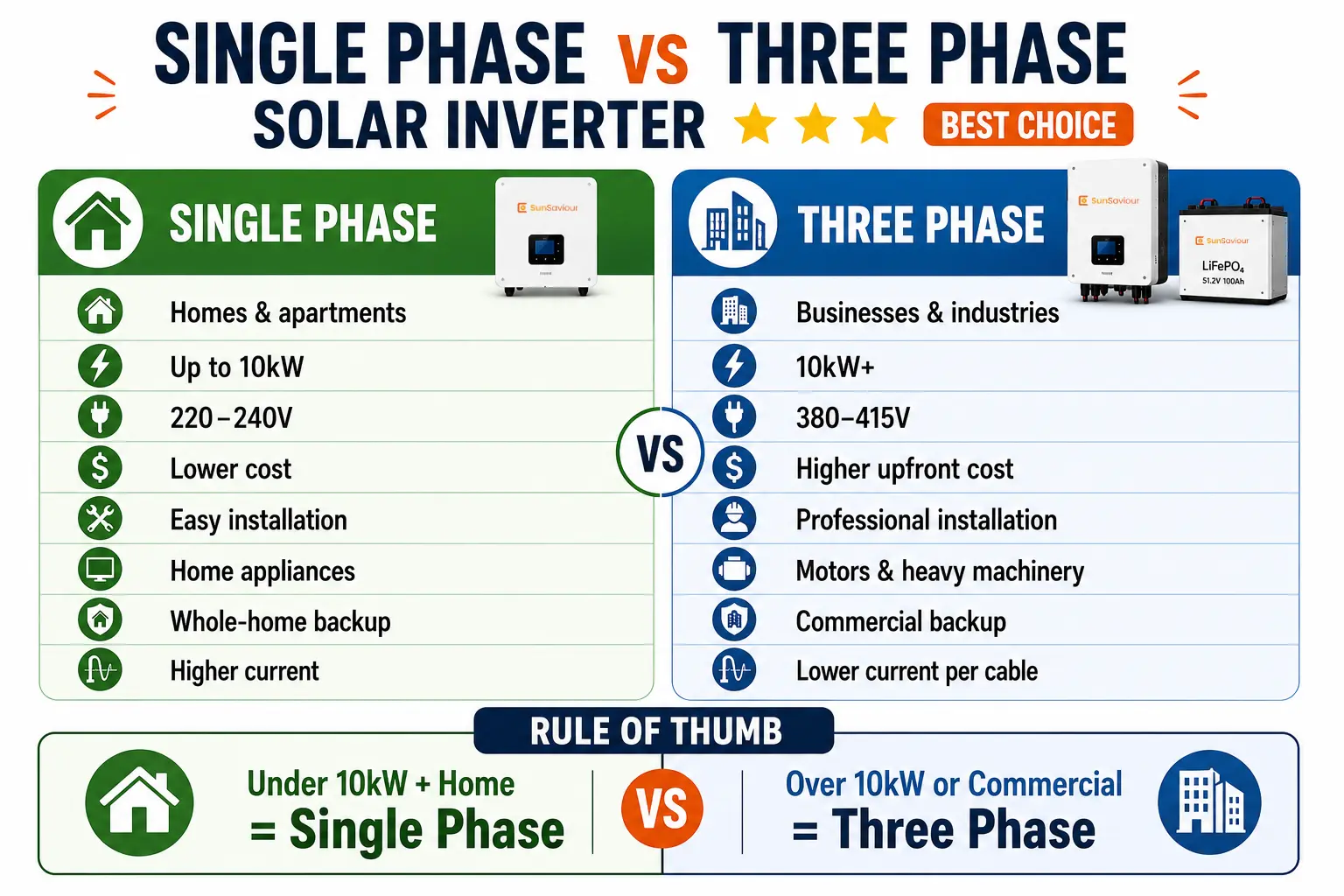
Factor | Single-Phase | Three-Phase |
Grid connection required | Single-phase service | Three-phase service |
Typical system size | 1kW to 10kW | 10kW to megawatt scale |
Utility export limits | Capped per phase, often around 5kW | Spread across 3 phases |
Load compatibility | Home appliances, small shops | Motors, pumps, heavy machinery |
Installation complexity | Simple, modular | Professional, 3-phase board required |
Upfront cost | Lower | Higher, but lower per kW at scale |
Backup capability | Whole-home storage solutions | C&I and workshop backup |
Cable requirements | Thicker cables for high current | Thinner cables at equivalent power |
A Step-by-Step Buyer Decision Framework
Use these five checks in order. The first check that gives you a definitive answer is your decision.
Step 1: Check your grid connection type: Your property’s grid supply is the primary deciding factor and cannot be overridden by preference. A three-phase hybrid inverter cannot be installed on a single-phase supply. A single-phase inverter can sit on one phase of a three-phase supply, subject to phase balance rules from your utility.
Step 2: Audit your loads: Do you run three-phase motors, irrigation pumps, industrial air conditioning, or other three-phase equipment? If yes, you need a three-phase inverter regardless of system size.
Step 3: Calculate your system capacity: Is your planned solar array above 10kW? Above this threshold, a three-phase configuration becomes the standard recommendation for electrical and grid compliance reasons, assuming your supply type supports it.
Step 4: Review your utility’s export rules: Confirm your DISCO’s per-phase export limit. If you plan a system that will generate more than the single-phase export cap allows, either size the system to match the cap or switch to three-phase where your supply permits it.
Step 5: Consider future expansion: If you plan to add an EV charger, scale up the panel array, or add industrial equipment within the next five years, factor the three-phase requirement into the current system design even if it is not strictly necessary today.
Safety, Monitoring, and Grid Compliance
MPPT performance determines how much energy your system actually harvests versus how much it theoretically could. Inverters with multiple MPPT inputs handle shading and mixed panel orientations significantly better than single-MPPT units.
AFCI 2.0 technology (Arc Fault Circuit Interrupter) detects arc faults in DC wiring within milliseconds, preventing the electrical fires that undetected arcing can cause. This is particularly important in residential settings where wiring routes through ceilings and walls.
Rapid shutdown capability allows the inverter to de-energize the solar array quickly in an emergency, a critical safety function for rooftop systems that firefighters or service personnel need to work around safely.
EMC filtering (electromagnetic compatibility) prevents the inverter’s switching electronics from causing magnetic interference with home electronics and appliances operating nearby.
Remote monitoring through platforms like iSolarCloud or equivalent apps allows system owners to track real-time generation, battery state of charge, grid export, and fault alerts from a mobile device without physical site visits.
SunSaviour’s single-phase hybrid inverter range, including the ALPHA Series, V-Series, X-Series, and X-Plus, is designed for Pakistani residential and commercial solar conditions. Explore SunSaviour inverter options at sunsaviour.com
Pre-Purchase Checklist
Before finalizing any inverter purchase, confirm these five points:
- Grid connection type identified: single-phase or three-phase supply confirmed with your DISCO bill
- Total system capacity calculated and compared against the 10kW threshold
- All significant loads audited for three-phase motor requirements
- DISCO per-phase export cap confirmed for your feeder
- Hybrid battery backup requirement assessed based on daily load-shedding hours and critical loads
Frequently Asked Questions
Can I install a three-phase inverter on a single-phase supply?
No. A three-phase inverter requires a three-phase grid connection to operate. Installing one on a single-phase supply would require upgrading the property’s grid connection through your DISCO, which involves an application process, infrastructure cost, and approval timeline.
Can a single-phase inverter work on a three-phase supply?
Yes. A single-phase inverter can be connected to one phase of a three-phase supply. However, you will need to comply with your utility’s phase balance rules, which may limit how much load you can put on one phase relative to the others.
At what system size should I switch to three-phase?
The practical crossover point is 10kW of solar panel capacity. Below this, single-phase is standard. Above it, three-phase becomes the preferred configuration for both electrical and grid compliance reasons.
Is a three-phase inverter more efficient than a single-phase one?
Peak conversion efficiency is broadly similar between equivalent quality units from both categories, typically above 97%. Three-phase systems are more electrically efficient at large scale because lower current per line reduces cable losses, and they avoid the voltage rise curtailment that can reduce single-phase output on weak grids.
Do three-phase inverters work during power cuts?
Standard grid-tie three-phase string inverters shut down during grid outages as a safety requirement. Three-phase hybrid inverters with battery storage continue supplying the site from batteries and solar generation during outages, making them the correct choice for sites requiring battery backup systems through load shedding.
Is three-phase the same as split-phase?
No. Split-phase (120/240V) is the standard in North America, using two live conductors at 120V each to deliver 240V for high-draw appliances. Three-phase (380 to 415V line-to-line) is a different system used for industrial applications and as the standard commercial supply in Pakistan and most of the world outside North America. Inverters designed for split-phase markets are not interchangeable with three-phase units.
Which inverter is right for a home in Pakistan?
For the vast majority of Pakistani households with standard WAPDA single-phase connections, a single-phase hybrid inverter with LiFePO4 battery storage is the correct choice. It matches the grid supply type, handles daily load shedding through battery backup, and is sized appropriately for residential panel capacities.
Which inverter is right for a business or commercial site in Pakistan?
Commercial premises, factories, hospitals, cold storage facilities, and agricultural pump installations in Pakistan almost universally operate on three-phase supply. A three-phase hybrid inverter or three-phase string inverter is required. The choice between hybrid and string depends on whether battery backup is needed for critical loads during load shedding.
Conclusion: The Decision Is Hierarchical
The single phase vs three phase solar inverter choice follows a clear order of priority.
Your grid supply type decides first. You cannot override this with preference or budget. If the supply is single-phase, you use a single-phase inverter. If it is three-phase, you have the option of either, subject to load requirements and system size.
System size and load type decide second. Above 10kW or with three-phase motor loads, three-phase is the practical and regulatory standard.
Export rules and future expansion break any remaining tie. If your utility’s per-phase export cap limits a single-phase system’s financial return, or if you plan significant growth, three-phase provides the architecture to scale without system redesign.
For homeowners in Pakistan: a high-quality single-phase hybrid inverter with battery storage is the correct investment for nearly all residential applications.
For businesses and commercial sites: a three-phase hybrid inverter or string inverter matched to your supply, load profile, and battery backup requirements is the right starting point.
SunSaviour supplies hybrid inverters suited for both residential and commercial solar applications across Pakistan, backed by 59+ sales points and 28 service centres nationwide. Visit sunsaviour.com to find the right inverter for your grid connection type and system size.