Pakistani businesses face two compounding energy problems: electricity tariffs that have risen sharply over the past three years, and daily load shedding that disrupts operations, damages equipment, and forces reliance on expensive diesel generators.
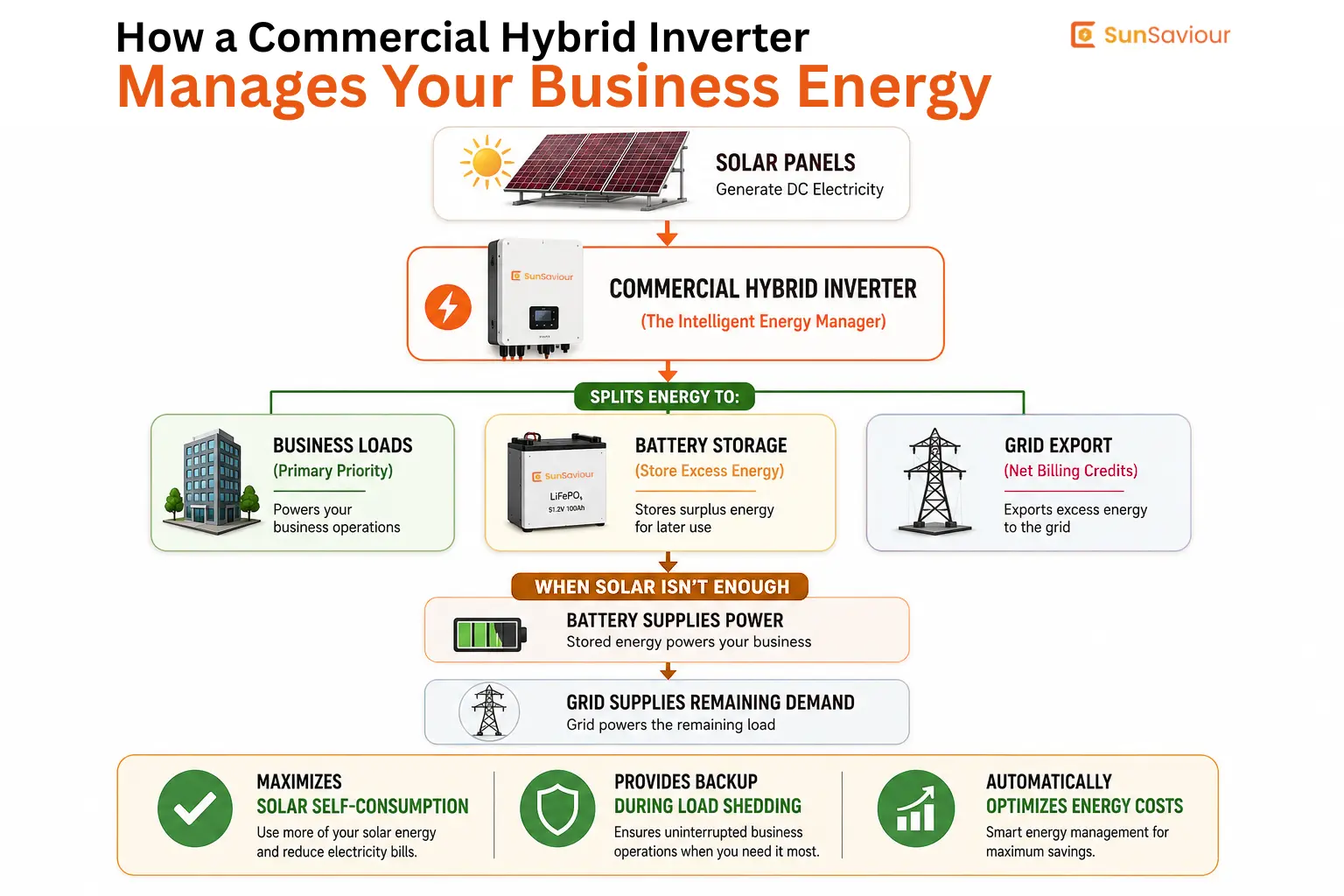
A commercial hybrid inverter addresses both simultaneously. It generates power from solar panels during the day, stores surplus energy in batteries for evening or outage use, and manages the grid connection intelligently so the business always draws from the cheapest available source.
For offices, retail outlets, factories, clinics, and schools, the commercial hybrid solar inverter is no longer a niche solution. It is becoming the standard infrastructure decision for any business serious about energy cost reduction and operational continuity.
What Is a Commercial Hybrid Inverter?
A commercial hybrid inverter is a power conversion and energy management device that integrates three energy sources: solar panels, battery storage, and the utility grid, into a single intelligent system. It sits at the center of a commercial solar power system, making real-time decisions about where to draw power from and where to send surplus generation.
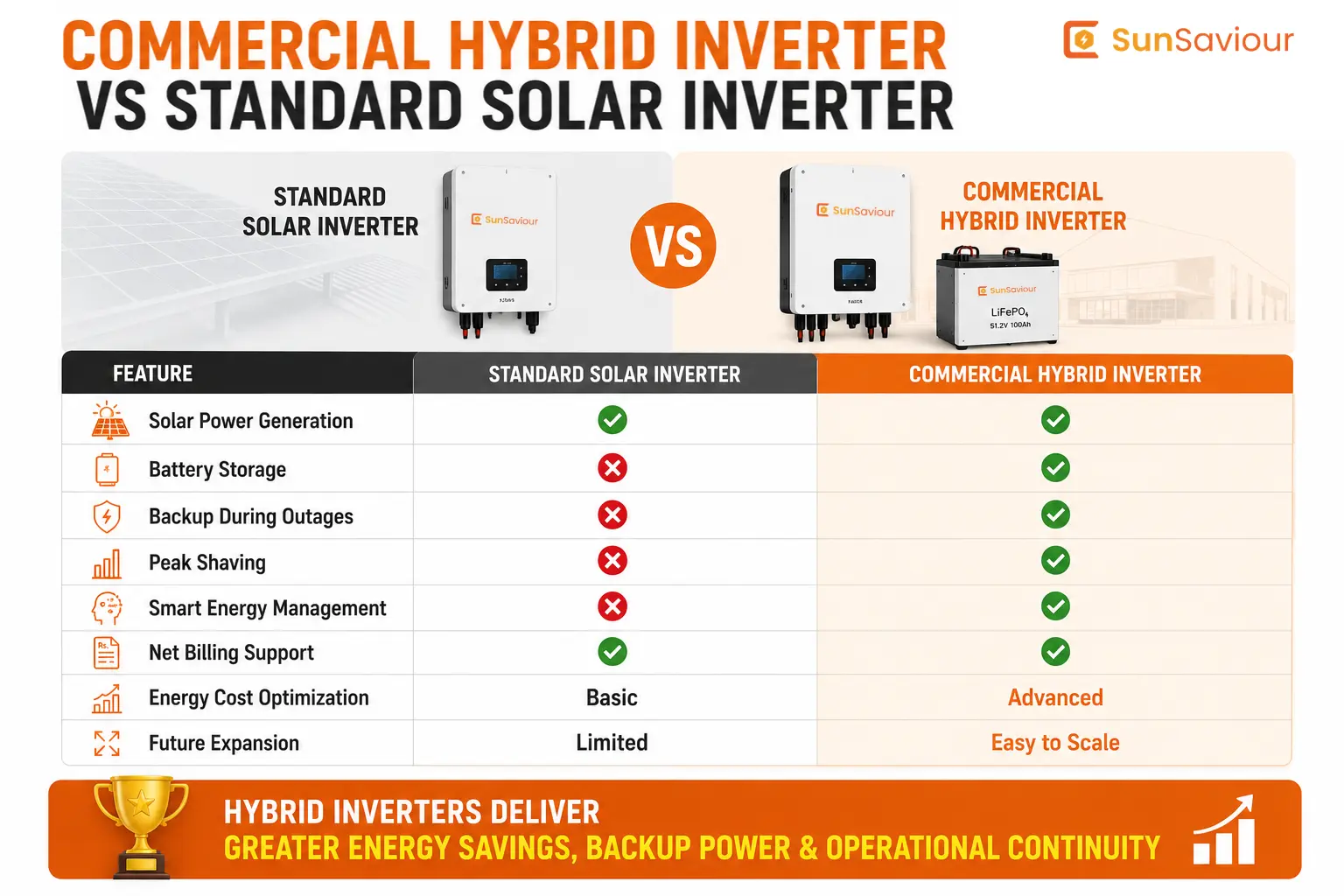
This is what separates a hybrid solar inverter from a conventional solar inverter. A standard solar inverter only converts DC power from panels into AC power for loads. A commercial hybrid inverter does that and manages the battery charge and discharge cycle, coordinates grid import and export, and applies energy management logic to optimize costs automatically.
Main components of a commercial hybrid inverter system:
- Solar panels generating DC electricity
- Hybrid inverter performing DC to AC conversion and managing all power flows
- Battery storage bank for energy storage and backup power
- Bidirectional meter for grid interaction and net billing
- Monitoring system for real-time energy management data
Key difference from a standard solar inverter: A standard on-grid solar inverter shuts down completely when the grid fails. A commercial hybrid inverter with battery storage continues operating during outages, supplying the business from batteries and solar generation simultaneously.
How a Commercial Hybrid Inverter Works
Solar Energy Conversion
During daylight hours, solar panels generate DC electricity. The inverter’s MPPT (Maximum Power Point Tracking) circuits extract the maximum available power from the array at any given irradiance level and convert it to AC for immediate use by the business.
Battery Charging and Storage
Surplus solar generation beyond what the business is consuming at that moment is directed to the battery bank. The inverter’s battery management function controls the charge rate and depth based on battery chemistry and state of charge, protecting the battery from overcharging and extending its operational life.
Grid Interaction
When solar generation and battery state of charge are both insufficient to meet load demand, the inverter draws the balance from the grid. When the business generates more than it consumes, surplus power is exported to the grid, earning credits under NEPRA’s net billing framework. The inverter manages this import and export automatically.
Intelligent Energy Management
Commercial energy storage systems include programmable energy management logic. The inverter can prioritize solar self-consumption, charge batteries from cheap off-peak grid power for discharge during peak tariff hours, schedule energy-intensive operations during high-generation windows, and apply peak shaving to limit maximum grid demand charges. This smart energy management capability is what generates savings beyond simple bill reduction.
Benefits of Installing a Commercial Hybrid Inverter
Maximize Energy Efficiency
A commercial hybrid inverter ensures every available unit of solar generation is either consumed directly or stored for later use. Round-trip efficiency for modern lithium battery systems paired with quality inverters typically exceeds 90%, meaning very little of the energy captured from panels is wasted.
Lower Electricity Bills
Direct solar self-consumption eliminates grid import during daylight hours. Battery discharge during peak tariff periods or load shedding reduces evening and nighttime grid draw. Net billing credits from surplus export offset remaining bill amounts. The combined effect reduces business electricity bills substantially for operations with significant daytime and evening loads.
Faster Return on Investment
Commercial electricity consumption is typically higher and more continuous than residential, which means a larger share of solar generation is consumed directly rather than exported at the lower net billing export rate. This higher self-consumption ratio improves the commercial hybrid inverter ROI relative to residential systems. Pakistani businesses with monthly electricity bills above PKR 50,000 commonly achieve payback periods of 3 to 5 years on a complete commercial solar power system.
Reliable Backup Power
For clinics, data centers, retail POS systems, cold storage, and manufacturing with continuous process requirements, power outages carry direct financial and operational costs. A battery backup inverter with sufficient storage keeps critical loads running through load shedding without the noise, fuel cost, and maintenance burden of a diesel generator.
Environmental Benefits
Every unit of electricity generated from solar and consumed directly displaces a unit from Pakistan’s fossil-fuel-dependent grid. For businesses with sustainability commitments or ESG reporting requirements, a commercial renewable energy installation reduces reported carbon footprint and supports credible sustainability claims.
Scalability for Future Growth
Commercial hybrid inverter systems designed with expansion in mind can have additional solar panels, battery capacity, or even parallel inverter units added as business loads grow. Planning for future expansion at the initial design stage is significantly more cost-effective than retrofitting capacity later.
Smart Energy Monitoring
Modern commercial hybrid solar inverters include remote monitoring platforms accessible via web browser or mobile app. Real-time generation, consumption, battery state, and grid export data allow energy managers to track system performance, identify inefficiencies, and demonstrate the financial return of the investment to stakeholders.
Key Features to Look For
High Conversion Efficiency
Look for an inverter with a stated peak efficiency above 97%. Efficiency loss at the conversion stage compounds over thousands of operating hours and directly reduces the energy available to the business. For commercial applications, three-phase output is required to match commercial building electrical infrastructure.
Battery Compatibility
Confirm the inverter supports your chosen battery chemistry. LiFePO4 lithium batteries require BMS communication via CAN or RS485 protocol. An inverter that does not support this protocol cannot properly manage a lithium battery bank, regardless of nominal voltage compatibility.
Smart Monitoring System
A solar monitoring system that provides generation, consumption, battery, and grid data in real time is essential for commercial applications. Look for platforms that support data export, historical trend analysis, and alert notifications for fault conditions.
Expandability
Inverters that support parallel operation allow capacity to be expanded by adding units rather than replacing the entire system. Confirm the maximum parallel unit limit and the expansion process before purchasing.
Safety Features
Commercial-grade inverters should carry IP65 or IP66 ingress protection for dusty or humid environments. Built-in protections should include over-voltage, over-current, over-temperature, short circuit, and islanding protection. MPPT over-voltage protection is particularly important for Pakistan’s variable grid conditions.
Remote Management
Remote firmware updates, parameter adjustment, and fault diagnosis without physical site visits reduce ongoing service costs and response times. Confirm the inverter manufacturer’s remote management capability and whether the local distributor can provide remote technical support.
Commercial Hybrid Inverter vs Solar Inverter
Factor | Commercial Solar Inverter | Commercial Hybrid Inverter |
Energy Storage | None | Yes, with battery bank |
Backup During Outages | No (shuts down) | Yes, continues operating |
Initial Cost | Lower | Higher |
Long-Term Savings | Moderate | Higher |
Energy Management | Basic | Intelligent, programmable |
Net Billing Support | Yes | Yes |
Peak Shaving | No | Yes |
Sustainability | Partial | Full |
Energy Storage
A standard solar inverter generates and consumes in real time with no storage. A hybrid solar inverter stores surplus for use when generation is low or absent.
Backup During Power Outages
A grid-tied solar inverter without batteries shuts down automatically during grid outages. A commercial hybrid inverter with batteries continues supplying the business, eliminating the operational disruption that a solar-only installation would not address.
Initial Cost vs Long-Term Savings
The hybrid system costs more upfront due to battery storage. For businesses with high electricity bills and significant load-shedding exposure, the combination of bill reduction and backup power avoidance of generator costs typically makes the hybrid system cheaper over a 5 to 7-year horizon.
Energy Management
A standard solar inverter has no energy management capability beyond basic MPPT. A hybrid solar inverter applies time-of-use logic, peak shaving, and self-consumption optimization.
Sustainability
A hybrid system with battery storage can achieve near-zero grid import during operational hours, maximizing the carbon footprint reduction from the solar investment.
Installation Best Practices
Choose the Right Installation Location
Three-phase commercial hybrid inverters should be installed in a well-ventilated, shaded location away from direct sunlight. Battery banks require controlled temperature environments, ideally below 35°C, to maximize cycle life. Planning the physical layout before purchasing equipment avoids costly repositioning.
Hire Certified Professionals
If your solar provider works through an experienced installation partner, ask who is responsible for design, commissioning, and after-sales support before signing any contract. AEDB-registered installers are required for net billing applications through WAPDA.
Proper Wiring and Grounding
Commercial systems operate at higher voltages and currents than residential. All DC and AC cabling must be sized for the system’s maximum current, properly protected with correctly rated circuit breakers, and earthed to a qualified earth electrode. Undersized cabling and inadequate earthing are the most common safety failures in commercial solar installations.
System Monitoring
Configure the monitoring system during commissioning and verify all data channels are reporting correctly before accepting the installation. Establish baseline performance figures against which future performance can be benchmarked.
Plan for Future Expansion
Specify conduit sizing and cable routes for potential additional panels or battery units at the design stage. Retrofitting cable infrastructure through a completed building is expensive and disruptive.
Tips to Maximize Performance
Schedule Energy-Intensive Operations
Machinery, HVAC, and high-consumption equipment scheduled during peak solar generation hours (typically 9am to 4pm) maximizes self-consumption and reduces the grid import needed to run those loads.
Monitor System Performance
Review monthly generation and self-consumption data. A system generating significantly less than expected is signaling a performance issue: dirty panels, a shading problem, a battery imbalance, or an inverter fault. Catching these early prevents compounding losses.
Expand Solar Capacity When Needed
If monitoring shows the battery is regularly fully charged well before sunset, the system is generating more than it can usefully store. This is the signal to evaluate adding load-side consumption or expanding capacity to match business growth.
Optimize Battery Usage
Avoid programming the battery to discharge to very low state of charge regularly. Keeping discharge above 20% for lithium systems preserves cycle life and maximizes the usable lifetime of the battery investment.
Perform Routine Maintenance
Panel cleaning monthly in dusty environments such as Lahore, Multan, and Karachi. Quarterly cable inspection and connection torque check. Annual thermal imaging of all DC connections to detect hotspots before they cause fires or failures.
Train Staff on Energy Management
Energy managers and facilities staff who understand the system’s operating modes and monitoring platform make better scheduling decisions and identify problems earlier than untrained staff relying on automated alerts alone.
Commercial Hybrid Inverter Price in Pakistan
Based on verified 2026 market data from multiple Pakistani solar equipment dealers:
Capacity | Phase | Indicative Price Range (PKR) |
10 kW | Single Phase | 270,000 to 440,000 |
15 kW | Three Phase | 500,000 to 750,000 |
20 kW | Three Phase | 700,000 to 1,000,000 |
30 kW | Three Phase | 900,000 to 1,200,000 |
Commercial hybrid inverter price in Pakistan varies significantly by brand, IP protection rating, MPPT configuration, warranty terms, and whether BMS communication for lithium batteries is supported. Three-phase units are required for commercial buildings with three-phase electrical supply, which includes most commercial and industrial premises in Pakistan.
SunSaviour’s ALPHA Series, X-Series, and X-Plus hybrid inverters are designed for commercial and residential solar applications in Pakistan. Explore SunSaviour’s commercial hybrid inverter range at sunsaviour.com
Frequently Asked Questions
What is the difference between a hybrid inverter and a solar inverter?
A standard solar inverter only converts DC power from panels into AC electricity. A commercial hybrid inverter also manages a battery storage bank, coordinates grid import and export, provides backup power during outages, and applies intelligent energy management to optimize costs.
Can I use a hybrid inverter with existing solar panels?
In most cases, yes. A hybrid inverter can be retrofitted to an existing solar array provided the panel voltage and current specifications fall within the inverter’s MPPT input range. An inverter upgrade from on-grid to hybrid also requires adding a battery bank.
How much can businesses save with a commercial hybrid inverter?
Savings depend on electricity consumption, tariff rate, system size, and self-consumption ratio. Businesses with monthly electricity bills above PKR 50,000 and significant daytime loads typically achieve payback periods of 3 to 5 years on a complete commercial solar power system.
Do hybrid inverters provide backup power during load shedding?
Yes, provided the system includes battery storage. The inverter switches to battery and solar power during grid outages, typically within 10 to 20 milliseconds, fast enough that most connected equipment remains uninterrupted.
Which batteries are compatible with commercial hybrid inverters?
Most modern commercial hybrid inverters support LiFePO4 (lithium iron phosphate) batteries via CAN or RS485 BMS communication, as well as lead-acid types including tubular and AGM. Lithium iron phosphate is recommended for commercial applications due to deeper discharge, longer cycle life, and lower maintenance.
How often is maintenance required?
Monthly panel cleaning in high-dust environments, quarterly cable and connection inspections, and annual thermal imaging of DC connections. Battery maintenance varies by chemistry: lithium requires minimal attention; lead-acid requires periodic electrolyte checks.
How long does installation take?
A commercial hybrid inverter system of 10 to 30 kW typically takes 2 to 5 days for a professional installation team, depending on system complexity, building access, and cable routing requirements.
Can hybrid inverters improve sustainability?
Yes. By maximizing solar self-consumption and reducing grid import, a commercial hybrid solar inverter minimizes dependence on Pakistan’s fossil-fuel-dependent grid and measurably reduces the business’s carbon footprint.
Can the system be expanded later?
Most commercial hybrid inverters support parallel operation, allowing additional units and battery capacity to be added as the business load grows. Confirm the specific expansion capability of your chosen inverter model before purchase.
Are hybrid inverters suitable for all commercial buildings?
They are suitable for most commercial premises. Three-phase buildings require three-phase inverter models. The optimal system size depends on the business’s electricity consumption, load profile, available roof area, and sanctioned load limit under NEPRA regulations.
How do hybrid inverters manage energy?
Through programmable energy management logic that prioritizes solar self-consumption, applies time-of-use charge and discharge scheduling, performs peak shaving to limit grid demand charges, and manages battery state of charge to balance backup availability with daily cycling.
Are hybrid inverters worth the investment?
For businesses with high electricity bills, significant daytime loads, and frequent load shedding, yes. The combination of bill reduction, backup power, and avoided generator costs typically makes the commercial hybrid inverter ROI compelling over a 5 to 7-year horizon.
Conclusion
A commercial hybrid inverter is not a luxury upgrade for Pakistani businesses in 2026. For any operation with consistent daytime loads, monthly electricity bills above PKR 30,000 to 50,000, and exposure to regular load shedding, it is a financially sound infrastructure investment.
The combination of solar self-consumption, intelligent battery management, peak shaving, and reliable backup power addresses the two core energy problems Pakistani businesses face simultaneously: cost and continuity. Over a 10 to 15-year system lifetime, the long-term savings, reduced carbon footprint, and energy independence achieved through a properly designed commercial solar power system are compelling by any commercial evaluation standard.
SunSaviour offers hybrid inverters suited for commercial and residential solar applications across Pakistan, backed by 59+ sales points and 28 service centres nationwide. Visit sunsaviour.com to find the right commercial hybrid inverter for your business.