A solar battery is no longer luxury for Pakistani homes. It’s becoming the backbone of energy independence as households face rising electricity costs and grid instability. A battery energy storage system stores excess solar power for use after sunset or during load-shedding outages, transforming how families consume energy. Pakistan imported 1.25 gigawatt-hours of batteries in 2024 alone, with demand projected to grow to 8.75 GWh by 2030. This guide explains BESS strategy from the ground up.
What Is a Battery Energy Storage System?
A battery energy storage system, or BESS, converts electrical energy into chemical energy during charging, then releases it as electricity when needed. The core mission: capture power when it’s abundant and release it when demand peaks.
The BESS consists of four key components:
Battery modules store energy chemically. A solar battery at home typically uses lithium iron phosphate chemistry, though iron phosphate batteries and lead-acid alternatives exist.
Battery Management System (BMS) monitors voltage, current, and temperature to protect cells from damage and extend lifespan.
Energy Management System (EMS) decides when to charge, discharge, and how much power to route to appliances or the grid.
Power Conversion System (PCS) converts DC power from panels to AC power for home use.
Together, these components create what BESS efficiency depends on: seamless energy flow with minimal losses.
Types of Battery Energy Storage Systems
Three main types of battery energy storage systems exist in Pakistan’s market. Each serves different needs.
Lithium-Ion BESS
Lithium ion batteries in Pakistan are the modern standard. Lithium iron phosphate batteries specifically dominate because they’re safer, last longer, and handle deep cycling better than older chemistries.
Performance: 90-98% round trip efficiency of BESS. This means if you store 10 kWh, you recover 9-9.8 kWh of usable electricity.
Cost: PKR 95,000-120,000 per kWh for premium brands.
Lifespan: 10-15 years, 6,000-8,000 full cycles.
Why it dominates Pakistan: Handles summer heat (50°C) without capacity loss, charges fast (2-3 hours from solar), and needs no maintenance.
Lead-Acid BESS
Legacy technology still used in lower-budget systems. Iron phosphate battery alternatives like tubular lead-acid cost PKR 40,000-60,000 per kWh.
Performance: 70-85% round-trip efficiency. Loses 15-30% of stored energy as heat.
Lifespan: 2-3 years with heavy daily cycling.
Pakistan reality: Popular in commercial setups, but total cost of ownership favors lithium for residential use.
Flow Batteries
Large-scale industrial BESS systems store energy in liquid electrolyte tanks. Capacity decoupled from power rating, meaning you can scale independently.
Cost: PKR 150,000-200,000 per kWh, used mainly for 100+ kWh installations.
Pakistan adoption: Minimal for residential. More relevant for commercial and industrial scale.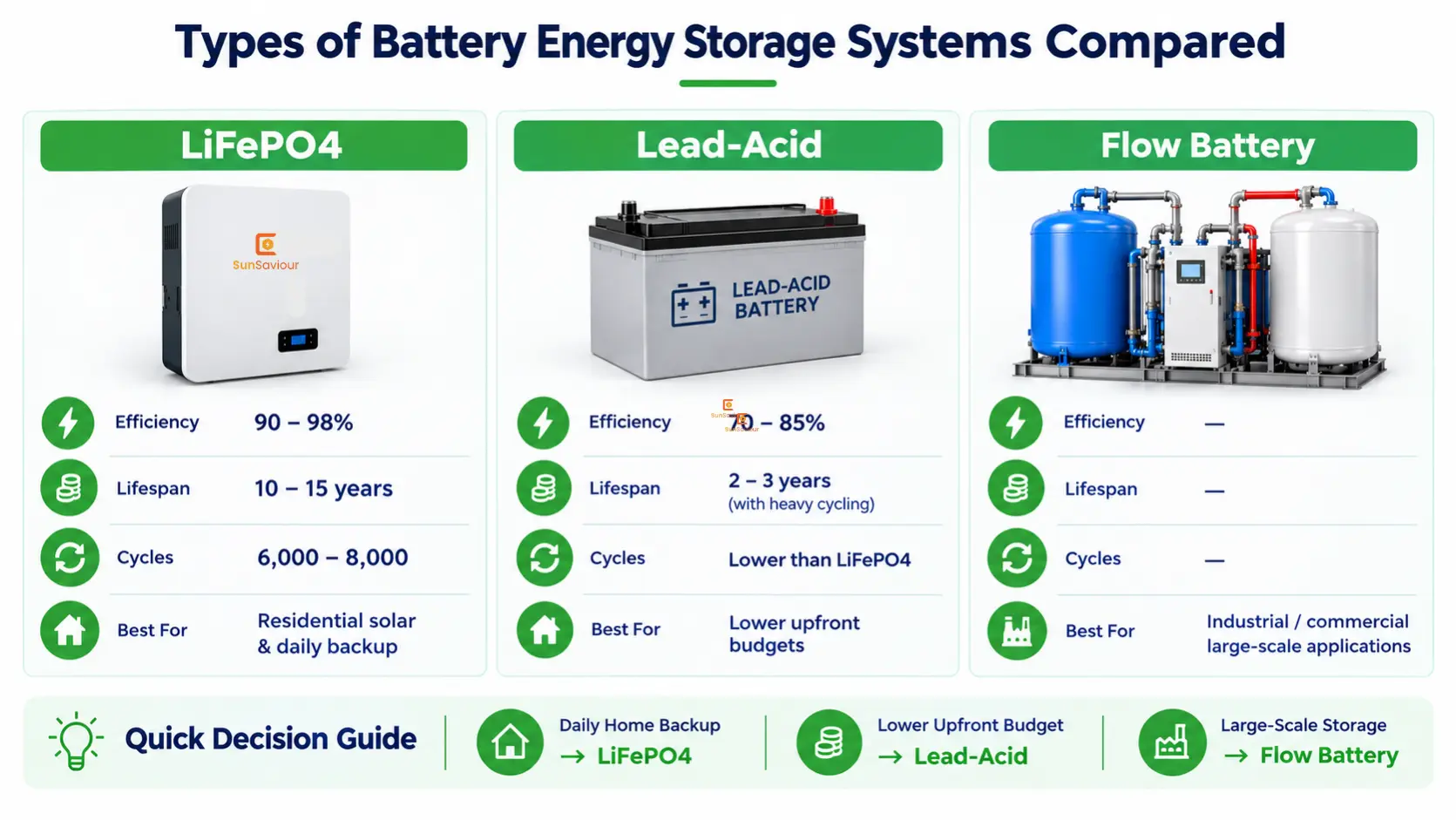
How Battery Energy Storage Systems Work
Understanding how does a battery energy storage system work clarifies why BESS efficiency matters.
Charging phase: Solar panels generate DC power. An inverter manages current flow into battery cells, where chemical reactions store energy. BMS monitors cell voltage to prevent overcharging.
Storing phase: Fully charged solar battery waits. EMS tracks grid prices and load-shedding schedules to optimize discharge timing.
Discharging phase: When grid power fails or demand rises, PCS inverts stored DC power back to AC, supplying home appliances. BMS ensures discharge rate doesn’t stress cells.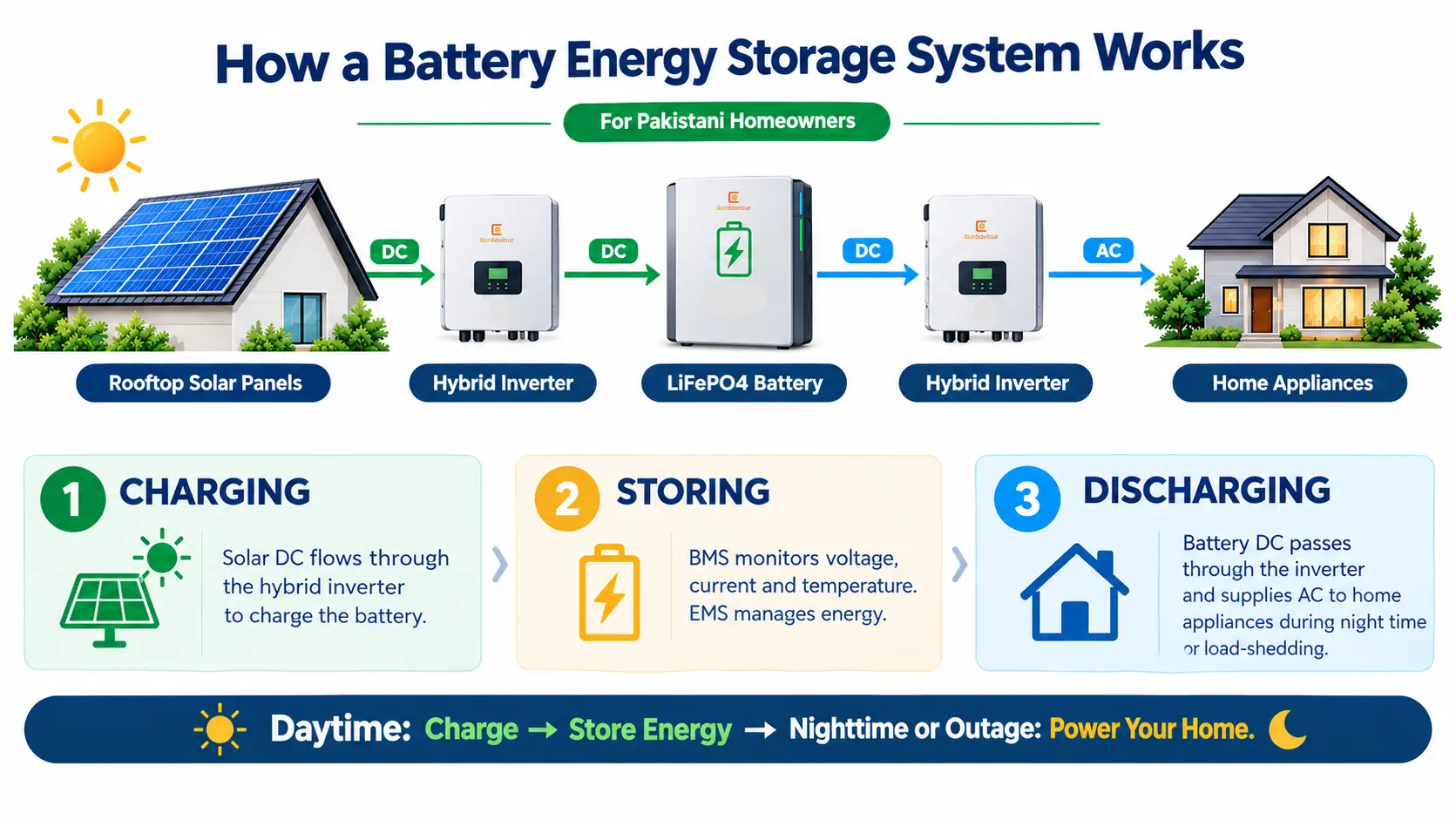
Round-trip efficiency loss occurs at two points: charging (2-3% loss) and discharging (2-3% loss). Lithium systems minimize this; lead-acid systems waste more to heat.
Real-world example: A BESS capacity planning exercise for a 5-person home with 1.2 kW backup load during 6-hour load-shedding needs a 10 kWh battery energy storage system to maintain 20% safety margin.
SunSaviour’s hybrid inverters integrate BMS and EMS natively, meaning your solar battery system operates at peak efficiency without separate charge controllers. Our ALPHA Series and X-Series inverters are optimized for Pakistan’s grid conditions and load-shedding patterns. Visit sunsaviour.com to explore BESS-compatible inverters and get professional sizing.
BESS Efficiency: Round-Trip and Real-World
BESS efficiency describes how much of stored energy you actually use versus what you store.
Round-trip efficiency is the key metric. If you charge a 10 kWh BESS and later discharge it:
- Lithium-ion: 9.0-9.8 kWh available (90-98% efficient)
- Lead-acid: 7.0-8.5 kWh available (70-85% efficient)
Why the difference? Lithium handles charge/discharge cycles cleanly. Lead-acid converts energy to heat, wasting 15-30%.
Pakistan impact: Over 10 years, a lithium system delivers 36,500 kWh of stored energy per cycle per year. Lead-acid delivers 25,550 kWh. The lithium system produces 43% more usable energy from the same capacity.
Cost of battery storage in Pakistan reflects this. A 10 kWh lithium BESS costs PKR 950,000-1,200,000. Lead-acid costs PKR 400,000-600,000. But lithium lasts 10 years; lead-acid lasts 2-3 years. Over 10 years, lithium’s per-kWh cost is 40-50% lower.
Storing Solar Energy Without Batteries
What if storing solar energy without batteries makes sense? It does, but only under specific conditions.
Net metering (grid-tied systems) let homes sell excess solar power to WAPDA at NEPRA-approved rates. No battery needed. Panels feed daytime power directly to the grid, reducing your bill.
Advantage: Cheaper upfront (PKR 800,000-900,000 for 5kW), simpler installation.
Disadvantage: Zero backup during load-shedding. System shuts down when grid fails.
Pakistan context post-2026: NEPRA changed net metering to “net billing” (PKR 11-13 per kWh export credit instead of 1:1). This makes BESS economically superior. Battery energy storage system payback is now 5-7 years vs. 10+ years for on-grid solar alone.
Storing solar energy without batteries is now a worse investment than it was three years ago. Most new Pakistani solar owners choose hybrid setups with battery storage despite higher initial cost.
BESS in Pakistan’s Energy Strategy
Pakistan imported 6.004 gigawatt-hours of battery storage capacity between January 2024 and August 2026. April 2026 alone saw PKR 126 billion invested in BESS systems as households exited the grid.
Why BESS matters nationally:
- Reduces transmission losses (currently 18% of all generated power)
- Stabilizes peak demand, preventing blackouts
- Enables renewable integration (solar without BESS creates grid instability)
- Decentralizes energy, improving reliability
NEPRA and DISCO regulations now encourage BESS adoption. Government is drafting a National Battery Framework to incentivize large-scale deployment.
For individual consumers: BESS provides four months of free electricity annually once the system is paid for.
BESS Cost and Return on Investment
Bess battery pricing varies by chemistry, capacity, and brand.
BESS Type | Capacity | Cost (PKR) | Lifespan | Annual Savings | ROI Period |
Lithium 10kWh | 10 kWh | 950,000–1,200,000 | 10–15 years | 150,000–200,000 | 5–7 years |
Lead-acid 10kWh | 10 kWh | 400,000–600,000 | 2–3 years | 150,000–200,000 | 2–4 years |
Lithium 5kWh | 5 kWh | 475,000–600,000 | 10–15 years | 75,000–100,000 | 5–7 years |
BESS capacity planning requires knowing:
- Your backup load (typically 1-2 kW for homes)
- Outage duration (4-8 hours in most cities)
- Budget constraint
A 10 kWh lithium battery energy storage system covers 8-10 hours of 1 kW backup. It costs PKR 1,200,000 including hybrid inverter and installation.
Most BESS systems in Pakistan achieve ROI within 3-5 years depending on system capacity and applicable tariff rate.
Frequently Asked Questions
What is a BESS battery exactly?
A BESS battery is a system that stores electrical energy in chemical form. A solar battery is one example. It includes the battery cells, management electronics, and power conversion hardware all working together.
How long do lithium batteries last in Pakistan’s heat?
A premium lithium iron phosphate battery lasts 10-15 years in Pakistan’s 50°C summers. Lifespan depends on depth of discharge and cycling frequency. Daily use reduces lifespan slightly versus periodic use.
What is the round-trip efficiency of BESS in simple terms?
If you charge a BESS with 10 kWh of solar energy, round trip efficiency describes how much of that 10 kWh you can actually use later. Lithium: 9-9.8 kWh (90-98%). Lead-acid: 7-8.5 kWh (70-85%).
Can I use BESS without solar panels?
Yes, but it’s inefficient. BESS paired with solar maximizes cost-effectiveness. Without solar, you’re charging from the grid at night (expensive) and discharging during peak demand.
Which BESS types work best in Pakistan?
Lithium iron phosphate batteries are the standard. Lead-acid is cheaper upfront but costs more long-term. Flow batteries are overkill for homes.
How much does BESS installation cost?
A complete battery energy storage system with panels, inverter, and batteries: PKR 1,500,000-2,000,000 for a typical 5kW home setup. Hybrid inverter alone: PKR 350,000-600,000.
What’s the difference between AC-coupled and DC-coupled BESS?
DC-coupled batteries connect directly to a hybrid inverter’s DC side (more efficient, cheaper). AC-coupled batteries have their own inverter, losing 5-8% more energy (useful only when retrofitting existing on-grid systems).
Is storing solar energy without batteries viable in Pakistan?
Grid-tied systems (net billing) work but no longer make financial sense. BESS payback is 5-7 years; on-grid payback is 10+ years post-2026 NEPRA changes.
How does BESS help during load-shedding?
Your BESS automatically switches to battery power when the grid fails. Critical appliances (lights, fridge, fan, router) stay on without interruption.
Which cities in Pakistan should prioritize BESS?
All: Lahore, Islamabad, Karachi, Peshawar, Multan, Hyderabad. Every city experiences 4-8 hours daily load-shedding. BESS is practical everywhere.
Conclusion
A solar battery paired with battery energy storage system technology is reshaping Pakistan’s energy independence. Understanding BESS types, BESS efficiency, round-trip losses, and cost-benefit analysis is essential before investing.
Lithium iron phosphate batteries are the clear choice for 10-15 year ownership despite higher upfront cost. BESS systems pay for themselves in 5-7 years and provide 8-10 years of free electricity after that.
The strategy is straightforward: size your battery energy storage system to your backup load and outage duration, choose lithium chemistry, pair with a quality hybrid inverter, and expect ROI in mid-decade. Pakistan’s energy future runs on BESS.