Why Battery Choice Matters More Than Panel Brand
Most buyers research solar panels carefully and pick an inverter brand they trust. Then they buy the cheapest battery available and wonder why their system underperforms within two years.
The battery is the component that determines how much of your solar generation you actually use, how long your home stays powered during load shedding, and what your total cost of ownership looks like over a decade. The lead acid battery vs lithium ion battery decision is where most of that outcome is decided.
This guide covers how each technology works, a detailed side-by-side comparison, Pakistan-specific performance factors, a 10-year cost analysis, and clear guidance on which battery type suits which situation.
What Is a Lead Acid Battery?
Lead acid batteries generate electricity through a chemical reaction between lead plates and a sulfuric acid electrolyte. They are the oldest rechargeable battery technology in commercial use, first developed in the 1850s, and remain widely available in Pakistan today.
Three main types exist in Pakistan’s solar market:
Flooded (Tubular) Batteries use liquid electrolyte that requires periodic top-ups with distilled water. They offer good deep-cycle performance and are the most common lead acid type in residential solar setups in Pakistan.
AGM (Absorbent Glass Mat) Batteries are sealed and maintenance-free. The electrolyte is absorbed into glass mat separators. They tolerate less deep discharge than tubular batteries and perform less well under sustained heat.
Gel Batteries use silica gel to immobilize the electrolyte. Also sealed and maintenance-free. More heat-tolerant than AGM but sensitive to overcharging and slower to charge.
Advantages: Low upfront cost, widely available, serviceable anywhere in Pakistan, compatible with virtually all inverters.
Limitations: Short cycle life, require 50% depth of discharge limit to preserve lifespan, flooded types need maintenance, heavy, lower energy efficiency.
What Is a Lithium Ion Battery?
Lithium ion batteries store energy through the movement of lithium ions between electrodes. For solar storage applications, the dominant chemistry is LiFePO4 (lithium iron phosphate), also written as LFP.
Why LiFePO4 is preferred for solar: Standard lithium-ion chemistries (NMC, NCA) used in phone and laptop batteries carry thermal runaway risk at high temperatures. LiFePO4 chemistry is thermally stable, does not require active cooling, and is considered the safest lithium chemistry for stationary storage applications. For Pakistan’s high-temperature climate, this distinction matters significantly.
Advantages: Long cycle life, deep discharge capability, minimal maintenance, high energy efficiency, stable voltage output, built-in BMS protection.
Limitations: Higher upfront cost, requires BMS-compatible inverter, needs careful purchasing from authorized dealers to avoid counterfeit cells.
Lead Acid vs Lithium Ion Battery: Side-by-Side Comparison
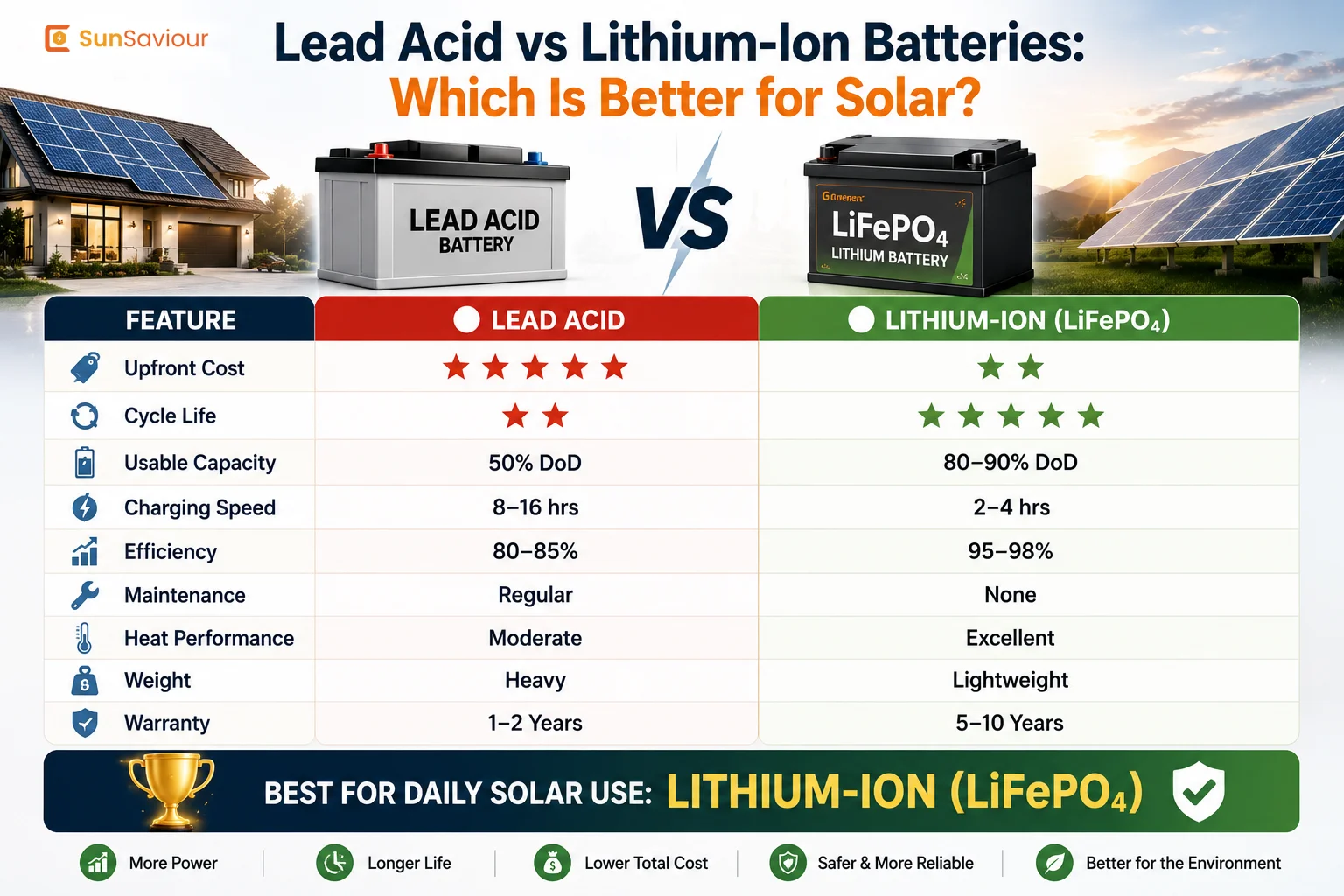
Feature | Lead Acid (Tubular) | Lithium Ion (LiFePO4) |
Upfront Cost (per kWh) | Lower | 2 to 3 times higher |
Cycle Life | 300 to 1,500 cycles | 3,000 to 6,000+ cycles |
Depth of Discharge (DoD) | 50% recommended | 80 to 90% safe |
Usable Capacity (100Ah) | ~50Ah | ~85 to 90Ah |
Round-Trip Efficiency | 80 to 85% | 95 to 98% |
Charging Speed | 8 to 16 hours | 2 to 4 hours |
Weight | Heavy | 50 to 70% lighter |
Maintenance | Water top-ups (tubular) | None |
Temperature Tolerance | Degrades faster in heat | Better heat stability (LFP) |
BMS Protection | None (inverter-dependent) | Built-in |
Warranty | 1 to 2 years typical | 5 to 10 years typical |
Environmental Impact | Lead disposal required | Cleaner chemistry |
10 Key Differences Between Lead Acid and Lithium Batteries
1. Upfront Cost vs Lifetime Value
Lead acid batteries cost less to buy. Lithium batteries cost significantly less to own over time. A tubular battery bank for a 5kW hybrid system in Pakistan might cost PKR 80,000 to 120,000. An equivalent lithium bank costs PKR 200,000 to 310,000.
The comparison only makes sense over the ownership period. A lead acid bank cycling daily at 50% DoD typically lasts 2 to 4 years before meaningful capacity loss. A LiFePO4 bank under the same conditions lasts 8 to 15 years. Over 10 years, the lead acid bank is replaced 2 to 3 times. The cumulative lead acid cost exceeds the single lithium investment.
2. Cycle Life
Lead acid batteries deliver 300 to 1,500 cycles depending on chemistry and usage conditions. Tubular batteries reach the higher end when maintained well and not over-discharged. LiFePO4 batteries deliver 3,000 to 6,000 cycles under similar conditions.
For a household cycling their battery once per day, a lead acid bank is exhausted in roughly 3 to 4 years. A LiFePO4 bank lasts 10 to 15 years under the same daily cycling pattern. This is the single most important difference for solar battery storage in Pakistan.
3. Depth of Discharge
A 100Ah lead acid battery should not be discharged below 50% to preserve cycle life. Effectively, you get 50Ah of usable capacity. A 100Ah LiFePO4 battery can be safely discharged to 80 to 90%, giving you 80 to 90Ah of usable capacity.
This means a 100Ah lithium battery delivers almost twice the real-world backup of a 100Ah lead acid battery. Comparing battery prices by Ah rating without accounting for DoD consistently makes lead acid appear more cost-effective than it actually is.
4. Charging Speed
Lead acid batteries require 8 to 16 hours for a full charge. LiFePO4 batteries charge in 2 to 4 hours at the same C-rate. In Pakistan’s solar context, where peak generation windows are 5 to 6 hours, charging speed directly affects how much solar energy you capture and store each day.
A slow-charging lead acid battery may not fully recharge from solar before sunset during shorter winter days, leaving you with reduced backup capacity each night. Lithium batteries recharge fully within the available solar window in most conditions.
5. Energy Efficiency
Lead acid round-trip efficiency is 80 to 85%, meaning for every 100Wh you put in, you get back 80 to 85Wh. LiFePO4 round-trip efficiency is 95 to 98%. The 13 to 15 percentage point gap means a lead acid system effectively wastes a portion of its solar generation as heat during each charge-discharge cycle.
Over a year of daily cycling, this efficiency deficit requires either a larger solar array or results in less backup energy available each evening compared to a lithium system of the same nominal size.
6. Weight and Installation
Lead acid batteries are heavy. A standard 200Ah 12V tubular battery weighs 50 to 60 kg. A 48V bank for a 5kW system using four such batteries weighs 200 to 240 kg, requiring reinforced battery room flooring in some cases. An equivalent LiFePO4 wall-mounted unit weighs 20 to 35 kg and installs in a fraction of the floor space.
7. Maintenance Requirements
Flooded tubular batteries require electrolyte top-ups every 2 to 3 months using distilled water. Terminal corrosion must be cleaned periodically. Overwatering damages the battery; underwatering accelerates sulfation. LiFePO4 batteries require no maintenance. The BMS handles cell balancing, protection, and monitoring automatically.
8. Safety Features
Lead acid batteries release hydrogen gas during charging, requiring ventilation to prevent accumulation. Overcharging can cause electrolyte boiling and in extreme cases battery damage. LiFePO4 chemistry is thermally stable and does not produce gas under normal conditions. Every LiFePO4 battery includes a Battery Management System (BMS) that protects against overcharge, over-discharge, over-temperature, and cell imbalance automatically.
9. Performance in Pakistan’s Climate
This is the most underreported factor in battery comparisons produced outside South Asia. Lead acid cycle life degrades significantly at elevated temperatures. At 33°C average ambient temperature, cycle life reduction for lead acid is measurable and well-documented. At the 45 to 50°C temperatures common in Lahore, Multan, Karachi, and Hyderabad during June and July, lead acid batteries in rooftop or ground-floor battery rooms degrade considerably faster than specifications suggest.
LiFePO4 chemistry handles heat significantly better than standard lithium-ion chemistries and performs more reliably than lead acid in sustained high-temperature environments. Adequate ventilation still improves performance and longevity, but the degradation curve is far less steep.
Pakistan also experiences frequent voltage fluctuations and irregular charging patterns from load-shedding cycles. Lead acid batteries are more susceptible to sulfation from incomplete charging, which occurs when the grid cuts before a full charge is complete. LiFePO4 batteries tolerate partial charging without equivalent damage.
10. Total Cost of Ownership: 10-Year Comparison
The following comparison is indicative, based on current Pakistan market pricing and typical cycling patterns. Prices vary by brand, dealer, and market conditions.
Factor | Lead Acid (Tubular) | Lithium (LiFePO4) |
Initial battery cost (5kWh usable) | ~PKR 160,000 to 200,000 | ~PKR 300,000 to 450,000 |
Expected lifespan (daily cycling) | 3 to 5 years | 10 to 15 years |
Replacements in 10 years | 2 to 3 | 0 to 1 |
10-year battery spend | PKR 400,000 to 600,000 | PKR 300,000 to 500,000 |
Maintenance cost | Moderate | Near zero |
Energy losses (efficiency gap) | Higher | Lower |
Over 10 years of daily cycling, lithium is typically cheaper in total cost of ownership, even at 2 to 3 times the upfront price per unit. The crossover point depends on cycling frequency: households cycling once per day strongly favor lithium, while households using batteries only for occasional backup favor lead acid.
Which Battery Is Better for Solar Systems?
For daily hybrid solar use: LiFePO4 is the clear choice. Deep discharge capability, fast recharging within the solar window, higher efficiency, and 10-plus year lifespan make it optimal for systems cycling every day.
For off-grid homes: LiFePO4 again, particularly because off-grid systems cycle deeply and frequently and cannot afford the capacity degradation that comes from lead acid replacement cycles.
For net billing setups focused on daytime self-consumption: Both are viable. If the battery is primarily for evening use after solar generation ends, a smaller lithium bank provides reliable service at lower total cost than a larger lead acid bank.
For occasional backup only: Lead acid is acceptable for households experiencing 1 to 2 hours of load shedding per day and running basic loads (lights, fans, router only). In this profile, the battery cycles less frequently and lead acid lifespan extends accordingly.
Which Battery Is Better for UPS Systems?
UPS systems discharge infrequently and spend most of their time in float charge. In this profile, the lithium advantages of fast charging and deep cycle life are underutilized. Lead acid (particularly AGM) remains viable and cost-effective for dedicated UPS applications with low cycling frequency.
However, for UPS applications that cycle frequently due to Pakistan’s load-shedding patterns, such as offices or clinics cycling their UPS multiple times per day, LiFePO4 becomes the better long-term value for the same reasons it outperforms in solar applications.
Which Battery Is Better for Home Backup?
Homes in areas with 4 to 8 hours of daily load shedding cycling their battery every day should choose LiFePO4. Homes with occasional outages, tight budgets, and basic loads (fans, lights, a router) can use quality tubular lead acid as an entry point, with the understanding that replacement will be needed within 3 to 5 years.
Which Battery Is Better for Businesses?
Offices and retail shops with continuous computer and POS equipment loads, cycling daily: LiFePO4.
Hospitals and clinics where power reliability is critical and maintenance cannot be deferred: LiFePO4. Battery failure at a critical moment is not acceptable, and the BMS protection and maintenance-free operation of lithium is particularly valuable.
Schools and colleges with high daytime loads and direct solar self-consumption: LiFePO4.
Factories with generator backup and battery as secondary standby only: Lead acid may suffice, depending on cycling pattern.
When Should You Choose Lead Acid?
Lead acid still makes practical sense in specific situations:
- Budget under PKR 100,000 for battery storage with no flexibility
- Load-shedding of 2 hours or less per day with basic loads only
- Temporary or transitional setup before a planned lithium upgrade
- Applications where the battery cycles fewer than 100 times per year
Recommending lithium to every buyer regardless of budget or usage pattern is not honest advice. Lead acid remains a functional option for genuinely low-cycling applications.
When Should You Choose Lithium?
LiFePO4 is the right choice when:
- Daily load-shedding exceeds 3 to 4 hours
- The battery will cycle once or more per day
- The system is a primary hybrid solar setup
- Long-term ownership (5 to 10 years) is planned
- Maintenance access is limited or inconvenient
- High summer temperatures are a factor (which applies to most of Pakistan)
Common Myths About Lithium Batteries
“Lithium batteries explode easily.” Standard lithium-ion chemistries (NMC, NCA) in consumer electronics carry thermal runaway risk under damage or overcharge. LiFePO4 chemistry, which is what solar batteries in Pakistan use, is thermally stable and does not exhibit thermal runaway under normal conditions. This distinction is consistently missed in generic battery comparisons.
“Lithium cannot handle Pakistan’s heat.” LiFePO4 handles heat considerably better than standard lithium-ion and better than lead acid in sustained high-temperature environments. Adequate ventilation still improves performance, but the chemistry itself is robust in the temperature ranges seen in Pakistan.
“Lithium is too expensive.” Upfront, yes. Over a 10-year ownership period with daily cycling, it is frequently cheaper. The comparison must be made on total cost of ownership, not purchase price alone.
“Lead acid lasts just as long.” Only in low-cycling applications. Under daily solar cycling, lead acid lifespan is 3 to 5 years at best. Lithium lasts 10 to 15 years under the same conditions.
“Lithium is not compatible with my inverter.” Most modern hybrid inverters in Pakistan support LiFePO4 batteries via BMS communication (CAN or RS485). Confirm inverter compatibility before purchasing, but incompatibility is increasingly rare for inverters manufactured in the last 5 years.
Buying Guide: How to Choose the Right Battery
Step 1: Calculate daily load during load shedding. List appliances and hours of use during outages. This gives you the minimum required usable capacity in kWh.
Step 2: Match battery chemistry to cycling pattern. Daily cycling strongly favors lithium. Occasional backup allows lead acid.
Step 3: Check inverter compatibility. LiFePO4 requires a compatible hybrid inverter with BMS communication support. Verify your inverter model supports lithium before purchasing.
Step 4: Verify voltage match. A 48V inverter requires a 48V or 51.2V battery bank. Voltage mismatch is a common and avoidable purchasing error.
Step 5: Evaluate BMS quality. For lithium batteries, the BMS determines how well the battery is protected from overcharge, over-discharge, and thermal events. Budget cells with poorly designed BMS units are a risk. Buy from authorized dealers with verified warranty documentation.
Step 6: Confirm warranty and dealer authorization. Counterfeit lithium cells are a real problem in Pakistan’s market. Purchase only through authorized dealers who can provide original warranty documentation.
Step 7: Plan for future expansion. LiFePO4 batteries can be connected in parallel to expand capacity later. Confirm this capability and the parallel connection limit before purchasing.
SunSaviour’s Lithium Battery Series is designed to integrate directly with their hybrid inverter range, covering compatibility, BMS communication, and warranty support. Explore SunSaviour solar battery solutions at sunsaviour.com
Frequently Asked Questions
Is lithium better than lead acid for solar?
For daily solar cycling in Pakistan’s climate, yes. Lithium delivers more usable capacity per unit, charges faster within the solar window, lasts significantly longer, and requires no maintenance.
How long do lithium batteries last in Pakistan?
LiFePO4 batteries with proper installation and compatible inverter settings typically last 8 to 15 years under daily residential cycling. Most quality brands carry 5 to 10 year warranties.
Can I replace a lead acid battery with lithium?
Yes, if your inverter supports LiFePO4 chemistry and BMS communication via CAN or RS485. Many modern hybrid inverters in Pakistan do. Confirm your specific inverter model before purchasing.
Which battery is best for solar systems in Pakistan?
LiFePO4 (lithium iron phosphate) is the most recommended battery type for hybrid solar systems in Pakistan, particularly for households with 4 or more hours of daily load shedding.
Is LiFePO4 the same as lithium-ion?
LiFePO4 is a specific chemistry within the lithium-ion family. It is safer and more thermally stable than other lithium-ion chemistries (NMC, NCA) and is the preferred choice for stationary solar storage.
Are lithium batteries safe in Pakistan’s heat?
LiFePO4 chemistry is thermally stable and handles Pakistan’s high summer temperatures better than standard lithium-ion and better than lead acid in sustained heat. Adequate ventilation still recommended.
Which battery works better in hot weather?
LiFePO4 outperforms lead acid in sustained high-temperature environments. Lead acid cycle life degrades measurably at the average temperatures seen in central Punjab and Sindh during summer.
Can lithium batteries work with my existing inverter?
Most hybrid inverters manufactured in the last 5 years support LiFePO4 via BMS communication. Check your inverter manual or contact the manufacturer to confirm before purchasing.
Is lithium worth the extra cost?
For households cycling daily, yes. The 10-year total cost of ownership for lithium typically equals or falls below lead acid once replacement costs are factored in.
Which battery offers better ROI?
LiFePO4 offers better ROI for high-cycling applications. Lead acid offers better short-term ROI for low-cycling or standby applications where the battery rarely discharges deeply.
Conclusion
Lead acid battery vs lithium ion battery is not a simple question with one answer. It depends on how often your battery cycles, your budget, your climate, and your time horizon.
For Pakistan’s solar storage context, where daily load shedding, high summer temperatures, and irregular grid charging patterns are normal, LiFePO4 lithium batteries deliver better performance, longer lifespan, and lower total cost of ownership for most residential and commercial applications. Lead acid remains a practical entry point for genuinely low-cycling backup needs and tight budgets.
The best battery for solar system use is the one matched to your actual consumption pattern and cycling frequency, not the one with the lowest price tag on the shelf.
SunSaviour supplies hybrid inverters and lithium battery storage solutions backed by 59+ sales points and 28 service centres across Pakistan. Visit sunsaviour.com or find your nearest location for a technical consultation before purchasing.
Note: Battery pricing figures in this article reflect indicative 2026 Pakistan market ranges. Actual prices vary by brand, capacity, dealer, and market conditions. Always purchase from authorized dealers with verified warranty documentation.