Why Going Solar in Pakistan Requires the Right Knowledge
Pakistan receives 5 to 7 peak sun hours daily across most regions, making it one of the best solar markets in South Asia. Yet thousands of homeowners install undersized systems, buy mismatched inverters, or skip safety basics and spend years recovering the cost instead of saving on bills.
This safe solar system guide for beginners is built on real installation experience and Pakistan-specific data. By the end, you will know how solar works, which components to buy, how to size your system, and how to stay safe.
If you are looking for trusted solar inverters and lithium battery storage in Pakistan, SunSaviour offers a range of hybrid and on-grid inverters purpose-built for Pakistani conditions.
What Is a Solar Power System and How Does It Work?
A solar power system converts sunlight into usable electricity for your home. It does not store sunlight; it converts it in real time, with optional battery storage for nighttime or backup use.
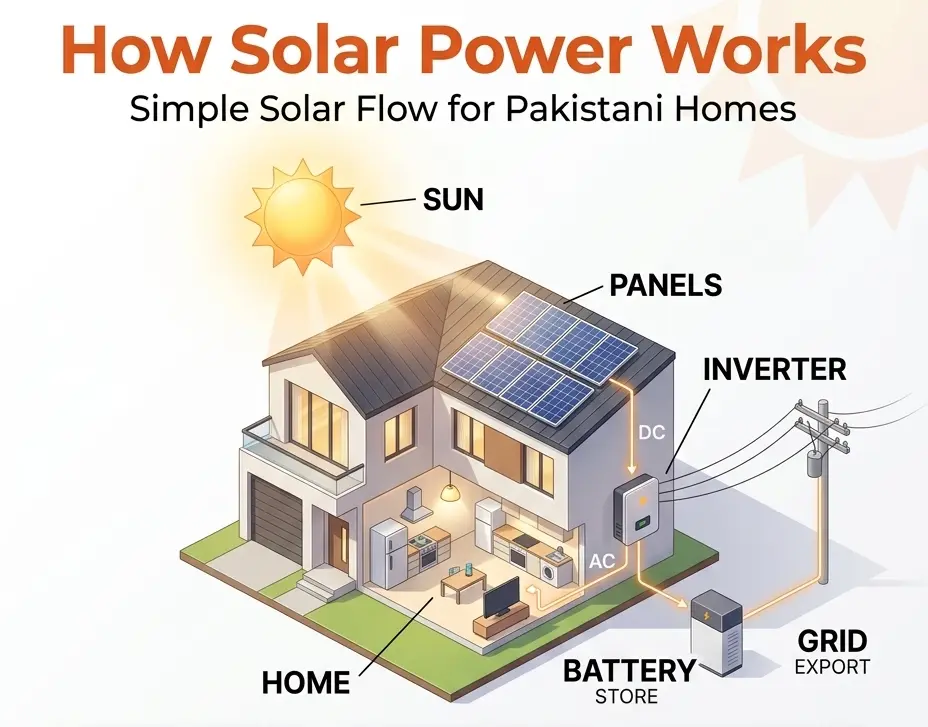
Solar power basics come down to one process: sunlight hits photovoltaic (PV) cells in a panel, releases electrons, and generates direct current (DC) electricity. An inverter then converts that DC into alternating current (AC) at 220V/50Hz for your appliances.
The Science Behind Solar Energy (Simplified)
Here is the step-by-step process inside a working solar system:
- Solar panels absorb sunlight and produce DC electricity.
- DC electricity travels through cables to the inverter.
- The inverter converts DC to AC at the Pakistani grid standard (220V/50Hz).
- AC electricity powers your home directly or feeds back to the grid.
- If batteries are installed, excess energy is stored for later use.
No moving parts. No combustion. No fuel cost.
Key Components Every Solar System Must Have
Understanding the parts of a solar system before buying protects you from incomplete setups. A complete solar system components list includes:
Component | Function |
Solar Panels | Generate DC electricity from sunlight |
Inverter | Converts DC to AC electricity |
Mounting Structure | Holds panels at the correct roof angle |
DC Cables and Connectors | Transfers power from panels to inverter |
AC Distribution Board | Routes AC power to home circuits |
Earthing and Protection | Prevents surges, shocks, and fire hazards |
Net Metering Equipment | Required for WAPDA grid connection |
Battery Bank (Optional) | Stores energy for nighttime or backup use |
Skipping the earthing and protection components is the most common and most dangerous mistake beginners make.
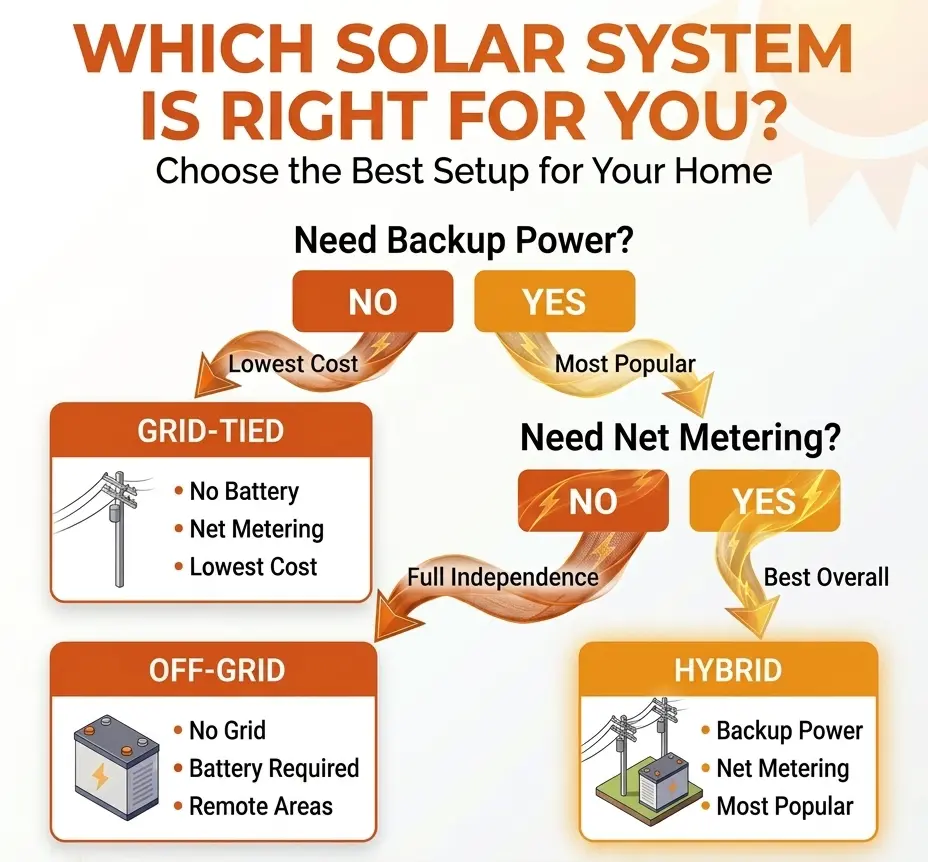
Types of Solar Systems: Which One Is Right for You?
Three system types dominate Pakistan’s solar market. Choosing the wrong one wastes money and may leave you without power during load-shedding.
Grid-Tied vs Off-Grid vs Hybrid: A Simple Breakdown
Grid-Tied Solar System: Connects directly to WAPDA. Uses the grid as a virtual battery, feeding excess power in during the day and drawing from it at night. Best for urban areas with stable grid access. Limitation: shuts down automatically during outages. No backup during load-shedding.
Off-Grid Solar System: Operates independently of the utility grid. Requires a battery bank sized to cover nighttime and cloudy day use. Best for rural areas or locations with severe load-shedding. Limitation: higher upfront cost due to batteries.
Hybrid Solar System: Combines both. Connects to the grid and includes batteries, giving backup during load-shedding while still benefiting from net metering. Best choice for most Pakistani households.
System Type | Grid Required | Battery Required | Load-Shedding Backup |
Grid-Tied | Yes | No | No |
Off-Grid | No | Yes | Yes |
Hybrid | Optional | Yes | Yes |
Choosing the Right Solar Panel: Monocrystalline vs Polycrystalline
Monocrystalline Panels: Made from a single silicon crystal. Efficiency ranges from 19 to 23%. Better heat and low-light performance. Identifiable by their uniform black appearance. In Pakistan’s climate where temperatures regularly exceed 40°C, monocrystalline panels retain more output than polycrystalline alternatives.
Polycrystalline Panels: Made from multiple silicon fragments. Efficiency ranges from 15 to 17%. More affordable per watt. Suitable for large commercial or agricultural rooftops where space is not a constraint.
For rooftops under 600 square feet, monocrystalline is worth the premium. For large open setups, polycrystalline offers acceptable cost-per-watt performance.
Understanding Inverters and Batteries in a Solar Setup
The inverter is the brain of your solar system. The battery is its memory. Getting these two components wrong means your entire system underperforms regardless of panel quality.
What Does an Inverter Do and Why Does It Matter?
An inverter for a solar system does three jobs: converts DC to AC electricity, manages power flow between panels, batteries, and the grid, and protects the system with built-in cutoffs for overvoltage and overcurrent.
In one installation we evaluated, a 10kW panel array was paired with an 8kW inverter. The inverter clipped production during peak hours and reduced annual yield by an estimated 11%. Inverter sizing is not a minor detail.
Common inverter types in Pakistan:
- String Inverters: One central unit for all panels. Lowest cost, easiest to maintain. Best for uniform rooftops.
- Hybrid Inverters: Manages panels, batteries, and grid simultaneously. Required for hybrid systems. SunSaviour’s ALPHA Series, V-Series, X-Series, and X-Plus are widely used hybrid inverter options in Pakistan, compatible with lithium battery storage for full hybrid setups.
Do You Need a Battery? Solar Storage Explained
If your area experiences 2 hours or less of load-shedding daily, a grid-tied system without batteries is sufficient. Above 4 hours, solar battery storage becomes a practical necessity.
Lead-Acid Batteries: PKR 25,000 to 60,000 per 200Ah unit, 3 to 5 year lifespan, requires ventilation.
Lithium Iron Phosphate (LiFePO4): PKR 80,000 to 150,000 per 100Ah unit, 8 to 12 year lifespan, safer chemistry, deeper discharge capability (80 to 90% vs 50% for lead-acid).
For a household running a refrigerator, 6 fans, and lighting through 8 hours of load-shedding, a lithium battery bank of 200 to 300Ah at 48V is the minimum viable storage.
SunSaviour’s Lithium Battery Series is designed to pair directly with their hybrid inverter range.
Solar System Safety Rules Every Homeowner Must Follow
Electrical Safety Basics Before and After Installation
Before installation:
- Hire an AEDB-registered installer.
- Install a DC isolation switch between panels and inverter.
- Ensure your distribution board has a dedicated solar circuit breaker.
- All conduit and junction boxes must be rated IP65 or higher for outdoor UV exposure.
After installation:
- Never open the inverter housing while the system is live.
- Do not attempt DIY repairs on the DC side. String DC voltages of 300 to 600V are lethal.
- Install a surge protection device (SPD) on both DC and AC sides.
Ground all metal mounting structures and panel frames to an earth electrode. A single ungrounded frame during a fault condition can electrify your entire roof structure.
How to Maintain Your Solar System for Long-Term Performance
- Monthly: Visual inspection for dust or damage. Check inverter for fault codes.
- Quarterly: Clean panels with a soft cloth and clean water. Check all cable connections for heat discolouration.If you are looking for trusted solar inverters and lithium battery storage in Pakistan
- Annually: Thermal imaging scan of connections and junction boxes to detect hotspots before they cause fires.
In our experience servicing systems across Lahore and Rawalpindi, the most common performance loss culprit is not panel degradation. It is dusty panels and loose DC connectors that were never re-torqued after the first monsoon season.
How to Size and Plan Your Solar System the Right Way
Using a Solar Calculator to Estimate Your Needs
Here is the manual sizing method for Pakistan:
Step 1: Calculate your daily load. List every appliance, its wattage, and daily usage hours.
Example: Refrigerator 150W x 24h = 3,600 Wh. Four fans at 75W x 12h = 3,600 Wh. Eight LED lights at 10W x 6h = 480 Wh. Total: 7,680 Wh.
Step 2: Divide by peak sun hours. Pakistan averages 5 peak sun hours in most urban areas.
Required capacity = 7,680 divided by 5 divided by 0.80 (system efficiency) = 1,920W. Round up to a 2kW system.
Step 3: Size your inverter and battery. Inverter should be rated at panel output plus 20% overhead. Battery size depends on load-shedding hours and battery type.
Understanding Solar System Cost and Return on Investment
System Size | Type | Estimated Cost (PKR) | Approx. Monthly Savings |
3 kW | On-Grid | 4,50,000 to 6,00,000 | PKR 8,000 to 12,000 |
5 kW | Hybrid | 8,50,000 to 12,00,000 | PKR 14,000 to 20,000 |
10 kW | Hybrid | 16,00,000 to 22,00,000 | PKR 28,000 to 40,000 |
At current tariffs of PKR 50 to 65 per unit, a well-sized 5kW hybrid system typically achieves payback in 3.5 to 5 years. With a 25-year panel lifespan, net ROI exceeds 400% in most cases.
Installation labour and civil work typically adds PKR 50,000 to 1,50,000 to any quoted price. Always request itemised quotes, not lump-sum figures.
Solar in Pakistan: What Makes It Different?
Temperature derating: Solar panels lose approximately 0.4 to 0.5% efficiency per degree Celsius above 25°C. In Lahore during July, roof temperatures can exceed 65°C. A panel rated at 400W under standard test conditions may deliver only 340 to 360W. Size your system with this derating factored in.
Dust accumulation: Punjab experiences heavy dust storms and smog from October to January. Panels left uncleaned for 3 to 4 weeks during smog season can lose 15 to 25% of output. Monthly cleaning is not optional in these regions.
Net metering reality: WAPDA approval timelines vary widely by DISCo and feeder load. Urban Punjab applications can take 60 days. Others have taken 6 to 12 months. Plan your timeline accordingly.
Start Your Solar Journey the Safe and Smart Way
Pakistan’s solar opportunity is real. Irradiance is high, electricity tariffs are rising, and equipment costs have dropped significantly in the last three years.
This safe solar system guide for beginners gives you the foundation. Use it to evaluate quotes and make decisions based on your actual load, not an installer’s estimate.
Three steps before signing any contract: calculate your real daily load, get at least three itemised quotes comparing component brands, and verify your installer’s AEDB registration.
The solar return on investment in Pakistan is among the best in South Asia. Go in informed and it becomes one of the most reliable financial decisions a homeowner can make.
SunSaviour supplies hybrid inverters, on-grid inverters, and lithium battery storage solutions for residential and commercial solar systems in Pakistan. Visit sunsaviour.com or stop by the Peshawar sales and service centre on Main University Road, Board Bazar, for a technical consultation before you buy.
Frequently Asked Questions
What is the minimum solar system size for a Pakistani home?
A typical 3-bedroom home with moderate usage requires a 5kW system to cover most daytime load. Smaller 3kW systems suit apartments or very low-consumption households.
Can solar panels work during load-shedding?
Grid-tied systems shut down automatically during outages. Only hybrid or off-grid systems with batteries provide power during load-shedding.
What maintenance does a solar system need?
Monthly cleaning, quarterly connection checks, and an annual professional inspection. Lead-acid batteries require electrolyte checks. Lithium batteries need BMS monitoring.
How long do solar panels last in Pakistan’s climate?
Quality monocrystalline panels carry 25-year linear power output warranties. Degradation rates of 0.5 to 0.7% per year are typical.