An on grid inverter converts solar DC power from your panels into AC power that feeds your home and, when there is surplus, the utility grid. It works only while the grid is live. The moment the grid goes down, it shuts off by design, which protects utility workers and keeps your system safe.
That single rule shapes every decision about this type of system in Pakistan. This guide explains how an on grid inverter works, why it stops during load shedding, the power electronics inside it, and what to check before buying one.
What Is an On Grid Inverter?
An on grid inverter, sometimes called a grid-tied inverter or grid-connected inverter, is designed to operate in parallel with the utility supply. It takes power from solar panels, matches its output waveform and frequency to the grid, and pushes energy into your home loads first. Any surplus flows back to the grid.
It has no battery input. It does not store energy. If you want backup power during outages, you need a different system design, which we cover in our hybrid inverter buying guide for Pakistan.
For a basic definition, a solar inverter 5kw is a common size for a home with moderate daytime loads. Its output must still match the grid it connects to, which is why grid behavior matters as much as capacity.
How an On Grid Inverter Works
The core job breaks into four steps.
Step 1: Panels produce DC power. Sunlight hits the modules and creates direct current at a voltage that varies with irradiance and temperature.
Step 2: The inverter tracks the best operating point. Most units use Maximum Power Point Tracking (MPPT) to keep the panels working near their highest output as conditions change. An MPPT inverter can follow changes in light and temperature more effectively than a unit without tracking. Confirm the MPPT input count and voltage range on the datasheet for your roof layout, because a mppt solar inverter with the wrong input range will not harvest the energy your panels can produce.
Step 3: The inverter converts DC to AC. Power electronics switch the DC supply rapidly to build a sine-wave output. This is where the semiconductor choice matters, which we cover below.
Step 4: The inverter syncs with the grid. Before it connects, the inverter measures the grid voltage and frequency and matches its own output to them. Once synced, it feeds power in parallel with the grid. This is the step that makes an inverter grid connected system possible.
The result is simple from the household side. Your appliances draw from the inverter first. Any shortfall comes from the grid. Any surplus goes back out.
Understanding this flow also explains how on grid inverter works in practice. The inverter does not decide the grid’s behavior. It follows the grid, and it stops when the grid stops.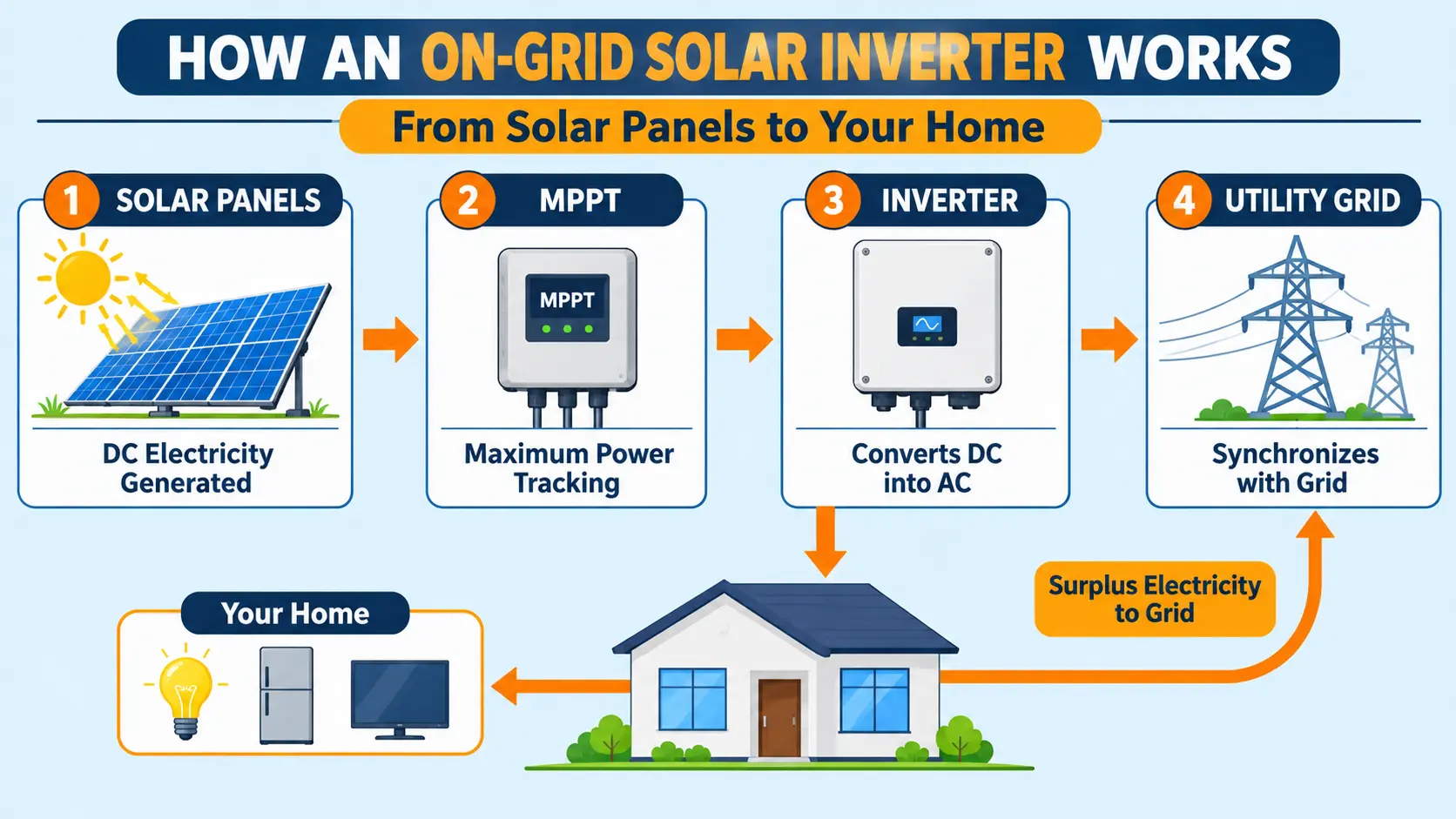
Why an On Grid Inverter Shuts Down During Outages
This is the most important safety point in the entire guide, and it is the one most buyers misunderstand.
An on grid inverter must stop feeding power when the grid is unavailable. This rule is called anti-islanding protection. If the inverter kept energizing a line that utility crews believe is dead, it could injure a worker repairing the network. Standards require the inverter to detect loss of grid and disconnect within a short time.
So a grid-tied system without a battery produces no power during load shedding, even on a bright afternoon. Panels may still be generating, but the inverter will not feed the home while the grid is down.
If you need power during outages, a grid-tied unit alone is not the answer. You need a battery-based hybrid design with a backup function, and the inverter and battery must be specified for that purpose.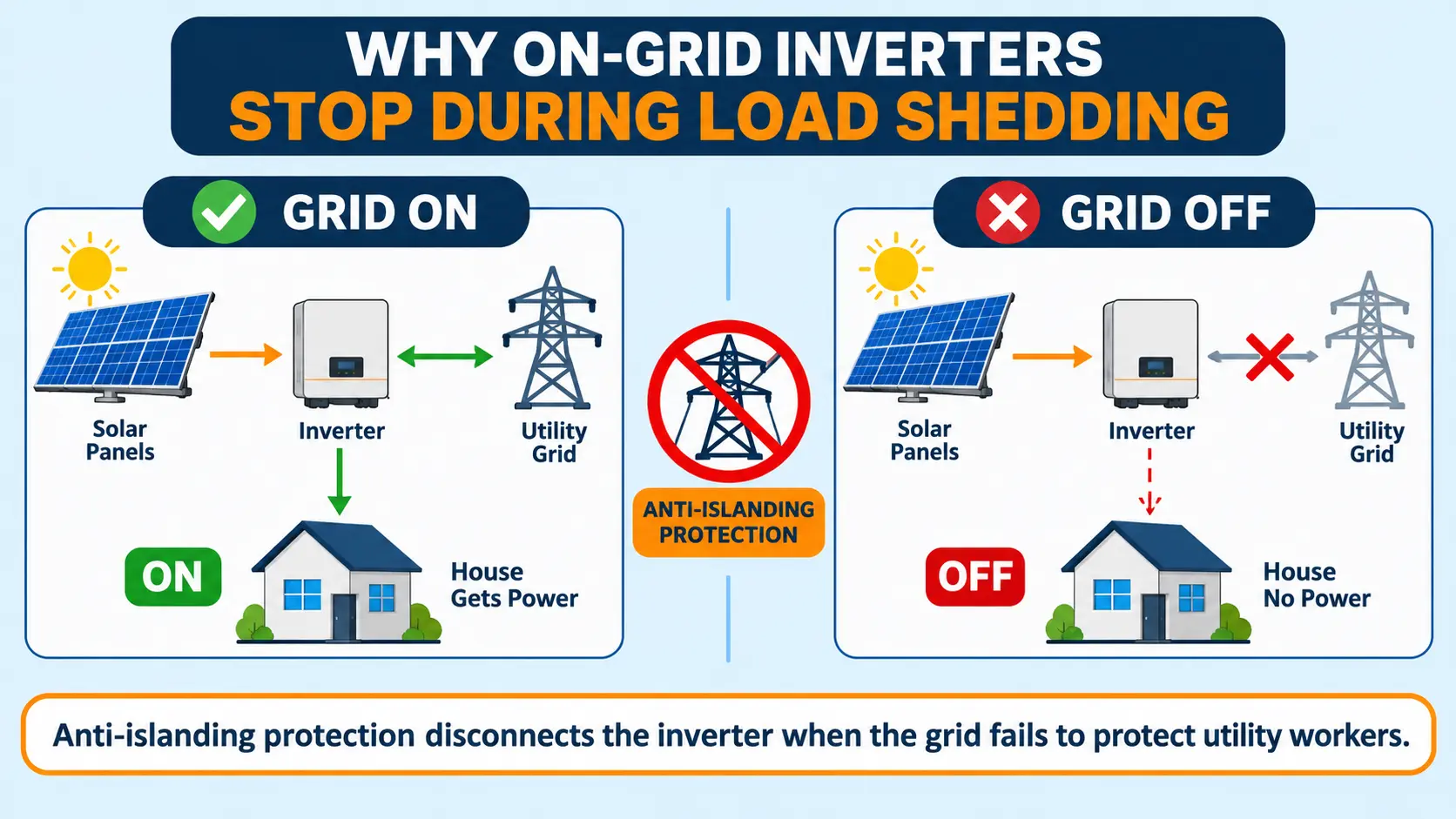
IGBT in Solar Inverter Design
Many on grid inverter designs use insulated-gate bipolar transistors (IGBTs) as the switching devices in the DC-to-AC stage. An IGBT combines the easy drive of a MOSFET at the gate with the ability to carry high current and block high voltage. That makes IGBTs common in medium-power inverters.
When people search for an igbt inverter, they usually want to know whether the device is suitable for the power level and grid connection they need. An igbt inverter circuit typically uses the switching devices in an H-bridge or three-phase bridge arrangement, with a gate driver and filter on the output. The igbt inverter working principle is straightforward. The switches turn on and off in a controlled pattern, and the filter smooths the result into a sine wave that matches the grid.
Designers choose the switching device based on power level, switching frequency, efficiency target, and cost. IGBTs are generally used where high power and robust voltage handling matter most. A high-power igbt module inverter often packages several switches and their drivers together for easier assembly and thermal management.
Do not decide purchases on component names alone. A well-designed unit with good thermal management and quality components matters more than a single device type. Ask the manufacturer for the specification sheet and the efficiency curve.
Advantages of IGBT Over MOSFET
Both IGBTs and MOSFETs are used in inverter power stages, and each has trade-offs.
IGBT advantages include high current handling and strong performance at high voltage, which suits medium and larger power inverters. Conduction losses at high current can be lower than for some MOSFET designs at the same voltage rating.
MOSFET advantages include faster switching speed and lower switching losses at high frequency. They are often used in lower-power or high-frequency stages.
The igbt vs mosfet switching speed comparison depends on the circuit, gate driver, and operating frequency. MOSFETs typically switch faster, but faster switching does not always improve the overall result if losses, EMI, or thermal limits become the constraint.
The question igbt vs mosfet which is better has no single answer. For a high-power grid-tied inverter, IGBTs are often a practical choice. For lower-power, high-frequency designs, MOSFETs may suit better. Choose based on the complete design performance and the manufacturer’s test data rather than a general rule.
How On Grid Inverter Works on Pakistan’s Grid
Pakistan’s distribution network experiences voltage variation, load shedding, and periods of low voltage in some areas. A grid-tied inverter must tolerate normal variation and disconnect when the grid moves outside its allowed window.
Practical points for buyers:
- Check the grid voltage and frequency windows in the inverter datasheet. The unit should accept the range it will see at your connection point.
- Look for protection functions such as over-voltage, under-voltage, over-frequency, and under-frequency disconnection.
- Ask about surge protection. Pakistan’s distribution network can produce sharp spikes. An over voltage protector at the AC or DC side reduces risk to the inverter. Ask whether one is built in or sold separately.
- Confirm grid code compliance with the distribution company and the relevant regulator before connection. Requirements can change, so check current rules with your DISCO.
Ask the installer to show the inverter’s grid protection settings as configured for your site.
Inverter for Unstable Grid and Voltage Fluctuations in Pakistan
Voltage fluctuation is a common concern for households and small businesses. An inverter for voltage fluctuations in Pakistan should have a wide input and grid tolerance window, clear fault codes, and automatic recovery after normal grid returns.
Buyers searching for an inverter for an unstable grid in Pakistan should check the same points. A unit that handles a wide grid window and reconnects cleanly after brief disturbances performs better on weak feeders than one with narrow limits.
A grid-tied inverter will disconnect during severe low or high voltage events. This protects equipment and meets safety rules, but it also means production stops. If your area sees frequent outages or unstable supply, combine the on-grid design with an assessment of backup needs.
For detailed backup planning, see our guide on choosing a hybrid inverter for Pakistan.
Solar Inverter Requirements Checklist
Before buying an on grid inverter, confirm these solar inverter requirements:
- Phase match: single-phase for most homes, three-phase for commercial supply
- PV input: voltage and current range match your string design
- MPPT: number of inputs suits your roof orientation and shading
- Grid window: voltage and frequency range covers your connection point
- Protection: anti-islanding, over-voltage, under-voltage, over-frequency, under-frequency, and surge protection
- Efficiency: published peak and weighted efficiency from the datasheet
- Enclosure: IP rating suitable for outdoor or covered indoor installation
- Temperature: operating range covers local summer conditions
- Warranty: term stated and local service contact confirmed
- Compliance: DISCO approval and certification documents available
Solar Inverter Function Explained
The solar inverter function is to convert panel DC into grid-quality AC, track the panels for maximum output, and protect both the system and the grid. Each of these functions depends on the others. Good tracking produces nothing if the conversion stage is weak, and good conversion is useless if the grid protection disconnects the unit too often.
When comparing units, look at the whole function rather than one specification. A grid-connected inverter that tracks well, converts efficiently, and handles the local grid window will deliver more usable energy over its life.
Who Should Choose an On Grid Inverter
An on grid inverter suits homes and businesses that have reliable grid supply, want to cut daytime bills, and do not need power during outages. It is usually the lowest-cost route to solar generation in areas with few outages.
It is a weaker match for households that depend on power during load shedding. For those buyers, a hybrid system with batteries provides the backup function the grid-tied design cannot.
Consider your load profile honestly. Ask how many hours per day you lose supply, which appliances must stay on, and whether you export surplus energy under current net billing rules.
Pre-Purchase Notes
Compare grid-connected inverter options using the same specification sheet. Look at input limits, grid window, protection list, efficiency, warranty, and local service. Confirm the product is genuine by buying from an authorized dealer and checking serial numbers with the manufacturer where possible.
For SunSaviour customers, the SunSaviour on-grid inverter range is the place to check current models, specifications, and availability before you request a quote.
Frequently Asked Questions
Does an on grid inverter work without the grid? No. It needs a live grid to operate and shuts down during outages for safety. Use a hybrid system with a battery if you need backup power.
Can an on grid inverter give backup power during load shedding? Not on its own. A grid-tied inverter without a compatible battery stops during outages even if the panels are producing.
What is the difference between an on grid inverter and a hybrid inverter? An on grid inverter feeds solar power to the home and grid, with no battery input. A hybrid inverter also manages battery charging and discharging and can supply loads during outages.
What is a grid-tied inverter? A grid-tied inverter is another name for an on grid inverter. It synchronizes with the utility supply and feeds solar power into the network.
Why does my on grid inverter turn off when the grid fails? Anti-islanding protection requires the inverter to disconnect when the grid is lost, so utility workers are not exposed to energized lines.
Does MPPT matter in an on grid inverter? Yes. MPPT keeps the panels operating near their maximum power point as light and temperature change, which affects daily energy yield.
Is an IGBT inverter better than a MOSFET inverter? It depends on power level, switching frequency, and design. IGBTs are common in medium and larger power inverters, while MOSFETs are often used for faster switching. Compare complete specifications rather than the device name.
What size on grid inverter do I need? Size the inverter to your panel array and the load you want to offset. A common approach is to pair panels with an inverter in a DC-to-AC ratio that suits your site, then confirm with a load and generation estimate.
Do I need an over voltage protector with an on grid inverter? It is strongly recommended in areas with voltage spikes. Check whether the inverter has built-in protection and whether an external overvoltage protector is needed.
Conclusion
An on grid inverter is a simple, efficient way to turn solar panels into lower daytime grid bills, provided the grid is available. It converts DC to AC, tracks the panels’ best operating point, syncs with the grid, and shuts down during outages for safety.
Choose one by matching its input limits, grid window, protection functions, and warranty to your site. If outages are a regular problem, a hybrid design with batteries is the better fit. Verify every specification on the datasheet before you buy.
Sunsaviour’s on-grid inverter range is built for grid-connected homes and businesses. Check current models and specifications at sunsaviour, and speak with our team about grid conditions at your site.