The Unreliable Grid and the Threat to Your Harvest
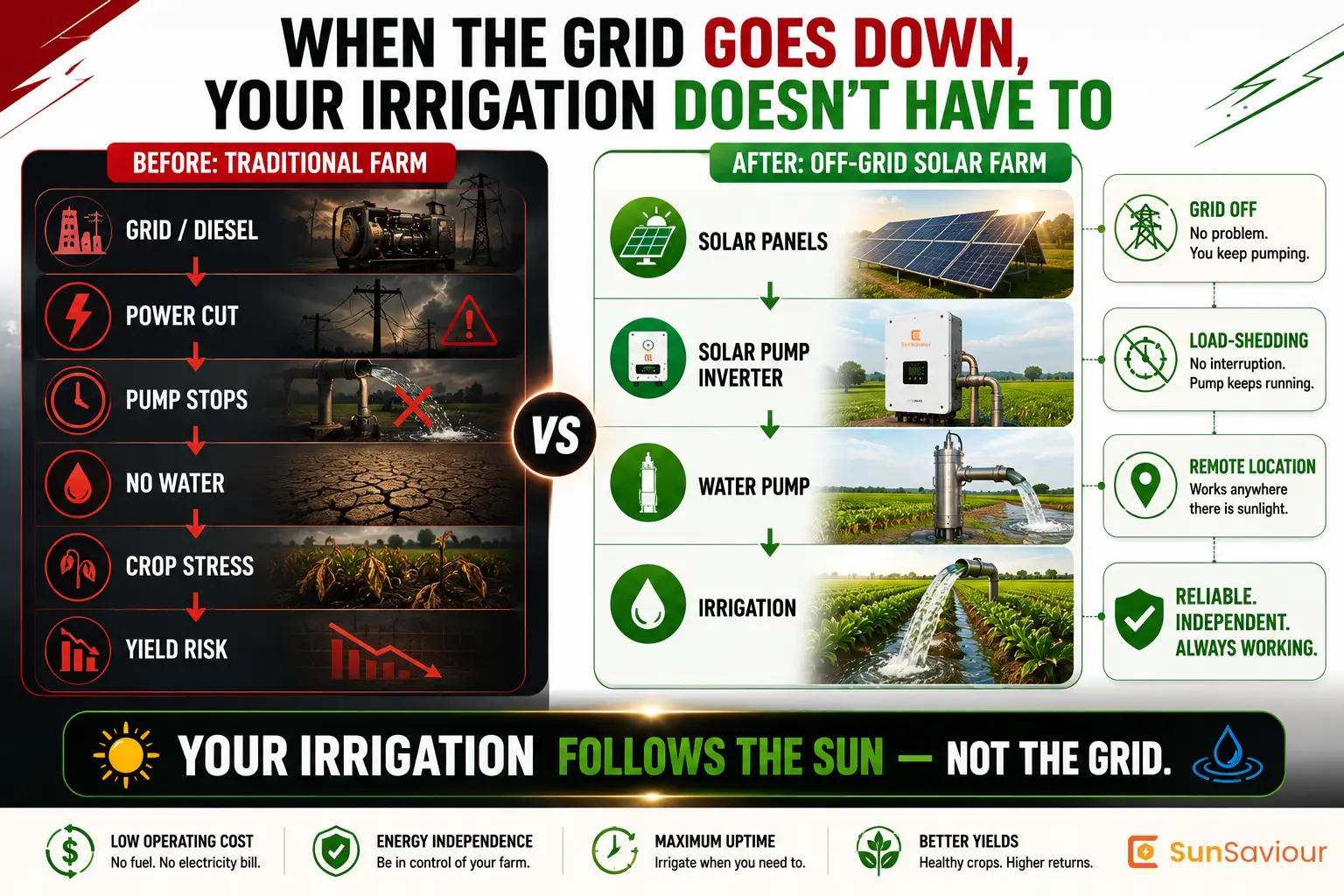
Every farmer in Pakistan’s agricultural regions, such as Sargodha or Multan, knows the feeling. The power goes out right when the crops need water most. Load-shedding of 10 to 12 hours a day has become normal in many areas. Relying on erratic grid electricity is no longer a sustainable way to irrigate.
Traditional farming stays vulnerable to grid instability. That instability leads to crop water deficits, lower yields, and reduced productivity across the season. A missed watering window during a critical growth stage can cost far more than the fuel bill ever did.
Solar pumps for unreliable electricity offer a way out of this cycle. Reliable solar irrigation runs on daylight, not on WAPDA’s schedule. It operates consistently during peak daylight hours when solar irradiance is abundant, exactly when crops need water most anyway.
For farms further from urban centers, solar irrigation for rural areas solves a second problem too. Grid connections in these areas are often thin, overloaded, or simply absent. Solar-powered pumping gives farmers complete control over their own watering schedule, regardless of what the grid is doing.
Going Off-Grid and What Energy Independence Actually Means
Going off-grid is not just about clean energy. It’s about absolute freedom from utility companies and high fuel bills. For a working farm, that freedom translates directly into fewer disruptions and more predictable costs.
A solar-powered pumping setup works by using a solar array of photovoltaic panels to convert direct sunlight into DC electricity. That electricity powers a motor, which lifts water from the source. No fuel line, no grid cable, no meter.
By switching to an off-grid setup, farmers no longer pay high electricity tariffs. They also stop buying expensive diesel fuel to run generators. This is the foundation of off-grid solar irrigation, and it applies whether the farm sits on a single acre or spans hundreds.
Off-grid solar pumping also opens up land that was previously unusable. Barren, remote land without electricity grid access can now be fully irrigated and cultivated. Off-grid solar pumps bring water to places the grid was never going to reach.
This is why off-grid water pumping has become the standard recommendation for solar irrigation for off-grid farms. An off-grid irrigation system does not depend on infrastructure decisions made by a utility company. It depends only on sunlight, which every farm in Pakistan has in abundance.
For farmers weighing their options, off-grid solar pumping systems and off-grid solar water pumping setups both remove the grid from the equation entirely. Solar pumping systems for off-grid areas are now common enough that sizing and installation are well understood, even for remote plots. A grid-independent solar pumping setup, once installed, simply runs.
Pumping Water Day, Night, and on Cloudy Days with Battery Backup
Farmers ask this question often. What happens when the sun goes down, or clouds cover the sky for a few days? The answer is battery integration, and it keeps irrigation plans running without interruption.
A solar pump backup system using lithium battery banks stores excess solar power generated during peak sunshine hours. That stored energy doesn’t go to waste. It gets used later, when the panels aren’t producing.
This stored power supports night-time watering. It also keeps automated drip cycles running during overcast weather, when panel output alone might not be enough. A solar pump battery bank turns a daylight-only system into a round-the-clock one.
A solar pumping system with battery does more than extend hours of operation. A robust battery bank also protects the system controller. It helps bear the high motor torque needed at pump start-up, which extends the pump’s overall working life.
A solar water pumping system with battery is the right choice for farms that need consistent, scheduled irrigation regardless of weather or time of day. Solar pumping system battery backup gives that consistency without adding a diesel generator into the mix.
Battery-Free Systems That Store Water Instead of Electricity
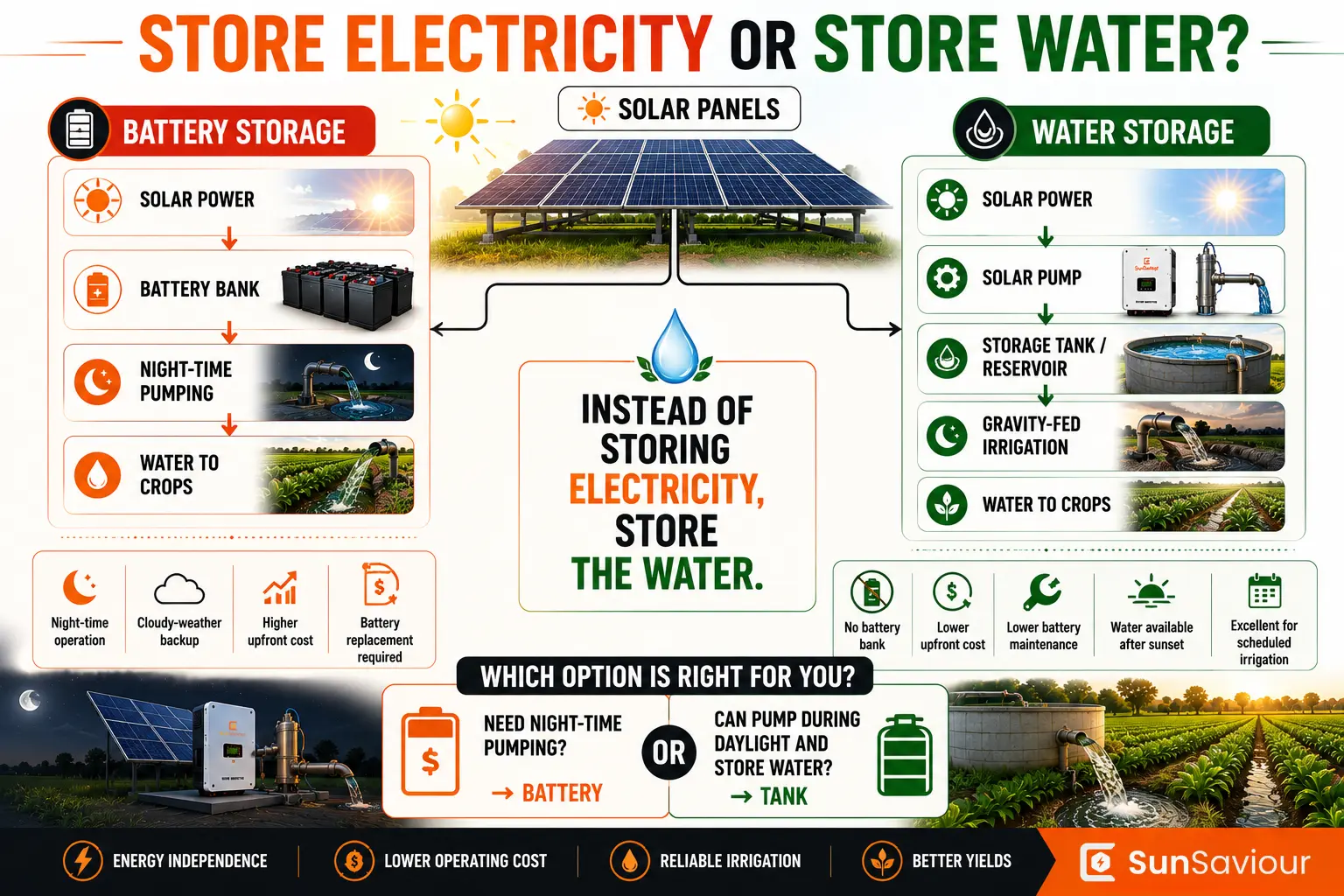
For farmers who want a lower upfront cost than battery banks, there is a simpler alternative. Instead of storing electricity, store the water itself.
A battery-free solar pumping system runs directly off the solar panels. Pump speed adjusts automatically based on sunlight intensity throughout the day. There is no battery to buy, monitor, or replace down the line.
During the day, direct solar pumping pushes water straight into a water storage tank or reservoir. This is sometimes called direct solar water pumping, since the panels power the pump with no electrical storage step in between.
When the sun goes down, or during load-shedding hours, the farm draws on the tank instead of the grid. Gravity-fed irrigation from the water storage tank distributes water to the fields on schedule, even when the pump itself isn’t running.
A solar pump system without battery dramatically reduces initial construction costs. A solar pump system without batteries also cuts long-term maintenance, since there are no battery cells to service or eventually replace. Solar pumping without batteries is a genuinely budget-conscious path to reliable irrigation.
Solar water pumping without batteries works especially well when paired with a properly sized solar pump storage tank. The tank does the job a battery would otherwise do, just with water instead of charge. This approach to solar water pumping and storage, sometimes called a solar water pumping storage system, suits farms that would rather invest in tank capacity than in battery replacement cycles.
Smart Automation, Let Your Farm Water Itself
Farmers already have enough hard labor to manage. Standing in the sun to flip a switch on and off shouldn’t be one of them. Modern automation accessories handle that job instead.
An automatic solar pumping system pairs an advanced controller and inverter with sensors that regulate operation on their own. Solar pump automation means the system responds to actual field conditions, not a fixed schedule someone has to remember.
Solar pump automatic control can start pumping the moment soil moisture drops below a set level. It can stop once the storage tank is full, or if the well runs dry, which prevents damaging dry extraction of the pump itself.
A water level switch is central to this setup. Solar pump water-level control and solar water level control keep the tank from overflowing or the well from running empty, without anyone watching the levels manually.
Solar pump water-level detection and solar water level detection work together with soil moisture sensing for full automation. A solar pumping system with water-level detection and a solar pumping system with water level control cut labor requirements down to nearly zero while improving solar pumping system reliability across the season.
Reliable Water Delivery for Tough and Remote Terrains
Farmers working in remote, mountainous, or hilly areas face a different set of problems. Grid lines were never built out there. Hauling diesel fuel over rough roads is expensive and, in bad weather, sometimes impossible.
In rugged or undulating terrain, harvesting water from distant streams, rivers, or deep wells has historically been difficult and costly. A solar water pumping system for remote areas removes the fuel-hauling problem entirely, since the power source is already on site.
High-efficiency solar pump for remote areas setups are highly adaptable. They can lift water from depths of 10 meters up to 250 meters, covering everything from shallow wells to deep boreholes.
This makes solar-powered irrigation for remote areas a practical fit for grazing land, grassland livestock operations, and farms that sit well outside any grid corridor. Solar irrigation for remote areas brings a reliable, year-round water supply to places that have never had one.
Solar pumping systems for remote areas and solar pumps for remote areas are increasingly common across Pakistan’s hill and mountain regions. Solar pumps for rural areas more broadly are closing a gap that grid expansion alone was never going to fill.
Bulletproof Your Farm Against Grid Unreliability
Load-shedding doesn’t have to mean crop failure. A high-efficiency solar setup, built from premium panels, an intelligent inverter, and the right battery or tank storage, gives farmers complete peace of mind through every power cut.
Whether the right fit is a battery-backed system for round-the-clock watering, a battery-free setup with tank storage, or full automation with water-level sensors, SunSaviour’s product catalog covers every configuration built for Pakistani farm conditions. Explore the full range of solar irrigation solutions at sunsaviour.com and take the next power cut out of your farm’s equation.