The Battery You Choose Determines How Well Your Solar System Performs
The advantages of lithium-ion solar batteries come down to one fact: they keep more of the power your panels generate usable, for longer, with less upkeep. That difference compounds every single day your system runs.
Among the benefits of lithium-ion batteries, lifespan and efficiency matter most, but they aren’t the whole story. Knowing why choose lithium battery technology over lead-acid means looking at performance under real conditions, not just a spec sheet.
Lithium-Ion vs Lead-Acid: A Direct Comparison
A lithium-ion vs lead acid solar battery comparison favors lithium on nearly every measurable metric except upfront price. The gap is wide enough that it changes how a system should be designed from the start.
Key Performance Metrics Side by Side
Metric | Lithium-Ion (LiFePO4) | Lead-Acid |
Round-trip efficiency | 95–98% | 80–85% |
Typical charge time | 2–4 hours | 8–16 hours |
Safe depth of discharge | 80–95% | Around 50% |
Cycle life (80% DoD) | 2,000–7,000 cycles | 300–1,000 cycles |
Typical lifespan | 8–15 years | 3–5 years |
Lithium battery energy efficiency alone explains much of this gap. A lead-acid bank wastes 15 to 20% of stored energy as heat, while lithium wastes only 2 to 5%.
Why Lead-Acid Falls Short for Modern Solar Setups
Among the benefits of lithium batteries over lead acid, usable capacity stands out most. Because lead-acid degrades quickly past 50% discharge, a lead-acid bank needs roughly double the rated capacity to deliver the same backup power as lithium.
This is one of several deep cycle lithium battery advantages that shrink the physical footprint and weight of a system for the same usable output.
Advantage 1: Longer Lifespan and More Charge Cycles
Lithium-ion battery lifespan is the single biggest reason Pakistani installers are shifting away from lead-acid. A longer-lasting battery means fewer replacements and less disruption over the life of a solar system.
How Depth of Discharge Affects Battery Longevity
Lithium battery depth of discharge tolerance is what protects lithium-ion battery lifespan even under daily heavy use. LiFePO4 cells can be safely discharged to 80 or even 95% without the damage that a lead-acid battery suffers past 50%.
That deeper safe discharge range means a lithium battery can deliver more usable energy per cycle without shortening its working life.
Cycle Life Comparison: Lithium vs Lead-Acid in Real Numbers
A long lifespan lithium battery typically delivers 2,000 to 7,000 cycles at 80% depth of discharge, compared to 300 to 1,000 cycles for lead-acid. Over a 10-year period, this often means replacing a lead-acid bank two to three times before a single lithium battery needs replacing.
These deep cycle lithium battery advantages compound further once you factor in lead-acid’s faster degradation under partial-state-of-charge conditions, which is common in solar systems.
Advantage 2: Superior Energy Efficiency and Faster Charging
Lithium battery performance advantages extend beyond storage capacity into how quickly and efficiently a battery recovers after use.
Why Higher Round-Trip Efficiency Means More Usable Power
Lithium battery energy efficiency of 95 to 98% means nearly all the solar power your panels generate ends up usable, rather than lost as heat during charging and discharging. Lead-acid’s 80 to 85% efficiency means a meaningfully larger array is needed to deliver the same usable output.
SunSaviour’s Lithium Battery Series is built to deliver this efficiency consistently, pairing with the ALPHA Series hybrid inverter to minimize conversion losses across the full charge cycle.
Fast Charging: Getting Back to Full Without the Wait
Lithium battery charging speed is one of the more underrated lithium battery performance advantages for Pakistani households facing daily load shedding. A lithium bank typically recharges in 2 to 4 hours, while a comparable lead-acid bank can take 8 to 16 hours to reach full capacity.
That speed matters most on cloudy days or short sunny windows, when every hour of available charging time counts.
Advantage 3: Zero Maintenance and Safer Operation
A maintenance free battery isn’t a marketing claim with LiFePO4. It’s a direct result of the sealed design and built-in protection electronics that lead-acid batteries simply don’t have.
What Makes Lithium Virtually Maintenance-Free
A low maintenance lithium battery needs no water top-ups, no terminal cleaning, and no equalization charging, unlike lead-acid batteries that require regular upkeep to avoid early failure. This maintenance free battery design is one reason lithium has become the default choice for new installations.
Built-In Safety Features That Protect Your System
Lithium battery safety features like overcharge, over-discharge, and over-temperature protection are built into the battery management system rather than relying on the inverter alone. These LiFePO4 battery benefits include a chemically stable structure that resists the thermal runaway risk seen in other lithium types.
SunSaviour’s Lithium Battery Series includes an integrated BMS that actively manages these protections, so the safety features work even during Pakistan’s extended summer heat.
Advantage 4: Reliable Performance Across Conditions
Lithium battery performance in extreme weather is where the gap with lead-acid widens further, particularly in hot climates like much of Pakistan.
How Lithium Handles Pakistan’s Heat and Load Fluctuations
Lithium battery performance in extreme weather holds up notably better than lead-acid at high temperatures, where lead-acid degrades fastest. This is one of the clearest advantages of lithium-ion solar batteries for a climate with long, hot summers and frequent voltage swings from load shedding.
Consistent Output Whether Fully Charged or Nearly Depleted
Lithium battery depth of discharge tolerance also means power delivery stays steady from a full charge down to near-empty, unlike lead-acid, which sags in voltage as it depletes. These deep cycle lithium battery advantages translate to more predictable backup performance during long outages.
Long-Term Cost Advantage: Is Lithium Worth the Higher Upfront Price?
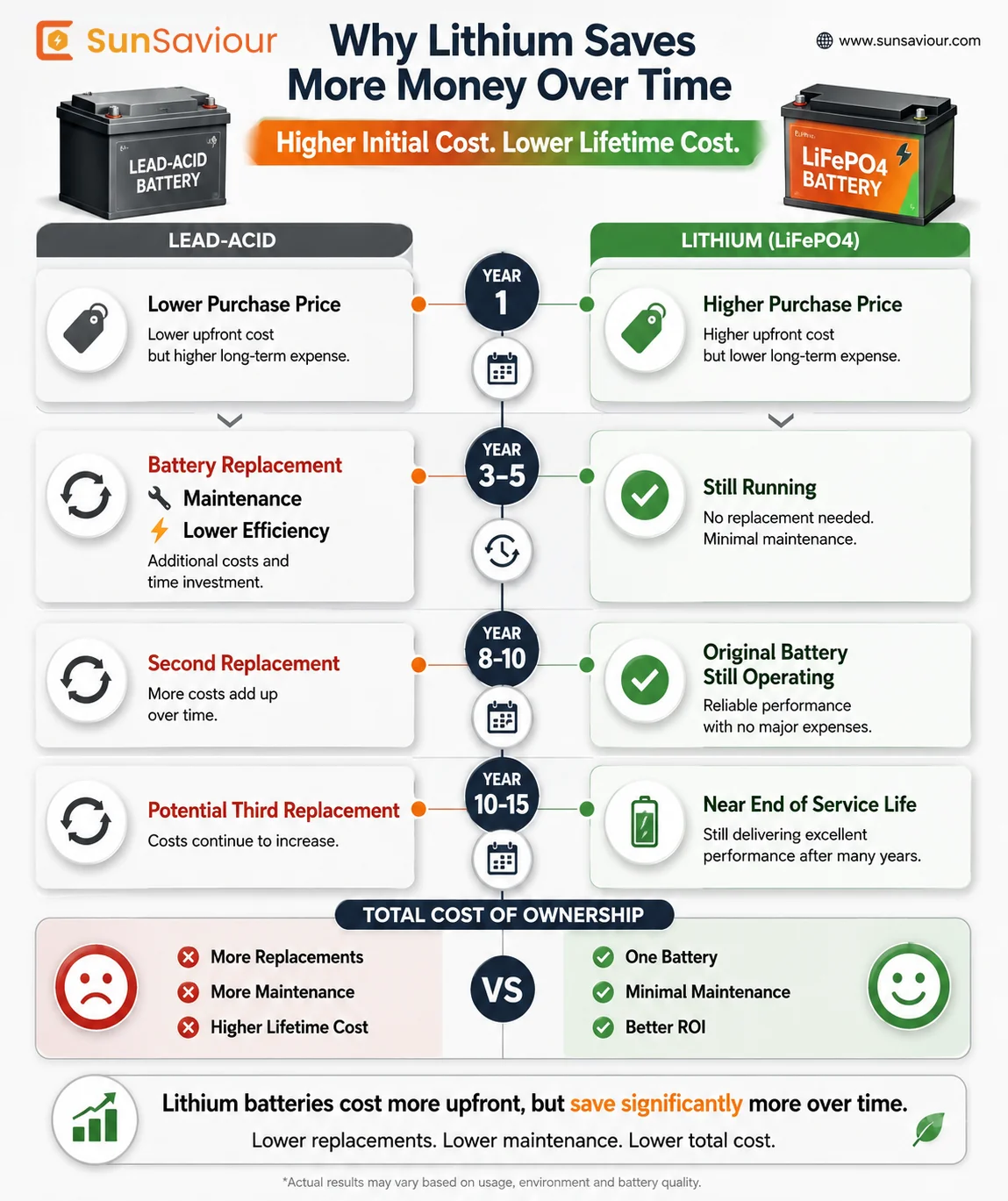
A lithium battery cost vs lead acid comparison only tells the full story when it includes replacement frequency, not just the initial purchase price.
Breaking Down the True Cost Per Cycle
When you divide total price by cycle life, a long lifespan lithium battery frequently costs less per cycle than lead-acid, even with a higher sticker price. Replacing a lead-acid bank two to three times over a decade adds up faster than most buyers expect.
Why Lithium Is the Smarter Long-Term Investment for Pakistan
The future of energy storage lithium batteries is already the present for serious solar buyers in Pakistan. Understanding why choosing lithium battery technology over lead-acid comes down to the total value delivered per rupee spent over the system’s working life, not just the price at checkout.
Explore SunSaviour’s Lithium Battery Series alongside compatible ALPHA Series, V-Series, and X-Plus hybrid inverters at sunsaviour.com, or visit our Peshawar sales and service center for a system comparison.
Lithium-Ion Is Not Just Better: It’s the Only Logical Choice for Solar Storage
The advantages of lithium-ion solar batteries, longer lifespan, faster charging, higher efficiency, and far less maintenance, add up to a clear case over lead-acid for nearly every modern solar setup. The benefits of lithium batteries over lead acid become more obvious the longer a system runs, not less.
If you’re still asking why choose lithium battery technology for your next system, the honest answer is that lead-acid simply can’t keep pace anymore on performance or total cost.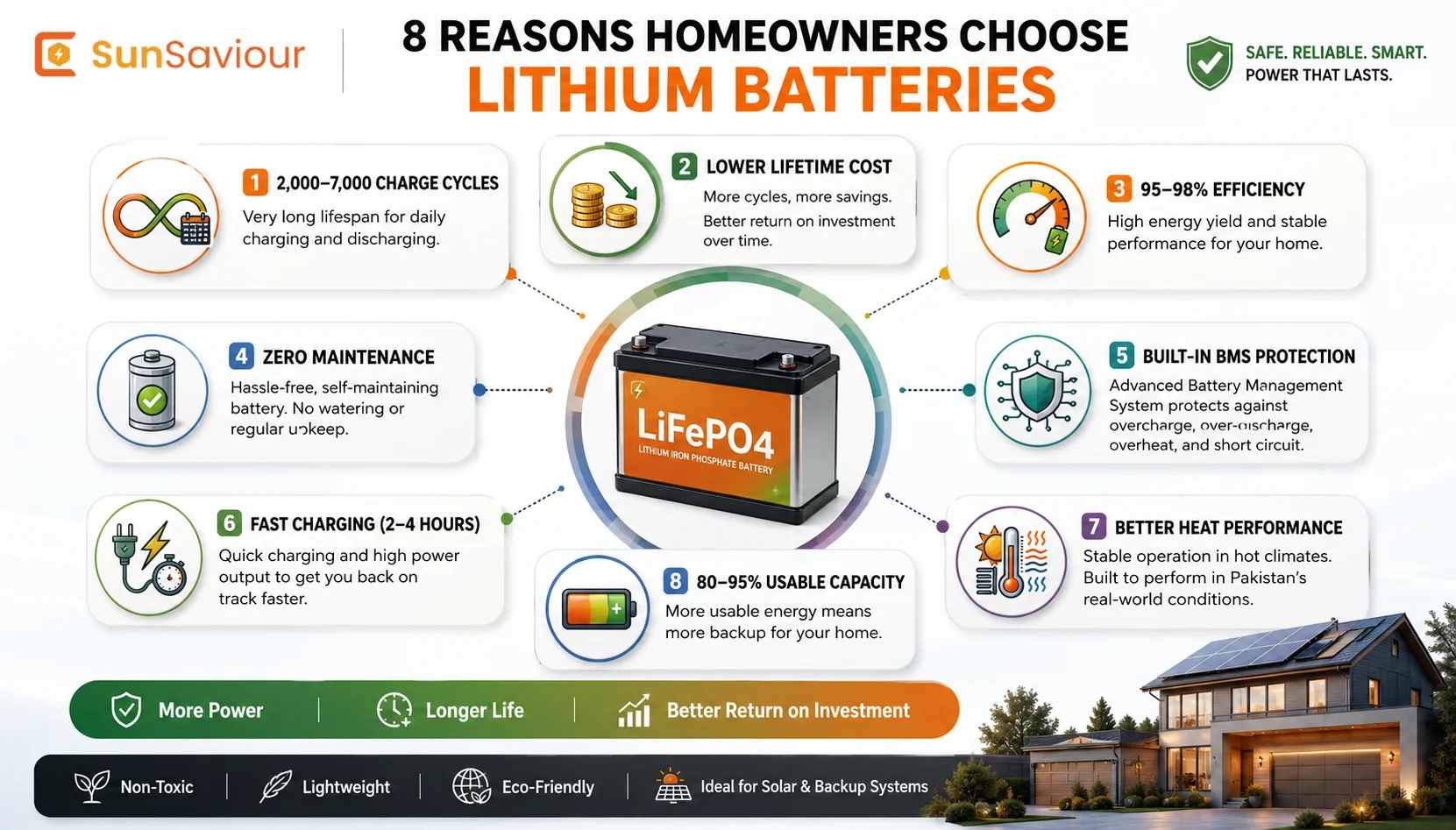
FAQs
What are the main advantages of lithium-ion solar batteries over lead-acid?
Lithium-ion batteries last longer, charge faster, deliver higher efficiency, and need almost no maintenance compared to lead-acid.
How much longer do lithium batteries last than lead-acid?
Lithium batteries typically last 8 to 15 years versus 3 to 5 years for lead-acid, and deliver far more charge cycles over that period.
Is a maintenance free battery really maintenance-free?
LiFePO4 batteries need no water top-ups or equalization charging, though keeping them cool and ventilated still helps maximize lifespan.
Why do lithium batteries charge faster than lead-acid?
Lithium batteries can safely accept a higher charging current, typically reaching full charge in 2 to 4 hours versus 8 to 16 hours for lead-acid.
Is lithium battery depth of discharge really safer at higher percentages?
Yes, LiFePO4 cells can be discharged to 80% or more without damage, while lead-acid batteries should generally stay above 50% to avoid shortening their lifespan.
Does lithium cost more than lead-acid overall?
Lithium costs more upfront, but its longer lifespan and fewer replacements usually make it cheaper over the full life of a solar system.