Why More Pakistani Homeowners Are Switching to Solar
Electricity bills in Pakistan have risen sharply in recent years, and daily load shedding continues to affect homes across the country. For most households, these two pressures have made residential solar energy solutions in Pakistan less of a luxury and more of a practical financial decision.
This guide covers what a home solar system Pakistan setup includes, ten real benefits for homeowners, verified 2026 costs, how the new net billing policy affects your return, and how to choose the right system for your needs.
What Is a Residential Solar Energy System?
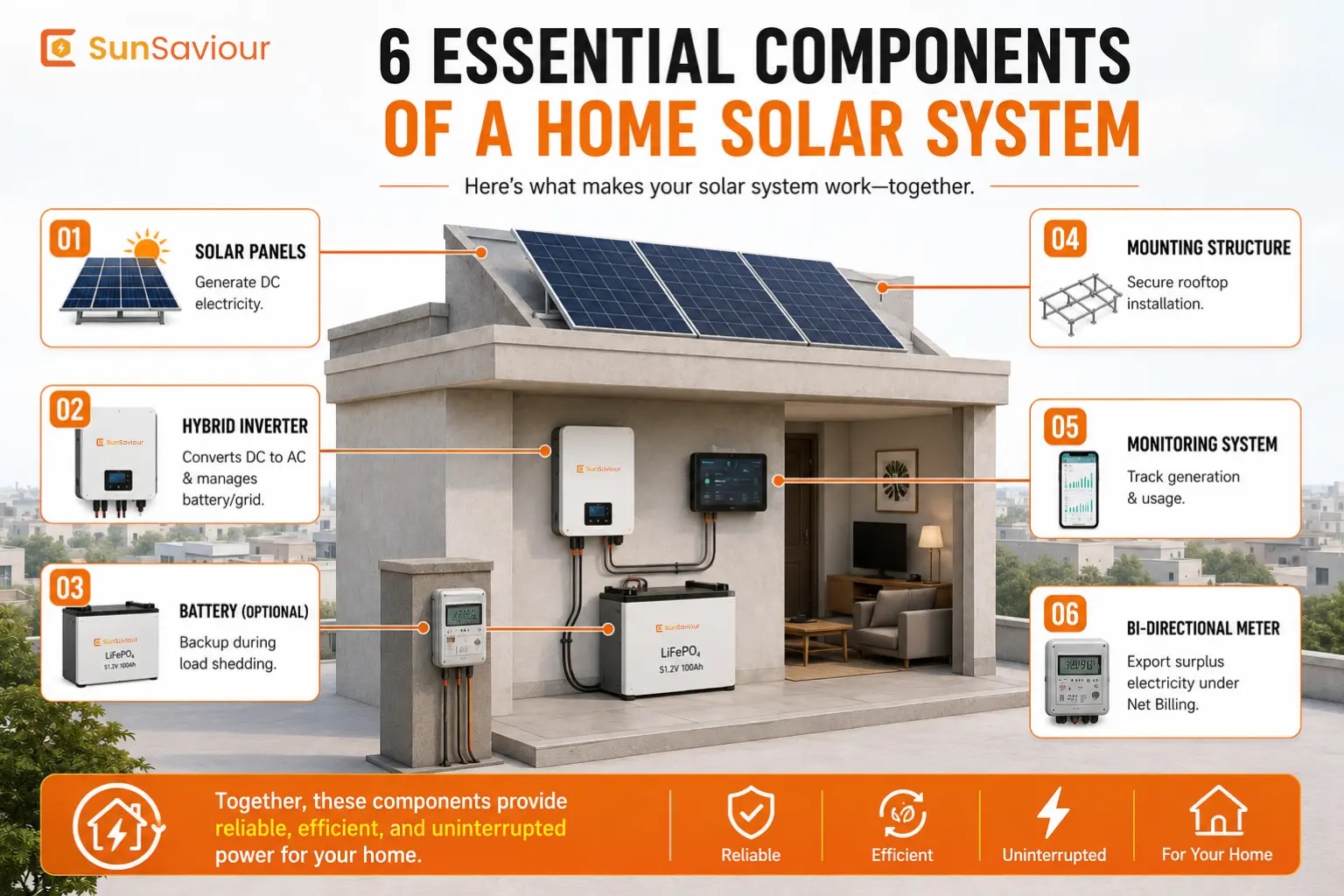
A home solar power system converts sunlight into electricity for your household through six core components.
Solar Panels generate direct current (DC) electricity from sunlight. Most residential panels available in Pakistan today range from 545W to 720W per panel.
Solar Inverter converts DC to alternating current (AC) at 220V for your appliances. Hybrid inverters also manage battery charging and grid interaction simultaneously.
Solar Battery (optional) stores surplus generation for use during load shedding or at night. Lithium iron phosphate (LiFePO4) batteries are now the most commonly recommended type.
Mounting Structure secures panels at the correct angle on your roof.
Monitoring System tracks real-time generation, consumption, and export via mobile or web.
Net Billing Connection allows grid-tied systems to export surplus electricity to WAPDA for bill credits. Pakistan moved from net metering to net billing under NEPRA Prosumer Regulations 2026 in February 2026. New connections are now credited at a lower export rate than the retail import tariff, making self-consumption the primary financial priority.
Why Residential Solar Is Growing in Pakistan
Pakistan receives 5 to 6.5 peak sun hours daily across most urban areas, among the highest in the region. Combined with rising grid tariffs and persistent load shedding, solar installation for home Pakistan has become one of the most financially defensible investments available.
Under NEPRA Prosumer Regulations 2026, oversized systems that export heavily now earn significantly less per exported unit than before. Systems sized around daytime self-consumption deliver the strongest returns, which favors hybrid systems with battery storage for households not at home during the day.
10 Benefits of Residential Solar Energy Solutions
1. Lower Electricity Bills
Solar energy for home use offsets daytime grid consumption directly. Homes running refrigerators, water pumps, and appliances during daylight hours benefit most from immediate bill reductions.
2. Protection From Rising Electricity Prices
Solar panels for homes in Pakistan lock in a portion of your electricity supply at zero per-unit cost after installation, providing a hedge against future tariff increases that no other household investment offers.
3. Backup During Load Shedding
A hybrid home solar battery system Pakistan setup keeps fans, lights, a refrigerator, and a router running through grid outages, replacing the need for a generator and its ongoing fuel costs.
4. Reduced Carbon Footprint
Each unit generated from solar displaces a unit from Pakistan’s fossil-fuel-heavy grid. Over a 25-year panel lifespan, a single residential system avoids a meaningful quantity of carbon emissions.
5. Increased Property Value
Homes with solar installations are increasingly attractive to buyers because they inherit reduced electricity bills and backup power. Local market feedback supports a positive effect on resale value in Pakistan.
6. Low Maintenance
Solar panels require monthly dust cleaning, a quarterly cable check, and an annual inspection. Panels carry manufacturer warranties typically covering 10 to 25 years, and there are no moving parts to service.
7. Long-Term Savings and Return on Investment
Based on 2026 installer market data, a 5kW system costs approximately PKR 600,000 to 800,000 fully installed. Payback periods for residential solar system Pakistan setups are commonly cited at 3.5 to 5 years under the new net billing rules, after which the system generates essentially free electricity.
8. Energy Independence
A home solar battery system Pakistan setup reduces daily dependence on WAPDA and removes exposure to grid failures, tariff increases, and fuel adjustment charges. Sustainable energy solutions Pakistan homeowners are choosing increasingly reflect this motivation.
9. Net Billing Benefits
Under NEPRA Prosumer Regulations 2026, new connections export surplus electricity and receive credits at the national average energy purchase price. Self-consumption delivers the strongest financial return, and hybrid systems are now recommended over pure on-grid setups for most residential buyers.
10. Better Lifestyle and Comfort
Solar energy benefits for homes in Pakistan include running an inverter AC during the day without cost anxiety, eliminating load-shedding disruption for study and work, and keeping a refrigerator running continuously. For many households, this is as meaningful as the financial return.
How Much Can You Save?
Consider a household in Lahore with a monthly electricity bill of PKR 25,000, consuming roughly 400 units per month.
A 5kW solar system generating around 20 units per day produces approximately 600 units per month. If 350 of those units are consumed directly during daylight hours, monthly grid import drops from 400 units to roughly 50. Monthly savings would be approximately PKR 19,000 to 22,000 depending on the applicable tariff slab.
At PKR 700,000 installed cost and PKR 20,000 monthly savings, payback works out to roughly 35 months for a household with strong daytime consumption. Households that are away during peak solar hours and export more will see longer payback under the 2026 net billing rules.
Residential Solar System Components: What Goes Into a Full Setup
Component | Purpose |
Solar Panels | Generate DC electricity from sunlight |
Hybrid Inverter | Converts DC to AC, manages battery and grid |
Battery Bank (optional) | Stores energy for night and load-shedding backup |
Mounting Structure | Secures panels on roof at optimal angle |
DC and AC Protection Devices | Circuit breakers, surge protection, earthing |
Bi-directional Meter | Required for net billing grid connection |
Monitoring System | Tracks performance via mobile or web dashboard |
Is Residential Solar Worth It in Pakistan?
Yes, for most homeowners with monthly bills above PKR 15,000 and significant daytime electricity use. The combination of high irradiance, rising tariffs, and falling panel costs makes home solar system Pakistan investment sound in 2026.
Under the new net billing policy, oversized systems earn much less per exported unit. Households away during the day need battery storage to benefit fully. The weakest link in most Pakistani installations is inverter quality, since a cheap inverter on quality panels limits overall system performance and longevity.
Who benefits most: Households with high daytime consumption (ACs, water pumps, appliances during school and work hours), joint family homes with continuous loads, and home businesses.
How to Choose the Right Residential Solar System
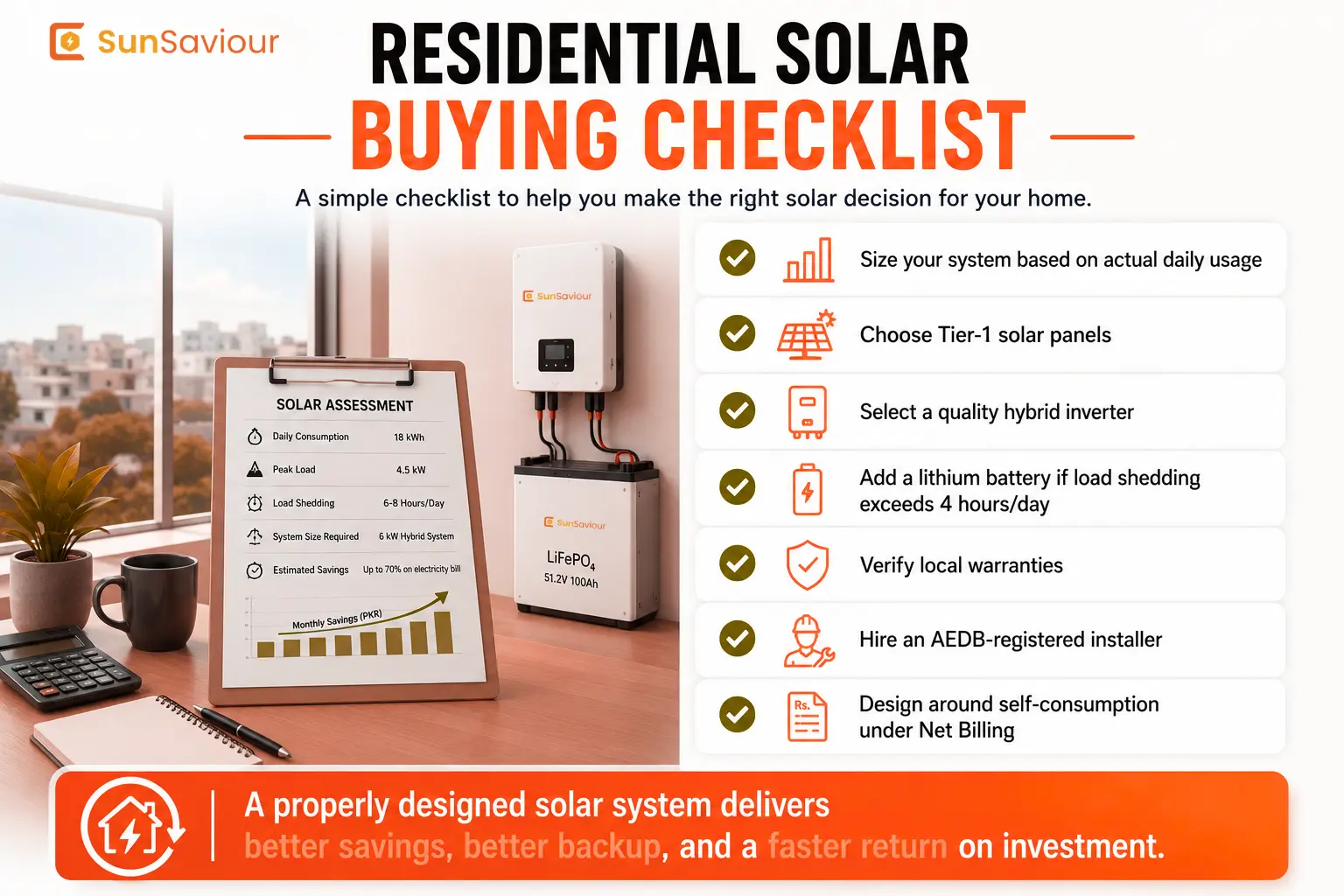
Capacity: Base it on your actual daily load, not a standard package. A solar company Pakistan installer should size around your real consumption pattern.
Panel Quality: Tier-1 brands with local warranty support are worth the premium. Ask for the panel model number and verify it against the manufacturer’s datasheet.
Battery: If you experience more than 4 hours of daily load shedding, a home solar battery system Pakistan setup is worth the additional cost. Lithium iron phosphate batteries are recommended for systems that cycle daily.
Warranty: Inverter minimum 5 years, panels backed by a local office that can actually honor claims, and at least 1 year installation labor warranty from the installer.
Installer: AEDB-registered only. This is required for net billing applications and ensures the installation meets NEPRA’s technical standards.
Net Billing: Under 2026 rules, your system cannot exceed your sanctioned load. Check your electricity bill for this figure before getting quotes.
SunSaviour’s hybrid inverter range, including the ALPHA Series, X-Series, and X-Plus, is designed for Pakistani residential conditions. Explore SunSaviour residential solar solutions at sunsaviour.com
Common Mistakes to Avoid
Buying the cheapest panels: Low-cost, unverified panels degrade faster with no local warranty support. The price difference per panel between budget and quality tiers is often small relative to the total system cost.
Wrong inverter size: An inverter rated below your panel peak output clips production during high-irradiance hours. Size it at panel capacity plus at least 20% overhead.
Ignoring battery needs: If load-shedding exceeds 4 hours daily, a battery-less system will not meet expectations. Plan for battery from the start, not as an afterthought.
Ignoring warranties: A 25-year manufacturer warranty honored only in China provides no practical protection. Verify local support before purchasing.
No maintenance plan: Monthly cleaning is not optional in high-dust regions. Smog season and monsoon dust storms can reduce output meaningfully if panels are left uncleaned.
Wrong installer: Unregistered installers cannot process net billing applications and may not meet NEPRA’s safety standards, resulting in rejected applications or long-term risks.
Frequently Asked Questions
Is solar worth it in Pakistan in 2026?
Yes, for households with monthly bills above PKR 15,000 and significant daytime usage. Payback periods of 3.5 to 5 years are commonly cited, after which electricity from the system is essentially free.
How much does a home solar system cost in Pakistan?
A 5kW system costs approximately PKR 600,000 to 800,000 fully installed in 2026. A 10kW system ranges from approximately PKR 1,000,000 to 1,200,000 or more depending on components and battery inclusion.
What are the main benefits of solar energy for homes?
Lower electricity bills, protection from tariff increases, load-shedding backup, reduced carbon footprint, low maintenance, long-term savings, energy independence, and better daily comfort.
Does solar increase property value?
Homes with solar are increasingly attractive to buyers in Pakistan due to lower bills and backup power. Market feedback supports a positive effect on resale value.
Can solar reduce electricity bills?
Yes. A correctly sized system covering most daytime consumption can reduce monthly grid import by several hundred units, translating to thousands of rupees in monthly savings.
How long do solar panels last?
Quality panels carry 25-year linear performance warranties. Annual degradation for modern panels is typically below 0.7% per year.
Is net metering available in Pakistan?
Pakistan moved from net metering to net billing in February 2026 under NEPRA Prosumer Regulations 2026. New connections export surplus electricity at the national average energy purchase price. Existing net metering contracts remain valid until expiry.
Which solar system is best for homes in Pakistan?
A hybrid system with battery storage is recommended for most households. It provides backup during load shedding, maximizes self-consumption, and connects to the grid for additional security.
Do solar panels work during load shedding?
Grid-tied systems without batteries shut down automatically during outages. Hybrid systems with batteries continue powering your home through load shedding. This is the primary reason most residential buyers now choose hybrid.
Can I run AC on solar panels?
Yes. An inverter air conditioner running during daylight hours is one of the most effective direct uses of solar, since AC peak demand aligns with solar peak generation. A 5kW system typically supports a 1.5-ton inverter AC alongside other standard household loads during the day.
Conclusion:
Solar Is a Long-Term Investment With Immediate Benefits
Residential solar energy solutions in Pakistan in 2026 offer bill savings, load-shedding backup, and long-term financial return that few other household investments match. Panel prices have fallen, system quality has improved, and Pakistan’s irradiance remains among the highest in the region.
The key shift in 2026 is policy: the move to net billing means system design matters more than system size. A correctly sized hybrid system focused on self-consumption delivers strong returns. An oversized system designed around grid export does not.
Choose based on your actual load, use an AEDB-registered installer, invest in quality components, and plan battery storage if load-shedding is consistent in your area. Done right, a residential solar system Pakistan installation is one of the most reliable financial decisions a homeowner can make.
SunSaviour offers hybrid inverters, on-grid inverters, and lithium battery storage suited for residential solar energy solutions in Pakistan, backed by 59+ sales points and 28 service centres nationwide. Visit sunsaviour.com to find the right system for your home.
Note: System cost figures cited in this article are based on publicly available 2026 market data from multiple Pakistani solar installers and retailers. Prices vary by component brand, battery inclusion, and installation complexity. Always request itemised quotes from AEDB-registered installers before purchasing.