Why Choosing the Right Solar Battery Is as Important as the Panel Itself
The best battery for solar system in Pakistan depends on your budget, backup needs, and how well it matches your inverter, not just the price tag on the shelf. Panels generate power, but the battery decides how reliable that power actually is.
Among the types of solar batteries available, most Pakistani households choose between lithium-ion and lead-acid options. Understanding solar battery types in Pakistan before you buy prevents an expensive mismatch later.
Understanding Solar Battery Types: What’s Available in Pakistan
Three battery families dominate the local market: lithium-ion (LiFePO4), tubular lead-acid, and sealed lead-acid. Each suits a different budget and backup pattern.
Lithium-Ion (LiFePO4): The Modern Standard for Solar Storage
A LiFePO4 solar battery is widely regarded as the safest solar battery type available for home energy storage today. Its chemical structure resists the thermal runaway risk seen in other lithium chemistries like NMC, and it does not release oxygen during decomposition, which keeps fire risk low.
This stability, combined with deep daily cycling and minimal maintenance, is why LiFePO4 has become the default recommendation among the best solar battery type options for new installations.
Lead-Acid & Tubular Batteries: Still Relevant in 2026?
A tubular battery for solar use remains a practical entry point for budget-conscious households. As a deep cycle solar battery, it tolerates daily discharge cycles better than a standard car battery, though it needs more upkeep than lithium.
Tubular batteries typically last 3 to 5 years in Pakistan’s climate with regular water top-ups, making them a reasonable short-term choice but not a long-term one.
Lithium vs Lead-Acid: A Head-to-Head Comparison for Pakistan’s Market
The core trade-off in any lithium vs lead acid battery solar comparison is upfront cost against long-term value. Lithium costs more to install but needs replacing far less often.
Lifespan, Efficiency and Real-World Performance
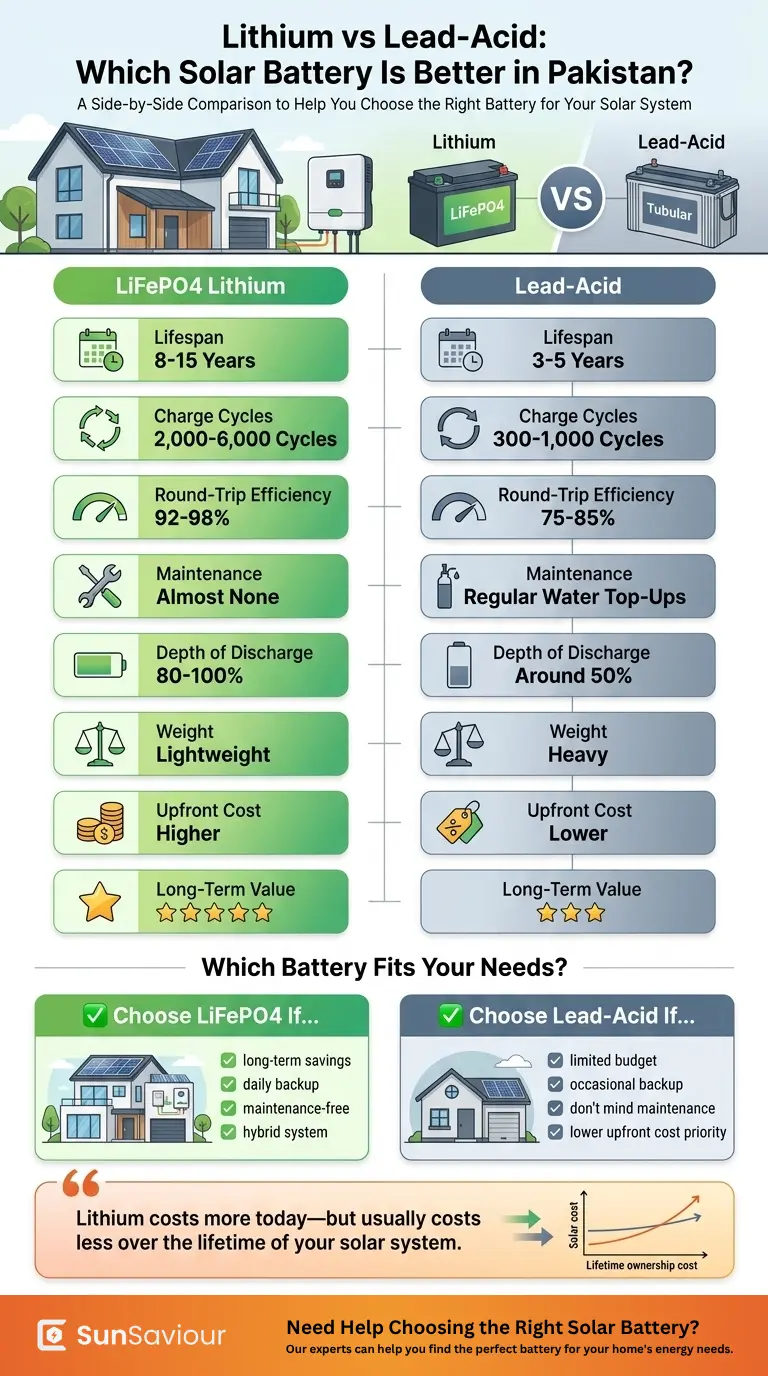
Solar battery lifespan is the clearest dividing line between the two chemistries. LiFePO4 batteries typically deliver 2,000 to 6,000 charge cycles at 80% depth of discharge and last 8 to 15 years, while lead-acid batteries generally manage 300 to 1,000 cycles and last 3 to 5 years.
Metric | LiFePO4 | Lead-Acid / Tubular |
Typical lifespan | 8–15 years | 3–5 years |
Cycle life (80% DoD) | 2,000–6,000 cycles | 300–1,000 cycles |
Round-trip efficiency | 92–98% | 75–85% |
Maintenance | Minimal | Regular water top-ups |
Solar battery efficiency percentage matters more than most buyers realize. A lead-acid bank loses 15 to 25% of stored energy as heat, while LiFePO4 wastes only 2 to 8%, which adds up significantly over a year of daily cycling.
Cost vs Long-Term Value: Which Battery Wins on ROI?
Solar battery cost vs lifespan is where lithium closes the gap that its higher sticker price suggests. Because lead-acid batteries need replacing two to three times over the same period a single LiFePO4 unit lasts, the total cost of ownership often favors lithium.
Solar battery capacity kWh should also be sized to your actual usable energy, not the rated capacity. Lithium batteries allow deeper discharge without damage, so a smaller-rated lithium bank can deliver the same usable backup as a larger lead-acid one.
Off-Grid vs On-Grid Battery Needs: Picking the Right Storage Type
Your grid situation, not just your budget, should decide which off-grid solar battery types you choose. A fully off-grid home has very different needs than one simply backing up against load shedding.
What Off-Grid Users Need From a Solar Battery
Off-grid solar battery types need to handle daily full cycling without losing capacity over years of constant use. Battery backup for solar system reliability in a true off-grid setup depends entirely on the battery, since there is no grid to fall back on.
This makes deep cycle life and high round-trip efficiency more important than upfront cost for off-grid buyers.
Home vs Business Solar Battery Requirements
A solar battery for home Pakistan setup usually needs enough capacity to cover evening and load-shedding hours, typically a few kWh to low double digits. Commercial sites need far higher solar battery capacity kWh and often multiple battery banks working together.
Sizing too small forces deeper daily discharges, which shortens battery life regardless of chemistry.
Inverter Compatibility: Why Your Battery and Inverter Must Work Together
A solar inverter with battery only performs as well as the match between the two. Pairing a high-capacity battery with an undersized inverter, or the wrong battery voltage with a hybrid inverter, limits real-world performance no matter how good either component is on its own.
How Hybrid Inverters Integrate With Lithium and Lead-Acid Batteries
A hybrid solar inverter manages charging, discharging, and grid switching for both LiFePO4 solar battery and deep cycle solar battery setups, but the charge profiles differ. Lithium needs precise voltage cutoffs to protect the battery management system, while lead-acid tolerates a wider charging margin.
SunSaviour’s ALPHA Series and X-Plus hybrid inverters are built to communicate directly with the SunSaviour Lithium Battery Series, matching charge voltage and current automatically instead of relying on generic settings.
Key Compatibility Factors to Check Before Buying
Confirm the inverter’s supported battery voltage, communication protocol, and maximum charge current before buying a solar inverter with battery setup. A mismatch here is the most common reason new systems underperform.
Solar battery efficiency percentage on the datasheet only holds true if the inverter’s charge controller is tuned for that specific battery chemistry.
Solar Battery Maintenance: Protecting Your Investment
Maintenance needs differ sharply by chemistry, and skipping them shortens battery life regardless of how much you spent upfront.
Maintenance Tips for Lithium vs Lead-Acid Batteries
Solar battery maintenance tips for lead-acid and tubular batteries center on topping up distilled water every two to three months and keeping terminals clean. LiFePO4 batteries need almost none of this, since the sealed design and built-in battery management system handle most protection automatically.
For safest solar battery type performance over time, keep any lithium battery in a cool, ventilated space and avoid letting it sit fully discharged for extended periods.
SunSaviour offers the Lithium Battery Series with a built-in BMS designed for Pakistan’s heat and frequent load-shedding cycles, reducing the maintenance burden compared to tubular alternatives.
Choose the Right Battery Once: Your Solar System Will Deliver for Years
The best battery for solar system in Pakistan is the one matched to your backup needs, budget, and inverter, not simply the cheapest option on a price list. Among the solar battery types Pakistan buyers compare, LiFePO4 consistently wins on lifespan and efficiency, while tubular remains a fair short-term budget choice.
Whichever direction you choose, the solar battery cost vs lifespan math almost always rewards buyers who plan for the full system life, not just the install date.
Browse SunSaviour’s Lithium Battery Series alongside compatible ALPHA Series, V-Series, and X-Plus hybrid inverters at sunsaviour.com, or visit our Peshawar sales and service center for a sizing consultation.
FAQs
What is the best battery for solar system in Pakistan?
For most homes, a LiFePO4 lithium battery offers the best balance of lifespan, safety, and efficiency, while tubular batteries remain a lower-cost option for tighter budgets.
How long does a solar battery last in Pakistan’s climate?
LiFePO4 batteries typically last 8 to 15 years, while tubular and lead-acid batteries generally need replacing every 3 to 5 years.
Is LiFePO4 safer than other lithium batteries?
Yes, LiFePO4 is widely considered the safest common lithium chemistry for home solar storage due to its high thermal stability and low fire risk compared to chemistries like NMC.
Can any battery work with any hybrid solar inverter?
No, the inverter must support the battery’s voltage and communication protocol, or charging performance and battery lifespan will both suffer.
Do lithium solar batteries need maintenance?
LiFePO4 batteries need very little maintenance beyond keeping them in a cool, ventilated space, unlike lead-acid batteries that require regular water top-ups.
What size solar battery do I need for my home?
Sizing depends on your evening and load-shedding power needs in kWh, with most homes requiring anywhere from a few kWh to low double digits depending on usage.