Solar Power Is No Longer Just a Trend: It’s a Practical Reality
10 years ago, solar was often viewed as an optional upgrade. Today, it is a strategic investment delivering measurable long-term returns.
The practical uses of solar energy have expanded far beyond rooftop panels on suburban homes. Solar now powers agricultural pumps in rural Punjab, charges electric vehicles in urban Karachi, heats water in commercial hotels across KPK, and keeps hospitals running during grid outages. Where fossil fuels require constant fuel supply and rising tariff exposure, solar energy uses a free and predictable resource: sunlight.
Pakistan receives some of the highest solar irradiance in the region. The gap between that resource potential and how much of it is actually being used is closing fast. This article covers the six most impactful real-world solar energy applications available today, with specific relevance to Pakistani households, farmers, and businesses.
1. Solar Power for Homes: The Most Common Application
Solar power for home use is the single largest and fastest-growing application of solar energy in Pakistan. Driven by rising WAPDA tariffs, daily load-shedding, and falling panel costs, residential solar adoption has accelerated significantly since 2022.
A standard residential setup consists of solar panels for home installation on the rooftop, a hybrid or on-grid inverter, and optionally a battery bank. The system generates electricity during daylight hours, reduces or eliminates grid import during peak generation periods, and exports surplus power through net metering where approved.
How Homeowners Use Solar to Cut Electricity Bills
The primary motivation for most Pakistani homeowners going solar is straightforward: reduce electricity bills with solar and recover the investment through monthly savings.
At current residential tariffs of PKR 50 to 65 per unit, a well-sized 5kW system generating 20 to 25 units per day can reduce monthly grid consumption by 600 to 750 units. At average tariff rates, that represents PKR 30,000 to 48,000 in annual savings on electricity alone.
Solar energy cost savings compound over time. Panel output degrades at approximately 0.5% per year, meaning a system installed today still delivers over 85% of its original output after 25 years. The fuel cost remains zero throughout.
Solar Panel Systems for Residential Energy Independence
For homeowners who want complete solar energy independence, an off-grid solar system with battery storage removes the grid dependency entirely. The system sizes the battery bank to cover nighttime consumption and generates all daytime power from panels.
Full off-grid is most practical in rural areas without stable grid access, or for urban users with extreme load-shedding exposure who want guaranteed uptime for essential loads. For most urban households, a hybrid system that combines grid connection with battery backup achieves the practical benefits of independence without the higher cost of a fully off-grid configuration.
SunSaviour’s X-Series and X-Plus hybrid inverters are designed specifically for residential energy independence. Explore residential solar inverter options at sunsaviour.com
2. Solar Water Heating: An Efficient Alternative to Electric Geysers
A solar water heating system is one of the most cost-effective solar energy applications available, and one of the most underutilised in Pakistan. Electric geysers are among the highest-consumption appliances in any household, accounting for 20 to 30% of electricity bills during winter months.
Solar water heaters replace that electrical consumption entirely using a separate thermal collection system that does not require an inverter, battery, or grid connection.
How Solar Water Heaters Work and Where They Are Used
A solar water heating system works through a simple thermal process. A roof-mounted collector panel absorbs solar radiation and transfers that heat to water circulating through a storage tank. The heated water is then available at taps and showers without any electrical input.
Two main types are used in Pakistan:
- Flat plate collectors: Lower cost, suitable for moderate-temperature requirements in Punjab and Sindh climates.
- Evacuated tube collectors: Higher efficiency in cold weather, more suitable for KPK and northern regions where winter temperatures are lower.
Solar water heaters are used in homes, hotels, hospitals, hostels, and food processing facilities anywhere hot water demand is consistent and high.
Residential vs Commercial Solar Water Heating
For a residential household using a 150-litre electric geyser for 2 hours daily, switching to solar water heating eliminates approximately 90 to 100 units of electricity consumption per month. At PKR 55 per unit, that is a monthly saving of PKR 4,950 to 5,500 from a single appliance replacement.
Commercial applications scale this significantly. A hotel running 10 electric geysers across guest bathrooms can eliminate several hundred units of daily consumption with a centralised solar water heating system, with payback periods typically ranging from 18 to 30 months.
3. Solar Backup Power: Staying On During Outages
Load-shedding is not a minor inconvenience in Pakistan. In many urban and rural areas, daily outages range from 4 to 12 hours. For households, this disrupts work, study, and comfort. For businesses, it directly damages productivity and revenue.
A solar backup system solves this with a combination of solar generation and battery storage that keeps essential loads running when the grid goes down.
Why Battery-Backed Solar Systems Matter in Pakistan
Solar battery storage is the component that separates a system that works only when the sun is shining from one that works around the clock. During grid outages, the battery bank supplies power to the home independently of both the grid and real-time solar generation.
Lithium iron phosphate (LiFePO4) batteries are the preferred choice for backup applications because of their safe chemistry, deep discharge capability (80 to 90% usable capacity vs 50% for lead-acid), and long cycle life (3,000 to 6,000 cycles at 80% depth of discharge). A properly sized lithium battery bank can supply a home’s critical loads through 8 to 12 hours of outage without degrading meaningfully over years of daily use.
How Solar Keeps Critical Appliances Running
Solar power during outages prioritises critical loads: lighting, fans, a refrigerator, and communications equipment. A 5kW hybrid system with a 100Ah lithium battery bank at 48V provides approximately 4.8 kWh of usable backup capacity. For a household drawing 500W from critical loads, that covers nearly 9 hours of uninterrupted power.
Medical equipment, point-of-sale terminals, cold storage, and home offices are examples where solar backup power moves from a comfort feature to an operational necessity.
SunSaviour’s ALPHA Series hybrid inverters with compatible lithium battery storage are built for exactly this use case. View SunSaviour energy storage solutions at sunsaviour.com or visit the Peshawar service centre for a consultation on backup sizing.
4. Solar Water Pumps and Irrigation: Powering Agriculture
Pakistan’s agricultural sector accounts for nearly 19% of GDP and employs over 38% of the workforce. A large share of that sector depends on groundwater irrigation, historically powered by diesel pumps or unreliable grid electricity. Solar water pumps are changing that dependency fundamentally.
How Solar Pumps Are Transforming Farming in Pakistan
A solar water pump replaces a diesel or electric pump motor with a DC or AC motor powered directly by solar panels. The system operates during daylight hours, pumping water into storage tanks or directly into irrigation channels when generation is highest.
The economics are compelling. A diesel pump drawing 5 litres per hour at current fuel prices costs PKR 3,000 to 5,000 per day to run during peak irrigation season. A solar irrigation system of equivalent capacity runs at zero fuel cost after installation, with payback periods commonly between 2 and 4 years.
Provincial governments in Punjab and Sindh have subsidised solar pump programs for smallholder farmers, recognising that the solar water pump is one of the most direct poverty-reduction tools available in the agricultural sector.
Off-Grid Agricultural Applications of Solar Energy
The practical uses of solar energy in agriculture extend beyond water pumping. An off-grid solar system can power:
- Grain drying equipment during harvest season.
- Poultry farm ventilation and lighting systems.
- Drip irrigation controllers and soil moisture sensors.
- Cold storage units for perishable produce at farm level.
For farms located more than 2 to 3 kilometres from the nearest grid connection, off-grid solar eliminates the cost and delay of grid extension entirely while providing more reliable power than the grid would supply in those locations.
5. Solar Cooling Systems: Air Conditioning Without the Heavy Bills
Air conditioning is the highest single-source electricity consumer in Pakistani homes and commercial buildings during summer. In cities like Lahore, Multan, and Karachi, cooling loads during June to August can account for 60 to 70% of a household’s monthly electricity bill.
A solar cooling system uses solar generation to offset or directly power the air conditioning load, cutting the most expensive consumption period with the period of highest solar generation. The alignment is near-perfect: cooling demand peaks at the same time solar output peaks.
How Solar-Powered Cooling Works for Homes and Businesses
There are two approaches to solar-powered cooling:
Offset approach:
A standard grid-tied or hybrid solar system generates power during peak hours, offsetting the AC load with solar generation. The inverter supplies the air conditioner directly from panels during the day, reducing grid import to near zero during peak cooling hours.
Direct DC cooling:
Newer DC inverter air conditioner systems can be connected directly to the solar array with a compatible inverter, eliminating AC conversion losses. These systems are increasingly available in Pakistan’s market and are particularly effective in commercial installations.
Solar energy cost savings from cooling offset are among the highest available because they reduce consumption during peak tariff hours. For a household running a 1.5-ton inverter AC for 10 hours daily, solar offset during daylight hours can cut cooling-related electricity costs by 50 to 65%.
6. Solar EV Charging: Driving on Sunshine
Electric vehicle adoption in Pakistan is early stage but accelerating, driven by rising petrol prices and improved EV availability in the 2024 to 2026 market window. Solar EV charging is the logical companion to EV ownership, turning solar surplus into transport fuel at zero marginal cost.
The Rise of Solar-Powered Electric Vehicle Charging
A solar-powered EV charging setup at home uses surplus generation from the rooftop array to charge the vehicle battery during the day. For an EV requiring 10 to 15 kWh for a full charge, a 5kW solar system generating 25 kWh on a sunny day can fully charge the vehicle and still cover household consumption from solar alone.
The reduction in running costs is significant. Charging an EV from the grid at PKR 55 per unit costs PKR 550 to 825 per full charge. Charging from solar surplus costs nothing. For a vehicle driven 40 to 60 kilometres daily, annual solar EV charging savings can range from PKR 80,000 to 1,50,000 depending on usage pattern and tariff rate.
Solar powered devices like EV chargers represent the next frontier of residential solar value: the system no longer just reduces electricity bills. It replaces a separate fuel budget entirely.
SunSaviour’s hybrid inverter range supports home solar setups that can integrate EV charging into the overall energy management system. Learn more at sunsaviour.com
Why Solar Energy Is Replacing Fossil Fuels Across Industries
The comparison between solar vs fossil fuels is no longer primarily environmental. It is now primarily economic.
Fossil fuel costs in Pakistan are exposed to global oil price volatility, currency depreciation, and government subsidy policy. All three have moved unfavourably for consumers over the past five years. Diesel at PKR 280 to 300 per litre, petrol above PKR 250, and electricity tariffs that have tripled since 2020 have fundamentally changed the return calculation for solar investment.
Solar energy independence protects against all three of those risk factors simultaneously. Once installed, a solar system’s generation cost is fixed at near-zero for 25 years. It does not respond to OPEC decisions, Rupee depreciation, or circular debt in the power sector.
Across agriculture, industry, commercial real estate, and residential use, the practical uses of solar energy now cover every major consumption category. The question for most Pakistani energy consumers is not whether solar applies to their situation. It is which application delivers the fastest payback for their specific load profile.
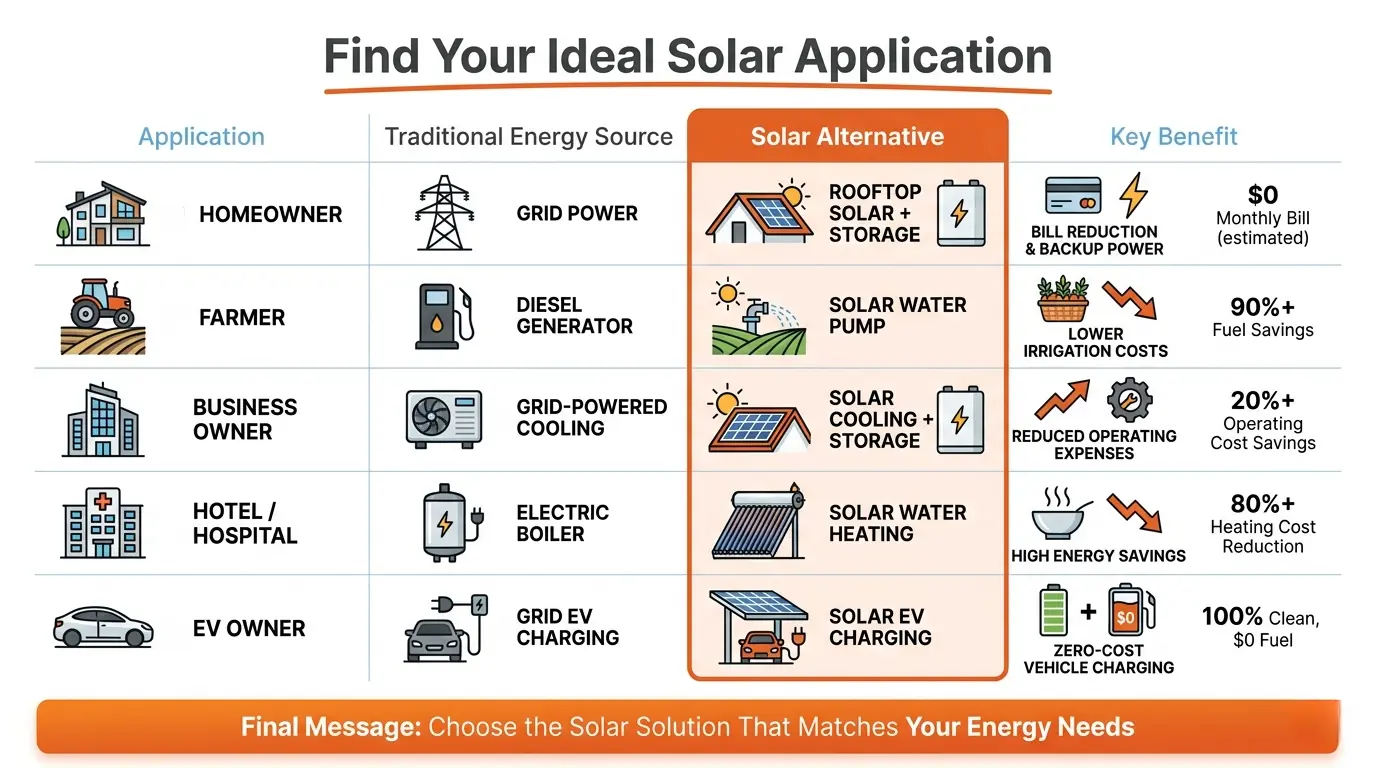
Solar Energy Has a Use Case for Everyone: Find Yours
The solar energy applications covered in this article share one common thread: each one replaces a recurring cost with a one-time investment that pays for itself and then continues delivering value for decades.
Whether you are a homeowner looking to reduce electricity bills, a farmer replacing a diesel pump, a business protecting operations against load-shedding, or an EV owner looking to eliminate charging costs. There is a solar energy use case built for your situation.
Solar energy cost savings are highest when the system is matched precisely to the load it is intended to serve. The right inverter, the right battery size, and the right panel capacity for your specific consumption profile make the difference between a system that pays back in 3 years and one that takes 7.
SunSaviour offers hybrid inverters, on-grid inverters, and lithium battery storage solutions suitable for residential, agricultural, and commercial solar applications. Visit sunsaviour.com or contact the Peshawar sales and service centre to find the right solution for your energy needs.
Frequently Asked Questions
What are the most common solar energy uses in Pakistan?
The most widespread applications are residential rooftop solar for electricity generation, solar water heating, battery-backed backup systems for load-shedding protection, and solar water pumps for agricultural irrigation.
Can solar power run an air conditioner?
Yes. A correctly sized solar system can supply all or most of the power required to run an inverter air conditioner during daylight hours. Since peak cooling demand and peak solar generation occur simultaneously, solar cooling is one of the highest-value applications available.
Is solar water heating separate from a solar panel system?
Yes. A solar water heating system uses thermal collectors to heat water directly and does not require solar panels, an inverter, or a battery. It is a standalone system focused specifically on replacing electric or gas water heating.
How does a solar backup system work during load-shedding?
A hybrid solar system with battery storage automatically switches to battery power when the grid fails. The transition is typically seamless, taking milliseconds, so appliances continue running without interruption. Batteries recharge from solar panels as soon as generation resumes.
What size solar system do I need to charge an electric vehicle at home?
For most Pakistani EVs requiring 10 to 15 kWh per charge cycle, a 5kW to 7kW solar system generates sufficient surplus on a sunny day to charge the vehicle and cover household consumption simultaneously.