Yes, in most cases you can run a solar inverter without a battery, but only under certain conditions. An inverter without battery is the standard choice for daytime bill savings. An inverter without battery can feed solar power into your home and reduce your daytime electricity bill, provided the grid is available. It cannot keep your home powered during a load-shedding outage, because the inverter must shut down when the grid fails.
That single limit decides whether a battery-free setup suits your home. This guide explains how a grid-tied system works without storage, why it stops during outages, when it makes sense, and when a battery is essential. It also covers the common confusion between a solar inverter and a solar UPS.
How a Solar Inverter Works Without a Battery
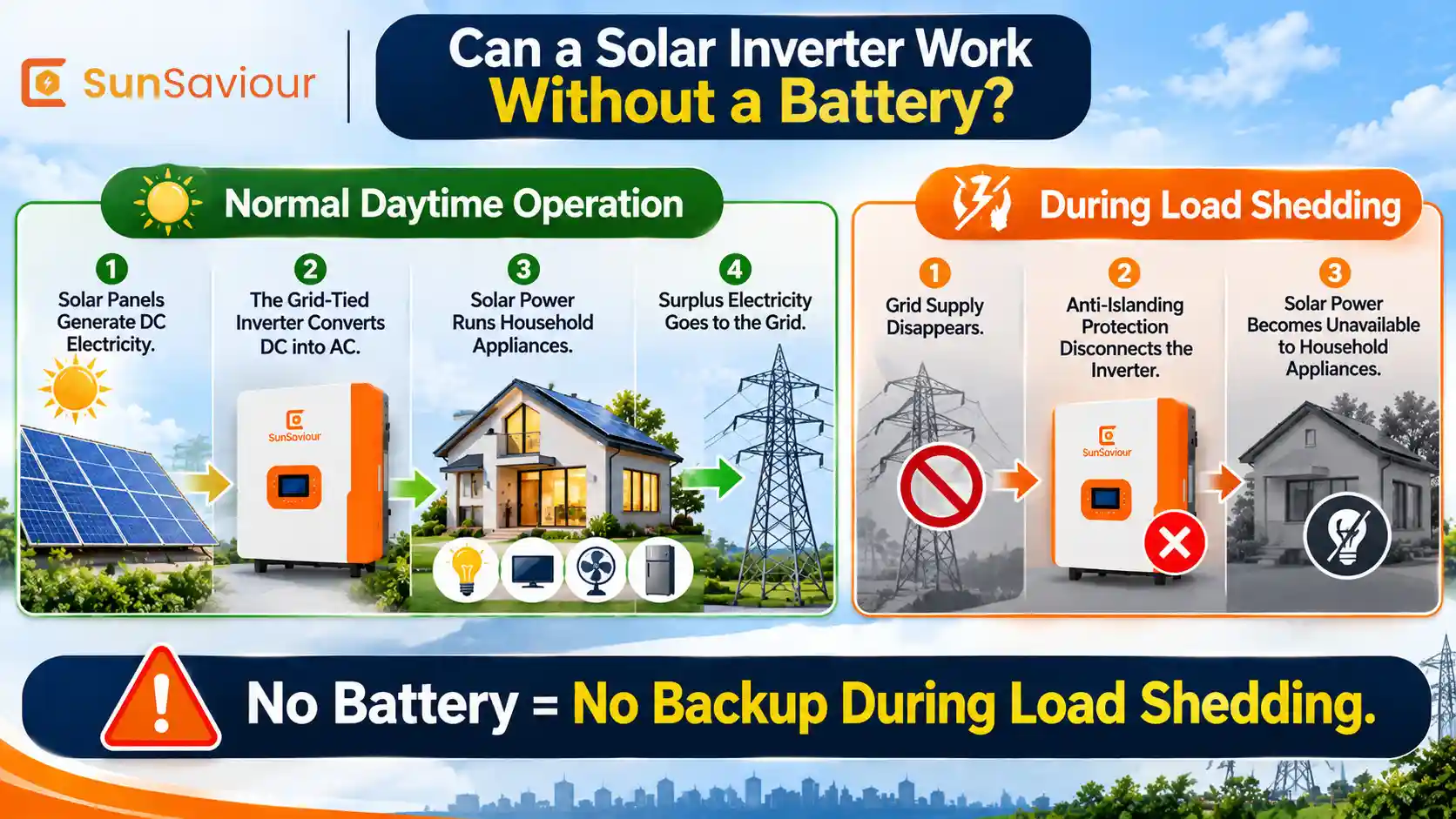
Most battery-free solar systems in Pakistan are grid-tied. Panels produce DC electricity, and the inverter converts it to AC and synchronises with the grid. Power flows to your appliances first. Any surplus goes back to the grid, which is metered and credited under the current net billing framework.
Because there is no battery, the system has no stored energy to draw on. The solar output exists only while the sun is shining and the grid is live.
This type of unit is usually called an on grid inverter. It is sometimes called a grid-tied inverter. You can read more about how these units work in our guide to on-grid inverters in Pakistan.
Why a Battery-Free Inverter Shuts Down During Load Shedding
Grid-tied inverters must shut down when the grid is lost. This safety rule is called anti-islanding protection. If the inverter kept energising a line that utility workers believe is dead, it could injure a person repairing the network.
So a battery-free solar system produces no usable power during load shedding, even on a bright afternoon. The panels may still generate, but the inverter disconnects. Many buyers discover this only after their first outage, so check it before you buy.
When a Battery-Free Solar Inverter Makes Sense
A solar inverter without battery is a sensible choice when:
- Your area has few outages, and you rarely lose supply during the day
- Your main goal is to cut daytime bills
- Your daytime consumption is high enough to use most of what the panels produce
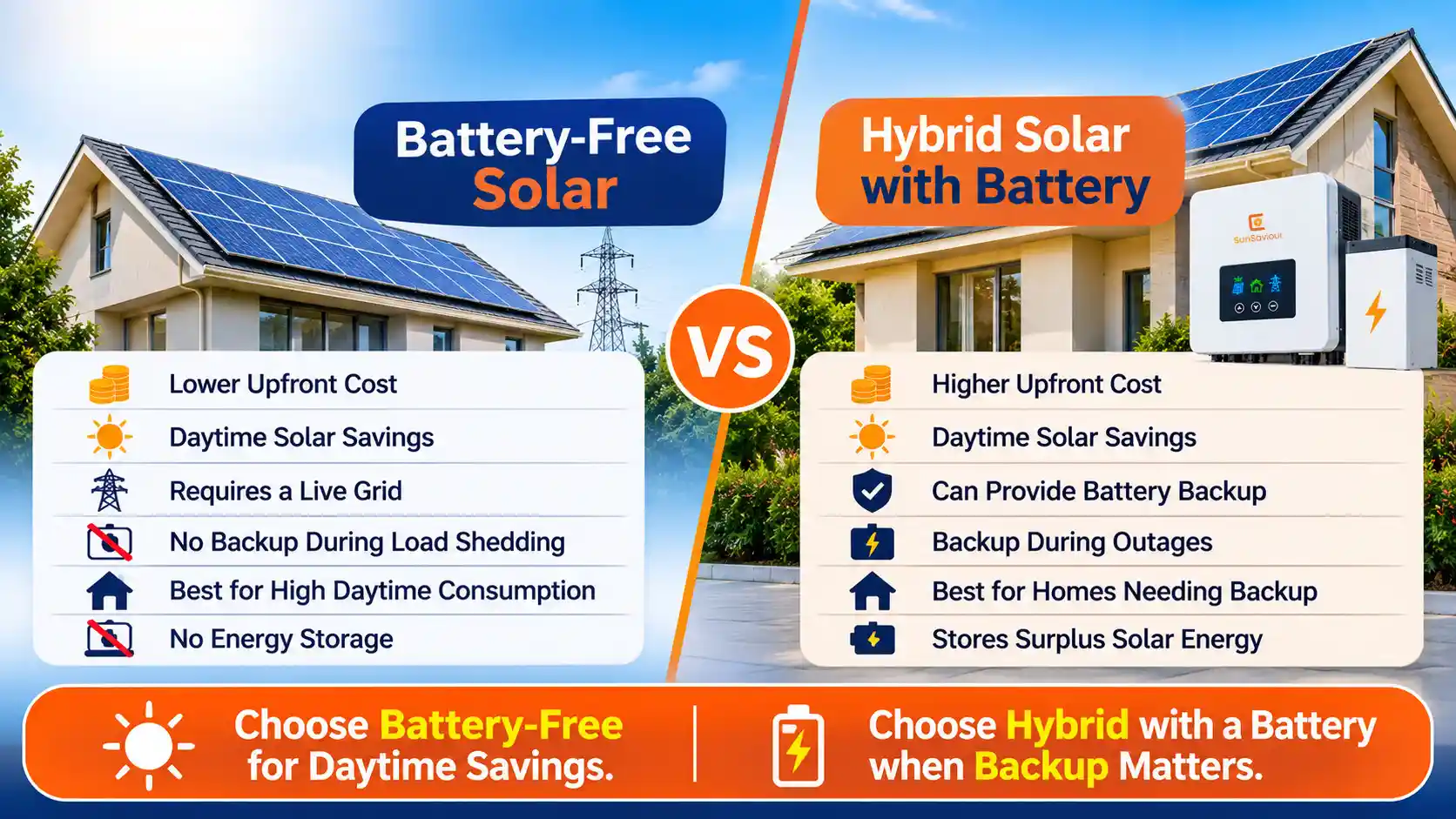
- You want the lowest upfront cost for a grid-connected system
- Your roof and budget suit a simpler design
For a home that uses most of its power in the daytime, such as one with a running air conditioner or a water pump, a battery-free system can deliver useful savings. Under the current net billing framework, the value of exported energy is lower than the value of energy you use yourself, so self-consumption matters more.
When You Need a Battery
A battery becomes necessary if any of these apply:
- You face regular load shedding and need power during outages
- Your evening and night loads are significant
- You want to store surplus solar for later use
- Critical loads, such as a refrigerator, router, or medical equipment, must keep running
- You want to reduce dependence on the grid over time
For these homes, a hybrid inverter with battery storage is usually the right choice. The battery makes backup possible, but it adds cost. Compare the full system cost against how often you lose power. Our solar battery guide for Pakistan explains how to size and choose storage.
Solar Power Inverter for Home: Choosing Without a Battery
A solar power inverter for home buyer should focus on daytime load and grid compatibility. A solar power inverter for home use should match your roof, your load, and your grid connection. For battery-free systems, check these points:
- Phase: single-phase units suit most homes. Confirm your supply on the electricity bill.
- Size: match the inverter to your panel array and typical daytime load.
- MPPT inputs: confirm the number of inputs suits your roof layout.
- Grid protection: check the voltage and frequency window and the protection functions listed on the datasheet.
- Warranty and service: confirm the local claim process.
A grid-tied inverter does not need battery input, so do not pay for battery features you will not use. Many buyers also compare an inverter battery option at this stage, which is only needed for backup.
Solar Inverter for Home: Heading Versus Search Reality
Many buyers search for a solar inverter for home before they understand whether they need a battery. The right first step is to decide the backup question, then choose the inverter type. A home that needs outage backup should not start with a grid-tied unit.
Solar Inverter Battery: How Pairing Works
If you may add storage later, choose an inverter that can accept a battery, or plan for a hybrid unit from the start. Pairing a solar inverter battery requires matching voltage, communication protocol, and charge current. A grid-tied unit cannot be turned into a backup unit by adding a battery alone, because the inverter must support battery charging and discharging.
Plan the wiring and cable sizing for future battery capacity, even if you do not buy the battery today. This avoids expensive rework later.
Inverter Battery Confusion: What to Check
Buyers often use the term inverter battery to mean a standalone battery used with an inverter. In this context, a battery is needed for backup, not for grid-tied operation. Ask the seller to clarify whether the quote is for a grid-tied inverter, a hybrid inverter, or an off-grid system, because each behaves differently in an outage.
Solar UPS: Can It Run Without a Battery?
Some buyers ask whether a solar ups product works without storage. A solar UPS is a product that uses solar power to run loads, usually with a battery. It is designed to provide backup, so it normally includes battery storage. Units sold as solar UPS systems are not usually battery-free.
If a seller offers a “solar UPS” with no battery, ask exactly how it provides backup during an outage. Without storage, the unit cannot supply power at night or during a grid cut. Get the operating mode in writing.
Off-Grid Inverters: Usually Need a Battery
An off-grid design is not the same as a without battery solar inverter system. An off-grid inverter operates without a grid connection and usually requires a battery bank to provide power at night and during cloudy periods. Without a battery, an off-grid design cannot supply a stable load from panels alone for most homes. Off-grid systems are a different category from grid-tied battery-free systems.
Inverter Without Battery Price in Pakistan
The solar inverter without battery price in pakistan is generally lower than a hybrid package. The cost of a battery-free grid-tied system is lower than a hybrid system with batteries, because you do not pay for the battery bank. For a current price comparison across inverter types and sizes, see our 3kW solar inverter price guide. Prices vary by brand, capacity, and warranty, so request a written quotation for your site.
When comparing quotes, confirm whether the price includes panels, inverter, structure, protection, net billing paperwork, and commissioning. A low headline price for an inverter alone is not the same as a complete system.
Without Battery Inverter Operation: Daytime Only
A without battery inverter setup works best with daytime loads. A without battery inverter runs during daylight, when the panels generate and the grid is available. It does not carry your home through the night, and it does not operate in an outage. Expect the system’s output to follow the sun, and expect no output at night.
Use this as a reason to plan load timing. Heavy daytime loads, such as laundry, water pumping, and air conditioning, make better use of solar output than evening loads.
Without Battery Solar Inverter: Real-World Expectations
A without battery solar inverter delivers power when the grid and sun are both available. It will not provide a backup supply, and it will not store energy for later. If you value daytime savings more than outage protection, it is a practical choice. If outages are your main concern, it is not.
Common Mistakes When Choosing a Battery-Free System
- Expecting backup power during load shedding
- Buying a grid-tied inverter for a home that needs outage cover
- Confusing a solar UPS with a grid-tied inverter
- Undersizing the inverter for peak daytime loads
- Ignoring the grid voltage and frequency window
- Skipping written confirmation of the operating mode
- Assuming a battery can be added later without planning the wiring
Frequently Asked Questions
Can a solar inverter run without a battery in Pakistan?
Yes, a grid-tied solar inverter can run without a battery as long as the grid is available. It will not supply power during an outage.
Does a battery-free solar inverter work during load shedding? No. It shuts down when the grid is lost, for safety reasons.
What is an inverter without battery?
It is a grid-connected solar inverter that operates without battery storage. It feeds power to your home during the day and exports surplus to the grid.
Is a solar UPS the same as a grid-tied inverter?
No. A solar UPS is designed to provide backup, so it usually includes battery storage. A grid-tied inverter does not provide backup on its own.
Can I add a battery to my grid-tied inverter later?
Only if the inverter supports battery charging and discharging. Many grid-tied units do not. Check the datasheet before buying.
Is a battery-free system worth it?
For homes with few outages and high daytime use, it can reduce bills at lower cost. For homes that need outage backup, a battery is essential.
What is the difference between a solar inverter battery and a backup battery?
A solar inverter battery is the storage used by a hybrid or off-grid system. Backup needs a battery that the inverter can charge and discharge during outages.
Can an off-grid inverter run without a battery?
Usually not reliably for a home. Off-grid designs normally rely on batteries to supply power when the sun is not shining.
Conclusion
You can run a solar inverter without a battery in Pakistan, but only as a grid-tied system that saves money during daylight. It will not keep your home running during load shedding. If you need backup, choose a hybrid system with a suitable battery. Decide the backup question first, then choose the inverter type and size.
For SunSaviour grid-tied and hybrid options, visit sunsaviour.com or contact our sales team for a written quotation that matches your outage and daytime needs.