The Rising Cost of Pumping Water in Pakistan
Every farmer in Pakistan knows the number by heart. What it costs to run the tube well this month. Diesel prices keep climbing. Where grid connections exist, 10 to 12 hours of daily load-shedding leaves fields dry exactly when crops need water most.
Fuel bills, generator maintenance, and unpredictable power cuts add up fast. Traditional irrigation has quietly become one of the biggest drains on farm profit. Sometimes bigger than seed, labor, or fertilizer combined.
Solar irrigation Pakistan is the answer more farmers are turning to. A solar irrigation system Pakistan farms install once can run for free, year after year. It’s not a minor upgrade. It’s a shift from paying for every drop of water pumped to owning the source of that power outright.
More than 30% of agricultural pumps in Pakistan cannot connect to grid electricity at all, due to poor rural infrastructure. For these farms, solar pumps for unreliable electricity aren’t a nice-to-have. They’re the only practical way to irrigate reliably.
Even where grid power is available, diesel fuel and generator upkeep have become unsustainable for most small and mid-sized operations. Solar pumps without grid electricity, and solar pumping without electricity grid access altogether, solve both problems at once. No fuel bill. No dependency on load-shedding schedules. No waiting for WAPDA to restore power before the fields can be watered. That’s the real promise of solar pumping without grid electricity.
What Off-Grid Solar Irrigation Is and How It Works
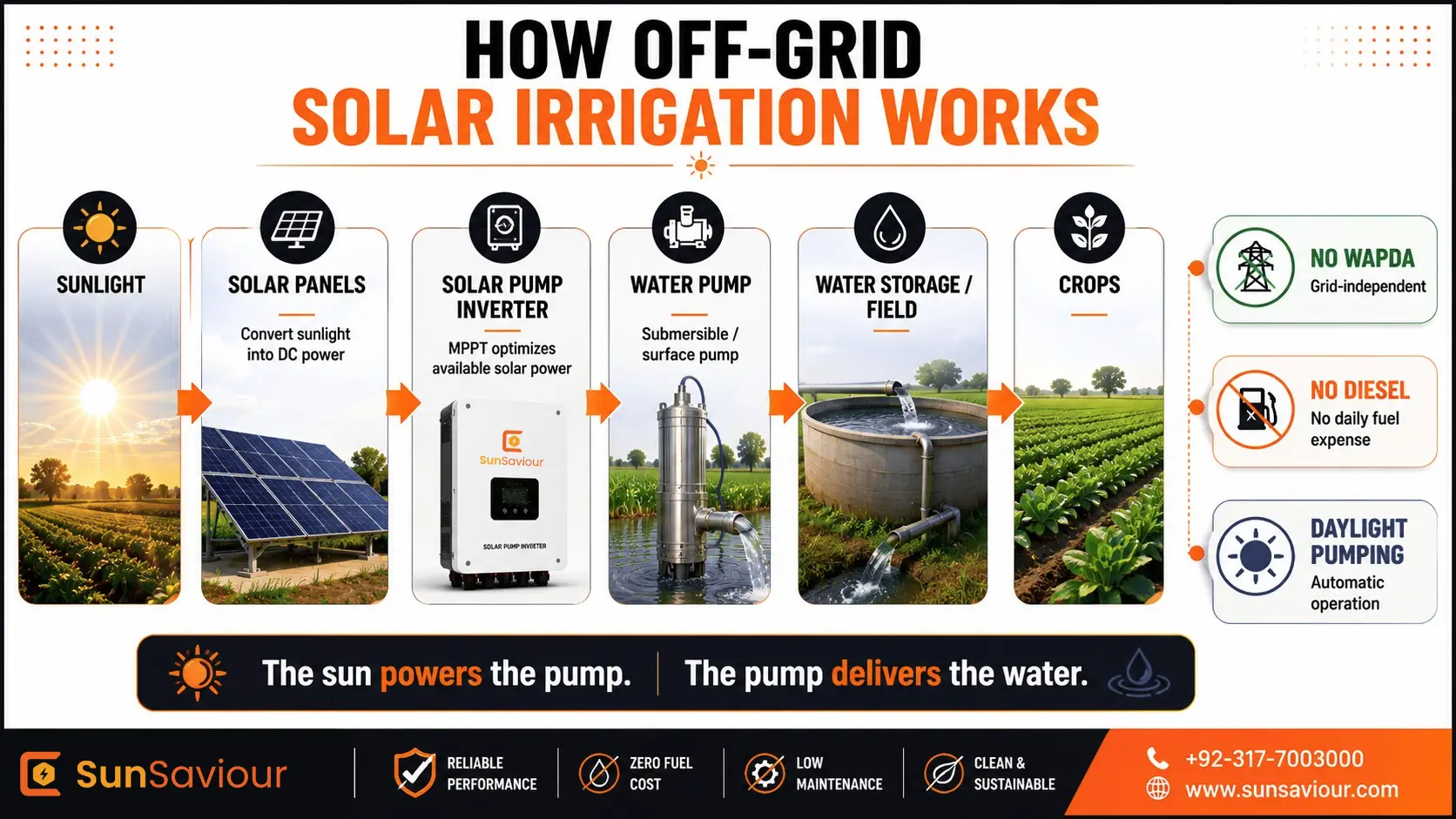
Off-grid solar irrigation means exactly what it sounds like. A pumping system that runs entirely on sunlight, with no connection to WAPDA or a diesel generator required. For farms in areas where the grid is unreliable, expensive to extend, or simply not present, an off-grid irrigation system turns the sun into the farm’s own private power plant.
The setup itself is straightforward. High-efficiency solar modules (panels) are mounted near the water source. They’re wired to a solar pump inverter, which converts the panels’ output into the exact power needed to drive a submersible or surface pump.
As the sun rises, the pump starts drawing water. As it sets, it stops. No switches to flip. No fuel to top up. No meter to watch. This is the core appeal of off-grid water pumping. Once installed, the system needs almost no daily attention.
This approach works especially well as solar irrigation for off-grid farms, where extending grid infrastructure would cost more than the solar system itself. Solar powered pumps for irrigation in Pakistan have matured a lot over the past few years. Today’s solar pumps for farmers in Pakistan are built specifically to handle local well depths, water tables, and flow-rate needs.
Whether the goal is watering row crops, orchards, or livestock troughs, solar pumps for farms in Pakistan of every size can be matched to an off-grid solar pumping system. From a one-acre plot to a large commercial operation.
Solar Irrigation Cost Savings and ROI, Broken Down
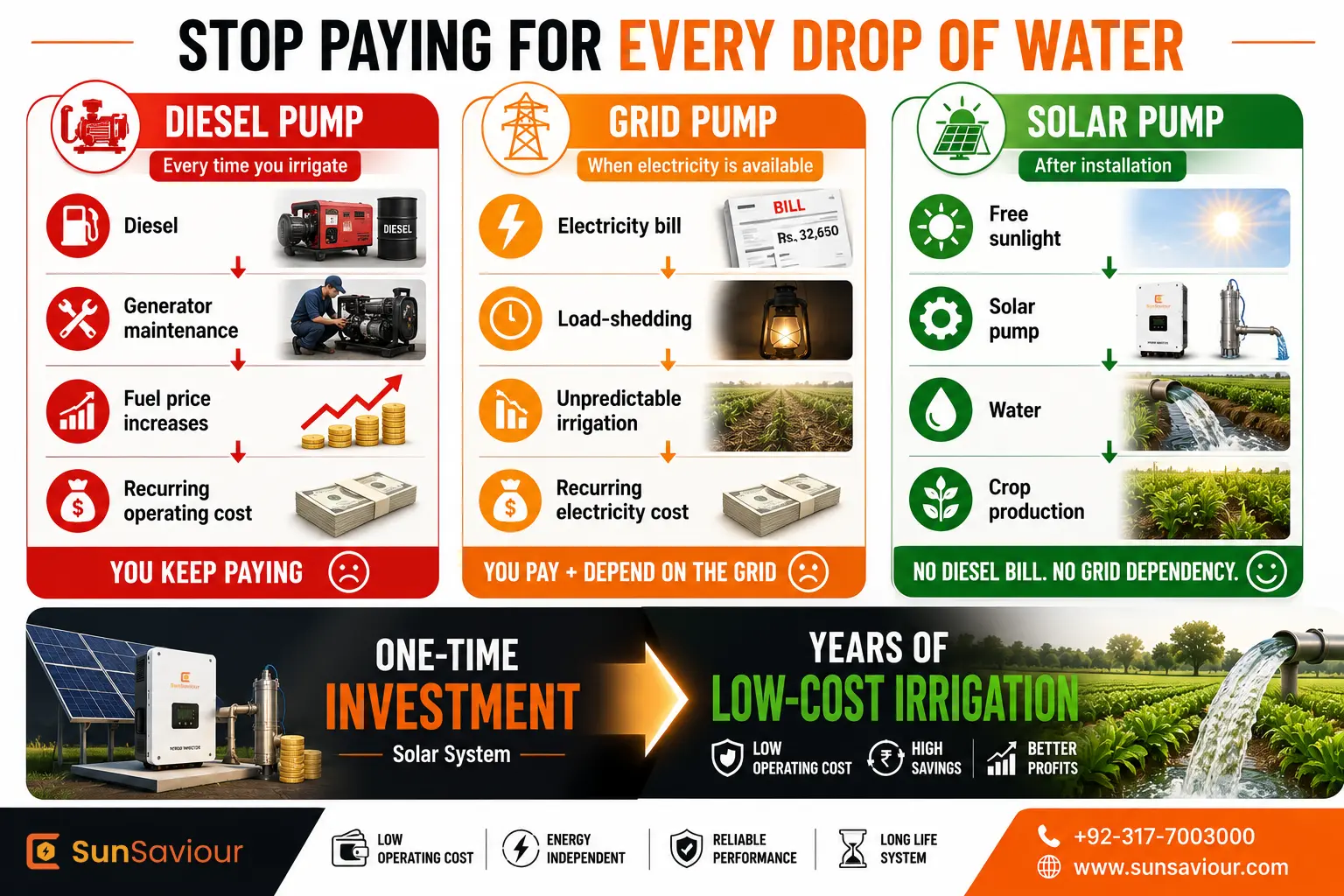
This is where the decision stops being about technology and becomes a plain business calculation. A diesel or grid-dependent pump comes with a bill every time it runs. A solar system comes with a bill once, at installation. After that, close to nothing for the operational life of the panels, typically 25 years or more.
That difference is what drives solar irrigation cost savings and solar irrigation energy savings over the life of the system. Every season the pump runs on sunlight instead of fuel is a season of solar irrigation fuel savings. That money goes straight back into farm income instead of out to a fuel supplier.
Diesel and grid tariffs are recurring, rising, and unpredictable. Solar irrigation operating costs settle close to zero once the system is paid for, routine cleaning and occasional maintenance aside.
This is the core of any Solar Irrigation Investment. It turns a variable, ongoing expense into a fixed, one-time cost. Farmers typically recover their initial capital within just a few growing seasons. This is the solar irrigation payback period, and it’s short enough that most farmers call it one of the fastest-returning investments on the farm.
Beyond the fuel savings, the solar pump energy savings bring something even more valuable: reliable, on-demand water. Farmers who stop rationing irrigation around fuel costs or load-shedding hours can water consistently through the year. They can grow off-season crops and diversify what they produce.
Solar energy for increased farm income data from farms that made the switch shows income gains of 3 to 4 times pre-solar levels in many cases. That’s a solar irrigation ROI, or solar pump return on investment, that few other farm upgrades can match.
The Hardware That Makes Solar Pumping Efficient
Not every solar pump on the market is built the same. The difference in components is what separates a system that barely keeps up from one that delivers efficient solar water pumping season after season. Getting the hardware right the first time decides how much water actually comes out of the ground, and how long the system lasts.
The most important component in energy-efficient solar pumps is the inverter. A high-efficiency solar pump inverter with Maximum Power Point Tracking (MPPT) constantly adjusts to draw the maximum possible power from the panels, even as sunlight changes through the day. This is what allows a high-efficiency solar pumping inverter to keep water flowing even on cloudy or hazy days, when a basic system would slow to a crawl.
Beyond the inverter, efficient solar pumping systems depend on properly matched panels, correctly sized pump motors, and quality wiring that cuts power loss between the array and the pump. This is where affordable solar pumps can sometimes cut corners. Cheaper components may lower the upfront price but reduce water output and shorten the system’s working life.
Farmers evaluating options should look for high-efficiency solar pumping systems and high-efficiency solar water pumps built with components rated for Pakistan’s heat, dust, and variable sunlight. Off-grid solar water pumping in the field is a very different environment from a lab test bench.
Solar Pump Costs, Financing, and Subsidies in Pakistan
The upfront cost is the one real hurdle standing between most farmers and switching to solar. So it’s worth addressing directly. Complete systems, including panels, pump, inverter, and installation, typically start around PKR 700,000 and can run up to PKR 1,700,000 or more. It depends on well depth, flow-rate needs, and whether new deepwell drilling is required.
It’s a real investment. But one that stops generating bills the moment it’s switched on.
For farmers comparing options, understanding the solar water pump price in Pakistan and general solar pump price ranges up front helps set realistic expectations before requesting a quote. The solar irrigation system price varies by farm size and pump capacity. The solar irrigation system price in Pakistan also shifts with brand, warranty, and drilling requirements. Getting a system properly sized avoids paying for capacity that isn’t needed, or under-sizing a system that can’t keep up with actual water demand.
When comparing quotes, think in terms of solar irrigation system cost per acre irrigated, not just the headline number. That figure actually reflects value for the farm. A solar pump for agriculture Pakistan buyers choose should always be sized against real water demand first, price second.
The full cost rarely has to be paid in one lump sum. Government-backed programs, such as the Prime Minister’s support program for solar tube wells, along with local subsidies, exist to ease this financial burden for small and mid-sized farmers. Solar irrigation subsidies and solar irrigation funding options can meaningfully cut what a farmer needs to pay upfront.
Solar irrigation financing plans let the system be paid off gradually, often using the fuel savings the system itself generates. It’s worth checking with local agricultural offices and solar suppliers for what’s currently available, since programs and eligibility change from time to time. A grid-independent solar pumping setup bought through the right financing structure can end up costing less per month than what many farms currently spend on diesel alone.
Take Control of Your Farm’s Future
Switching to solar isn’t just an environmental choice. It’s a business decision that protects a farm’s future against volatile fuel prices and unreliable grid power. Every season spent paying for diesel or waiting out load-shedding is a season of profit lost to circumstances outside the farmer’s control. Off-grid solar pumping systems hand that control back.
Whether the priority is solar pumps for unreliable electricity, a full off-grid solar irrigation system, or simply cutting fuel costs on an existing setup, SunSaviour’s catalog of high-efficiency solar panels, inverters, and battery backups is built to match Pakistani farm conditions. Explore the full range of solar pumping solutions at sunsaviour.com and start putting the sun to work on your fields.
Frequently Asked Questions
Can a solar pump run without any grid electricity at all?
Yes. A properly sized off-grid solar pumping system runs entirely on power generated by its own panels, with no WAPDA connection or generator needed. This makes solar pumping without grid electricity a practical option for farms in areas with poor or no grid infrastructure.
How long does it take for a solar irrigation system to pay for itself?
Most farmers recover their initial investment within a few growing seasons, since diesel and grid costs are eliminated from the moment the system is switched on. The exact solar irrigation payback period depends on prior fuel spending and system size, but it is typically one of the fastest-returning upgrades available on a farm.
Do solar pumps still work on cloudy days?
Yes, though output is reduced. High-efficiency solar pump inverters with MPPT technology are designed to draw maximum available power even in lower light, keeping water flowing on overcast days rather than stopping entirely.
What size solar pump system does a small farm need?
Sizing depends on well depth, required flow rate, and the area being irrigated. A supplier can calculate the right panel and pump combination based on the farm’s specific water demand — undersizing leaves crops short of water, while oversizing adds unnecessary cost.
Are there government subsidies for solar tube wells in Pakistan?
Yes. Programs such as the Prime Minister’s support program for solar tube wells, along with regional subsidies, are designed to lower the upfront cost for small and mid-sized farmers. Availability and terms vary, so it’s worth checking with local agricultural offices and solar suppliers for current options.