A solar battery is expected to last for years, but Pakistan’s conditions test it hard. Summer temperatures inside a poorly ventilated battery room can climb well above the ambient air. Dust settles on terminals and vents. Voltage swings and frequent deep discharges during load shedding add stress every day. Owners who ignore these factors often see capacity fade long before the warranty period ends.
This guide explains what shortens battery life in Pakistani homes, how lithium and tubular batteries differ in maintenance needs, a practical care routine, and the warning signs that call for a technician. The goal is simple: get the full life and usable capacity you paid for.
What Determines Solar Battery Lifespan
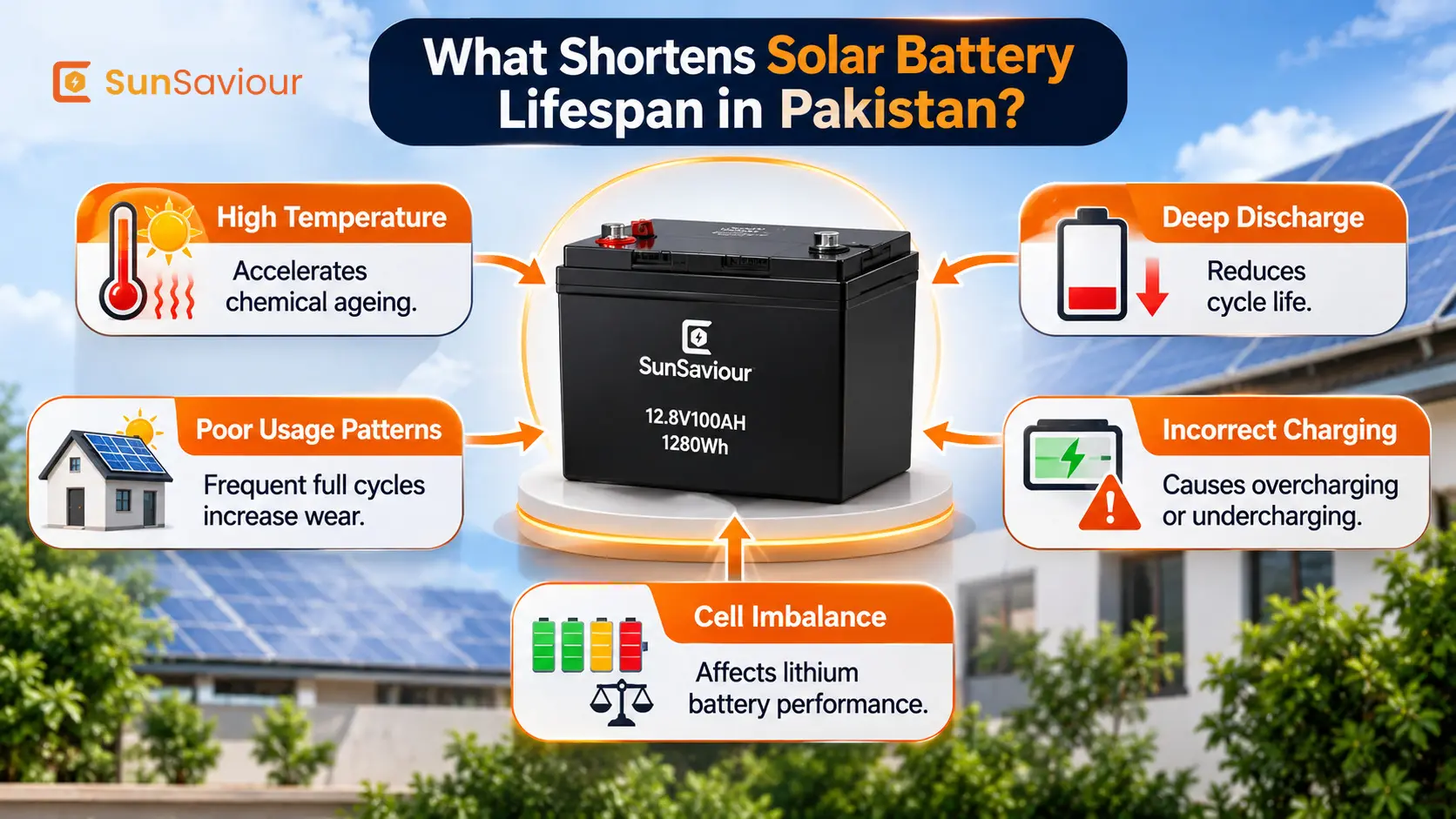
Battery life is set by a few variables working together. Understanding them helps you focus effort where it counts.
Temperature. Heat is the biggest enemy of most batteries. Higher operating temperatures speed up chemical ageing, and this effect is strongest when the battery is also charged to a high state of charge in hot weather.
Depth of discharge. Draining a battery deeply on most cycles reduces the number of cycles it can deliver. Lithium LiFePO4 batteries tolerate deeper discharge than tubular lead-acid batteries, but they still age faster if run near empty every day.
Charge management. Correct charge voltage and current, set by the inverter and BMS, protect the battery. Incorrect settings from a generic inverter profile can overcharge or undercharge the pack.
Balance across cells. In lithium packs, cells must stay balanced. A weak cell limits the whole pack. The BMS handles balancing, but it cannot fix a physically damaged cell.
Usage pattern. Frequent full cycles wear a battery faster than occasional shallow ones. Load management, such as keeping a large AC off battery at night, extends life.
Pakistan’s Climate and Your Battery
Pakistan’s heat is not only a daytime issue. Battery rooms, rooftop enclosures, and wall-mounted units can stay warm long after sunset. A battery that charges during the afternoon peak may be operating at high temperature for many hours.
Dust is the second concern. Fine dust clings to vents, fans, and connectors. It reduces cooling and can cause hot spots at terminals. Monsoon humidity adds corrosion risk to exposed metal.
Practical steps help:
- Keep the battery in a shaded, ventilated location, away from direct sun and away from the inverter’s heat output.
- Mount it off the floor to avoid damp and dust build-up.
- Use an enclosure rated for dust exposure where the battery is outdoors.
- Check that vents and air paths are clear every few months.
Lithium Battery Care in Hot Climates
A lithium ion solar battery ages best with the right charge settings, and lithium solar batteries need the checks described in the routine below. Lithium packs, including lithium batteries for solar panels setups, need little routine attention, but they still benefit from good conditions. Keep the BMS monitoring active, and avoid leaving the battery at full charge for long periods in extreme heat if your inverter settings allow a lower float or absorption setpoint. Ask the installer or manufacturer for the recommended charge limits for your climate.
Lithium batteries should not be charged below the manufacturer’s minimum operating temperature. Many units include temperature protection that stops charging in cold conditions. In Pakistan’s climate this is rarely a problem, but it matters during unusually cold nights in northern regions.
Lithium packs should be checked for cell balance and BMS fault codes through the monitoring app or the inverter display. Investigate any imbalance early rather than waiting for capacity loss.
Tubular Battery Care in Pakistan
Tubular lead-acid batteries need more hands-on care. The most important routine task is topping up electrolyte with distilled water when levels fall, using the manufacturer’s maximum and minimum marks as a guide. Overfilling causes spillage and corrosion. Underfilling exposes plates and damages them.
Other tasks include:
- Cleaning terminal connections and applying anti-corrosion protection
- Checking specific gravity or voltage readings where the manufacturer recommends it
- Keeping the battery fully charged after outages so plates do not sulfate
- Avoiding repeated deep discharges where possible
Tubular batteries also lose more capacity over time in hot conditions, so plan a replacement schedule rather than expecting the original capacity indefinitely.
Solar Battery Maintenance Routine
A simple routine keeps most batteries healthy:
Monthly: Check the monitoring app or display for state of charge, fault codes, and temperature. Note any unusual readings.
Every three months: Inspect enclosure, vents, and cable connections. Clean dust from the battery surface and surrounding area with a dry cloth. Check for signs of heat, swelling, or discolouration.
Every six months: Tighten terminal connections to the torque value in the manual. Check the earthing connection. For tubular batteries, check electrolyte levels and top up if needed.
Yearly: Run a capacity test if your inverter or monitoring system supports it. Compare results with the previous year. Review inverter settings for charge voltage and current against the battery specification.
Keep a log of readings and service visits. A trend across years is more useful than any single reading.
Warning Signs That Your Solar Battery Needs Attention
Act promptly if you notice any of these:
- Backup time falls noticeably compared with when the system was new
- The battery reaches full charge much faster or slower than usual
- The battery case feels hot to the touch during normal operation
- Swelling, leaking, or a sulphur smell
- Repeated low-voltage or over-temperature alarms
- A cell imbalance warning that persists after a full charge
- Corrosion on terminals or cables
Turn off the system at the isolators and contact a qualified technician if you see swelling, leaks, or burning smells. Do not open a lithium battery module yourself.
Warranty and Replacement
A solar inverter battery warranty depends on the pairing as well as the battery. Confirm that the inverter model is listed as compatible, because an unsupported setting can void cover. Battery warranties usually cover capacity retention over a stated number of cycles or years, not unlimited life. Read the terms carefully. Note the conditions that void cover, such as improper ventilation, incorrect inverter settings, or unauthorized repairs.
Keep the purchase invoice, the serial number record, and the commissioning report. A claim is much easier with complete records. Confirm the local claim process before you need it, because a battery fault in summer is not the time to discover that the warranty requires overseas approval.
When to Replace Rather than Repair
Some issues are repairable, such as loose connections, a dirty enclosure, or a BMS setting. Others are not. A cell that has failed, a pack with persistent imbalance, or a battery that can no longer hold a useful share of its rated capacity usually needs replacement.
When deciding, compare the cost of repair against the cost of replacement and the remaining warranty period. Factor in the energy you lose each day while the battery is underperforming. Replacing a battery that has fallen well below its usable capacity can restore backup time and daily savings.
Common Maintenance Mistakes
A solar battery system with poor airflow is the most common cause of premature failure. – Ignoring dust on vents and terminals
- Installing the battery in a sealed, hot cupboard
- Leaving inverter charge settings at generic defaults
- Overfilling tubular batteries with water
- Running the battery to empty every night without need
- Skipping torque checks on terminal connections
- Ignoring BMS alarms and cell imbalance warnings
- Storing an unused battery at full charge in hot conditions
Storing a Solar Battery When Not in Use
Best practice for a best solar battery in Pakistan is the same as for any other unit: follow the storage guidance in the manual. If a battery sits unused for an extended period, store it in a cool, dry, ventilated area. Lithium batteries should be stored at a partial state of charge, as recommended by the manufacturer, and checked periodically. Tubular batteries should be kept charged to prevent sulphation. Follow the manufacturer’s storage instructions rather than general rules.
SunSaviour Battery Support
SunSaviour offers lithium battery storage products for Pakistani homes and businesses, supported by a nationwide network of 59+ sales points and 28 service centres. For maintenance guidance on your specific model, battery warranty terms, and service locations, ask the SunSaviour team with your serial number and inverter model ready.
Frequently Asked Questions
How long does a solar battery last in Pakistan?
Lifespan depends on chemistry, depth of discharge, temperature, and charging settings. Lithium LiFePO4 batteries often last many years under daily cycling. Tubular batteries usually last fewer years in the same conditions.
Does heat really shorten solar battery life?
Yes. Sustained high temperature speeds up ageing, especially when the battery is also held at high charge. Good ventilation and shade help.
How often should I check my solar battery?
Check the monitoring data monthly and do a physical inspection every three months. Carry out a more detailed check yearly.
Can I clean my solar battery myself?
You can wipe the outside with a dry cloth with the system safely isolated. Do not open a lithium module or attempt internal repairs.
How often should tubular batteries be topped up?
Check electrolyte levels regularly, especially in hot months, and top up with distilled water to the marked level. Follow the manufacturer’s schedule.
What is the sign that a battery is failing?
Look for changes from normal behaviour, such as those listed above. Look for shorter backup time, unusual heating, swelling, persistent alarms, or cell imbalance that does not clear after a full charge.
Should I keep my solar battery fully charged when there is no power cut?
Not always. Lithium batteries are often best kept at a moderate state of charge in hot weather, while tubular batteries need regular full charges. Follow the settings recommended for your model.
Does my warranty cover heat damage?
Check whether your best battery for solar panel match is listed with the manufacturer’s warranty terms. It depends on the warranty terms and installation conditions. Confirm what is covered and what conditions apply before you buy.
Conclusion
For the best lithium ion battery in pakistan choice, durable care matters as much as the initial spec. Households searching for a solar battery in pakistan and best solar battery options should weigh maintenance effort alongside price, and a best solar battery in pakistan shortlist should include maintenance support. Owners who understand solar power battery care usually see the longest service life. A solar battery in Pakistan works hardest in the conditions that shorten its life. Ventilation, shade, dust control, correct inverter settings, and a simple monthly and yearly routine go a long way toward protecting capacity. Watch for warning signs, keep your records, and confirm the local warranty process before you need it.
Good care turns a battery from a recurring worry into a dependable part of your home energy system.
For SunSaviour battery maintenance guidance, service locations, and warranty support, visit sunsaviour.com or contact our team with your model and serial number.